


What Are Upstream, Midstream and Downstream in Oil and Gas?

Last updated: November 2, 2026
Upstream, midstream and downstream are the three broad segments of the oil and gas industry. Upstream covers exploration and production — finding and extracting crude oil and natural gas. Midstream covers the gathering, processing, storage and transport of those hydrocarbons between the wellhead and the refinery. Downstream covers refining, petrochemicals and the marketing of finished products such as gasoline, diesel and jet fuel to end users.
Definition
The oil and gas value chain is conventionally divided into three stages, named for their position relative to the wellhead — the point where oil or gas first reaches the surface. “Upstream” activity happens before the hydrocarbon leaves the ground; “downstream” happens after it has been turned into a sellable product; “midstream” is everything that connects the two.
The split is an industry convention rather than a single codified legal definition, but it is used consistently across energy companies, stock analysts, regulators and trade bodies. The International Organization for Standardization’s petroleum-industry reliability standard, ISO 14224, describes the upstream sector specifically as the “business category of the petroleum industry involving exploration and production” — the narrowest and most widely cited formal wording for that segment.
| Segment | What it covers | Typical activities | Typical assets |
|---|---|---|---|
| Upstream | Exploration & production (E&P) | Seismic surveys, licensing, drilling, well completion, field production | Oil and gas fields, drilling rigs, offshore platforms, wellheads |
| Midstream | Transport, processing & storage | Pipeline transport, gas processing, LNG liquefaction and shipping, storage | Pipelines, gas processing plants, LNG terminals, storage tanks, tankers |
| Downstream | Refining, petrochemicals & marketing | Crude refining, petrochemical manufacturing, fuel retail, distribution | Refineries, petrochemical plants, fuel terminals, filling stations |
How It Works
Upstream begins with exploration: geologists and geophysicists use seismic surveys and well data to identify where oil or gas is likely to be trapped underground. If a prospect looks commercial, a company drills an exploration well to confirm it, then appraisal wells to size the discovery. Production wells are then drilled and tied into surface facilities that separate oil, gas and water before the hydrocarbons are sent onward. Giant onshore fields such as Ghawar in Saudi Arabia and offshore developments in deep water all sit in this segment.
Midstream moves hydrocarbons from the field to where they are processed or consumed. Crude oil travels by pipeline, rail, truck or tanker to refineries or export terminals. Raw natural gas is processed to remove water, impurities and heavier hydrocarbons (natural gas liquids), then either piped directly to consumers or, for export over long distances, cooled into liquefied natural gas (LNG) for transport by specialized carriers. Midstream also includes underground and tank storage that balances supply and demand through the year.
Downstream converts crude oil and processed gas into usable products. Refineries break crude into fractions — gasoline, diesel, jet fuel, heating oil, asphalt and feedstocks for petrochemicals — through distillation and further processing units. Petrochemical plants turn some of those feedstocks into plastics, fertilizers and other chemicals. The final stage is marketing and retail: distributing fuel to filling stations, airports and industrial customers.
Why It Matters
The three-way split explains why oil and gas companies behave so differently depending on where they sit in the chain, and why energy news often separates “production” stories from “refining margin” stories.
- Different economics. Upstream earnings move closely with crude and gas prices — profits surge when prices rise and shrink when they fall. Downstream refining margins (“crack spreads”) often move in the opposite direction, since refiners buy crude as an input: cheaper crude can mean fatter margins. Midstream is typically the most stable of the three, since many pipeline and storage operators are paid a fee for throughput rather than exposed directly to commodity prices.
- Different risk profiles. Upstream carries geological and drilling risk; midstream carries long-term infrastructure and regulatory risk (permitting, right-of-way, cross-border agreements); downstream carries demand, margin and environmental-compliance risk.
- Integrated vs. independent companies. “Integrated” oil majors — such as Saudi Aramco, ExxonMobil, Shell, BP, Chevron and TotalEnergies — operate across all three segments, which smooths out earnings over the price cycle. “Independent” or “pure-play” companies specialize in just one segment, such as an upstream exploration and production (E&P) company or a midstream pipeline operator, and their results track that one segment’s economics much more closely.
Where It Is Used
Every oil- or gas-producing and consuming country has some mix of all three segments, but the balance varies by national strategy:
- Resource-rich exporters such as Saudi Arabia, Qatar and the UAE have historically been upstream- and midstream-heavy — producing and exporting crude, gas and LNG — while building downstream refining and petrochemical capacity as a second step to capture more value domestically. QatarEnergy and ADNOC are examples of state companies expanding this way.
- Resource-rich importers of crude but exporters of refined products, such as parts of Northwest Europe and the US Gulf Coast, concentrate heavily on downstream refining and petrochemicals, importing crude as a raw material.
- Transit and processing hubs, including countries along major pipeline routes, specialize in midstream infrastructure — moving hydrocarbons produced elsewhere to the markets that consume them.
Key Characteristics
| Characteristic | Upstream | Midstream | Downstream |
|---|---|---|---|
| Price sensitivity | High (direct exposure to crude/gas prices) | Low-to-moderate (often fee-based) | Moderate (margin-driven, can be counter-cyclical) |
| Capital intensity | Very high (drilling, platforms) | Very high (pipelines, LNG plants) | High (refineries, petrochemical plants) |
| Typical contract length | Field-life (years to decades) | Long-term (often 10–25 years) | Shorter-term, spot and term contracts |
| Main output | Crude oil, raw natural gas | Transported/processed crude, LNG, NGLs | Refined fuels, petrochemicals |
Related Technologies and Concepts
- Hydraulic fracturing (fracking) — an upstream technique used to produce oil and gas from shale and other tight rock formations.
- Liquefied natural gas (LNG) — the midstream technology that lets gas be shipped overseas rather than only by pipeline.
- Natural gas — the commodity whose processing and transport define much of the midstream segment.
- WTI crude oil and Brent crude — the benchmark prices that set upstream revenue and downstream input costs.
Real-World Examples
Most of the world’s largest oil and gas companies are “integrated,” meaning they run operations across upstream, midstream and downstream simultaneously, which is why their names appear across almost every stage of the chain:
| Company | Upstream | Midstream | Downstream |
|---|---|---|---|
| Saudi Aramco | Yes — Ghawar, Safaniya and other giant fields | Yes — pipelines, export terminals | Yes — refining and petrochemicals (e.g., SABIC stake) |
| ExxonMobil | Yes — Permian, Guyana | Yes — pipelines, shipping | Yes — refining and chemicals |
| Shell | Yes | Yes — LNG trading and shipping | Yes — refining, fuel retail |
| BP | Yes | Yes | Yes — refining, retail fuel stations |
| TotalEnergies | Yes | Yes — LNG | Yes — refining, petrochemicals, retail |
| QatarEnergy | Yes — North Field | Yes — LNG export | Growing — petrochemicals joint ventures |
| ADNOC | Yes | Yes | Growing — refining and chemicals expansion |
| Equinor | Yes — North Sea | Yes — gas pipelines to Europe | Limited — mainly through joint ventures |
| Gazprom | Yes | Yes — pipeline network | Limited internationally |
By contrast, many publicly traded US midstream companies — pipeline and storage operators often structured as partnerships — hold no upstream production or downstream refining assets at all; their entire business is transport and storage, paid for by fee-based contracts with producers and refiners.
FAQ
Is midstream part of downstream?
Not in the standard three-segment model, where midstream is treated as its own category covering transport, processing and storage. Some older or simplified classifications fold midstream into downstream, or describe the industry with only two segments (upstream and downstream), but most companies, investors and analysts today treat midstream as separate.
Which segment is the most profitable?
It depends on the price cycle, not a fixed ranking. Upstream tends to be most profitable when crude and gas prices are high; downstream refining margins often widen when crude prices are low or volatile, because that lowers the refiner’s input cost; midstream’s fee-based model generally delivers steadier, if less spectacular, returns across the cycle.
What is an example of a midstream company?
Midstream specialists include pipeline operators, LNG terminal owners and gas processing companies that move or store hydrocarbons for a fee rather than owning the oil or gas itself. Many integrated majors also run large midstream divisions alongside their upstream and downstream businesses.
Does petrochemicals count as downstream?
Yes. Petrochemical manufacturing — turning refinery feedstocks into plastics, fertilizers and other chemicals — is generally classified within downstream, alongside fuel refining and retail marketing.
Related The Daily Energy Pages
- Natural Gas
- LNG (Liquefied Natural Gas)
- Fracking (Hydraulic Fracturing)
- WTI Crude Oil
- Brent Crude
- Saudi Aramco
- ExxonMobil
- QatarEnergy
Sources
- ISO 14224 — Petroleum, petrochemical and natural gas industries — Collection and exchange of reliability and maintenance data for equipment (definitional reference for “upstream” as exploration and production)
- U.S. Energy Information Administration (EIA) — Petroleum & Other Liquids and Natural Gas data and glossary, eia.gov
- Company filings and investor-relations disclosures of Saudi Aramco, ExxonMobil, Shell, BP, Chevron, TotalEnergies, QatarEnergy, ADNOC, Equinor and Gazprom describing their upstream, midstream and downstream segments
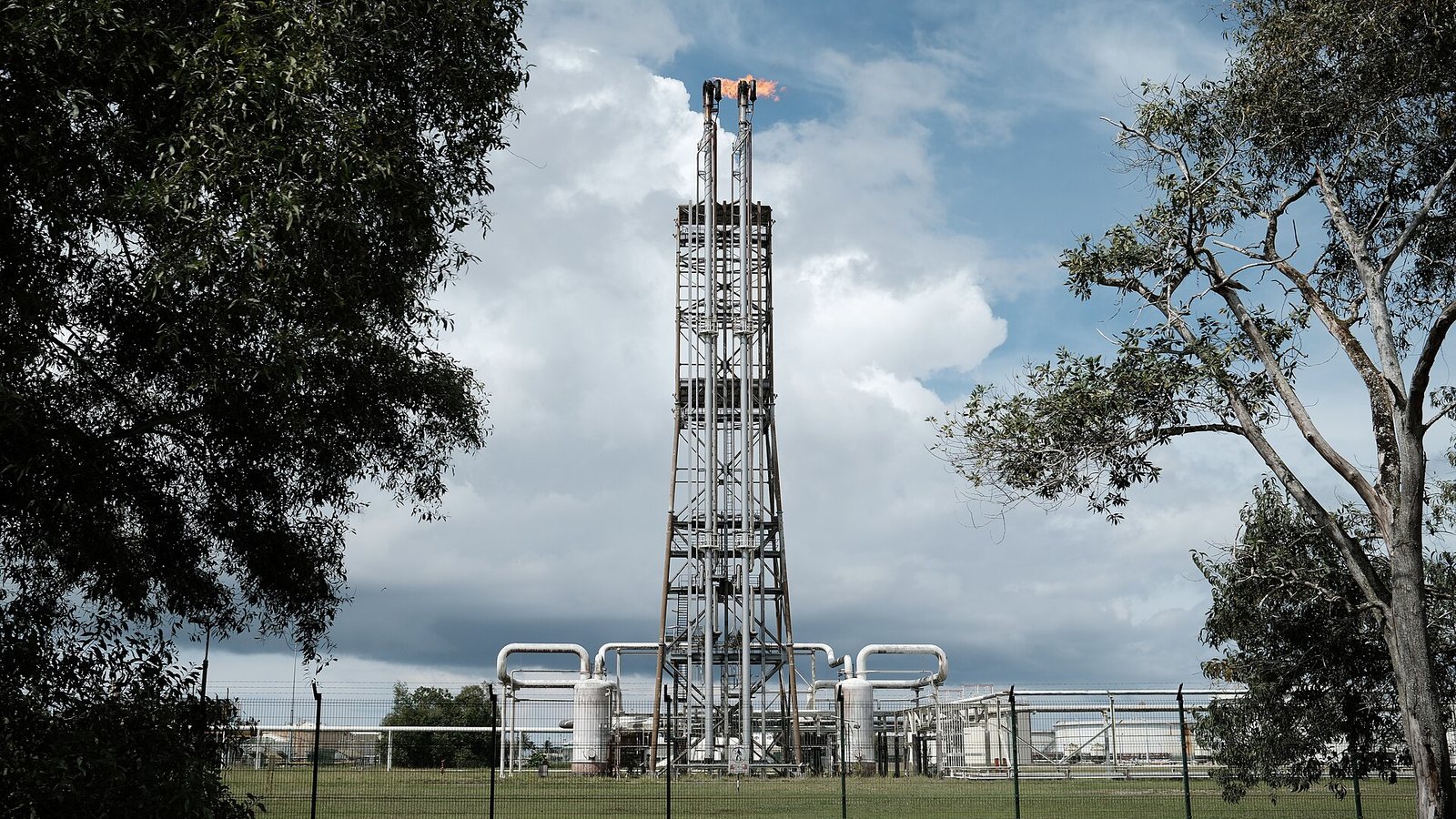
Illustrative image. Photo: Yu Chu Chin, CC BY-SA 4.0, via Wikimedia Commons — source


[…] Upstream, Midstream and Downstream: Aramco is a fully integrated oil and gas company, operating across exploration and production (upstream), pipelines and shipping (midstream), and refining and petrochemicals (downstream). […]