Where Does Germany Get Its LNG?

Last updated: 27 October 2026 · Last verified: 27 October 2026
Germany had almost no LNG import capacity of its own before 2022. After Russian pipeline flows were cut, Berlin built four LNG terminals in less than two years — and by 2025 those terminals were running on a supply base that is overwhelmingly American. Pipeline gas, led by Norway, still carries the bulk of the country’s imports, but the LNG share is growing quarter by quarter. This page tracks who actually supplies Germany’s gas today, using official Bundesnetzagentur (BNetzA) and BDEW data rather than headline claims about “replacing Russia.”
Germany’s Gas Imports, 2025: LNG Is Still the Minority, But Growing
Germany’s energy regulator, the Bundesnetzagentur, reports preliminary total gas imports of 1,031 TWh for 2025 via its SMARD market-data portal. Of that, 106 TWh arrived as LNG through the Wilhelmshaven, Brunsbüttel, Lubmin and Mukran terminals — 10.3% of total imports. The remaining roughly 90% arrived by pipeline, chiefly from Norway, though BNetzA does not publish a single annual pipeline-only total broken out the same way as its LNG figure.
| Category | Volume | Share of imports | Period | Source |
|---|---|---|---|---|
| Total gas imports | 1,031 TWh (preliminary) | 100% | Full-year 2025 | Bundesnetzagentur / SMARD |
| LNG (all 4 terminals) | 106 TWh | 10.3% | Full-year 2025 | Bundesnetzagentur / SMARD |
| LNG, Q3 only | Not separately disclosed in TWh | 13.25% | Q3 2025 | Bundesnetzagentur year-end review |
| LNG, first 9 months | Not separately disclosed in TWh | 10.9% | Jan–Sep 2025 | Bundesnetzagentur year-end review |
| Pipeline (implied residual) | ~925 TWh | ~89.7% | Full-year 2025 | TDE calculation: total minus LNG, per BNetzA figures above |
The rising quarterly share — from 10.9% over nine months to 13.25% in the third quarter alone — shows LNG’s role growing through the year as new volumes ramped up, rather than a flat 10% running throughout 2025. Figures are preliminary and, per BNetzA, “may be updated at a later date.”
Who Actually Supplies the LNG? Almost All of It Is American
Germany’s LNG terminals are overwhelmingly a United States story. The Bundesnetzagentur’s year-end review, citing data from the German energy and water industry association BDEW, puts the US share of 2025 LNG imports at around 96%. A Reuters report citing the same BDEW dataset gives 94.7% for the US over January–November 2025 specifically. The two figures differ slightly because they cover different time windows and, in some cases, different denominators (BNetzA’s own LNG total versus a slightly broader import count), but both describe the same picture: there is effectively no diversified LNG supply base at the German terminals yet.
| Supplier | Share of German LNG imports | Period | Source |
|---|---|---|---|
| United States | ~96% | Full-year 2025 | BDEW, via Bundesnetzagentur year-end review |
| United States | 94.7% | January–November 2025 | BDEW data, via Reuters |
| Oman | First cargoes delivered; volume not yet disclosed | From 2026 | SEFE (Sefe Securing Energy for Europe) contract announcements |
| Russia (indirect) | Not separately quantified for German-flagged terminal imports | Ongoing | Reporting on SEFE’s Yamal LNG-linked cargoes landed via Dunkirk, France |
Two qualifications matter here. First, “German LNG imports” in this table means cargoes landed at Germany’s own four terminals; it does not include LNG that is regasified at French or Belgian terminals and then sent onward to Germany by pipeline, which German import statistics often record simply as “French gas” or “Belgian gas.” Second, the Russian LNG line is real but indirect: the state-backed trading company SEFE holds a long-term offtake contract with Russia’s Yamal LNG project and has used intermediaries to bring cargoes into Europe — Reuters-reported SEFE purchases of 58 Yamal-linked cargoes via the French port of Dunkirk in 2024 — rather than shipping them straight into a German terminal. That gas still partly reaches German consumers through the integrated European pipeline grid, but it is not counted in BNetzA’s “German LNG terminal” figures above.
New Source, 2026: Germany’s First Omani LNG
In 2026, Germany received its first-ever LNG deliveries sourced from Oman, under a supply contract held by SEFE. The move came as Germany’s economics minister, Katherina Reiche, said the country was not receiving “significant quantities” of LNG from the wider Gulf region — a sign that Berlin is still actively trying to diversify beyond its near-total reliance on US cargoes, even as the volumes involved so far remain small relative to the US share above. TDE has not found an official disclosed annual volume for the Oman-origin cargoes as of this writing; this line will be updated once SEFE or BNetzA publish one.
Pipeline Gas: Norway Is the Backbone
Pipeline gas still supplies roughly nine-tenths of Germany’s total imports, and Norway is consistently named by BNetzA/SMARD as the largest single pipeline source, though BNetzA’s narrative text does not attach a precise annual percentage to that claim. A Statista chart sourced from Bundesnetzagentur daily import data gives a one-month country breakdown that is useful as an illustrative snapshot rather than an annual average:
| Pipeline source | Share, November 2025 snapshot | Caveat |
|---|---|---|
| Norway | ~39% | Direct Norwegian production via pipeline; the largest single source in this snapshot |
| Netherlands | ~24.6% | German import statistics record gas entering from the Netherlands under this label regardless of where it was originally produced, so this can include transit volumes, not only Dutch-produced gas |
| Belgium | ~20.2% | Same transit caveat applies; Belgian-flagged flows can include regasified LNG (including Russian Yamal-linked cargoes landed at Dunkirk, just across the French border) moving onward by pipeline |
Because these three categories, plus LNG, do not sum neatly to 100% and are drawn from a single month, this table should be read as showing the ranked order of pipeline entry points rather than a precise annual split. BNetzA has not published, in the sources TDE reviewed, a single definitive annual percentage table for pipeline gas by country of origin for 2025.
What Happened to Direct Russian Pipeline Gas?
Direct Russian pipeline deliveries to Germany, once routed via Nord Stream and the Yamal–Europe line, effectively ended after the Nord Stream pipelines were damaged in September 2022 and Ukraine declined to renew its gas transit agreement with Russia at the end of 2024. Germany’s own import statistics no longer show a meaningful direct Russian pipeline category; what remains of Russian-origin gas reaching German consumers arrives indirectly, through the LNG-trading route described above.
Why This Matters for Europe’s Gas Balance
Germany’s near-total LNG dependence on a single supplier is unusual among large European importers — Italy, for instance, still draws LNG from a more varied mix including Qatar and the United States (see Who Buys Qatar’s LNG?). It leaves German buyers exposed to US Gulf Coast weather disruptions, shipping costs and any future US export-policy shifts, which is the backdrop against which the Oman contract and continued diversification talk should be read. It is also a reminder that “LNG terminal built” and “diversified supply” are not the same thing: Germany solved its capacity problem in under two years but has not yet solved its concentration problem.
Frequently Asked Questions
Where does Germany get its LNG from?
Almost entirely from the United States — around 96% of Germany’s 2025 LNG imports, according to BDEW data cited in the Bundesnetzagentur’s year-end review. Germany received its first Omani LNG cargoes in 2026 as part of a diversification push.
Does Germany still get gas from Russia?
Not by direct pipeline — those routes effectively stopped after the 2022 Nord Stream damage and the end of Ukrainian transit in late 2024. Some Russian-origin LNG still reaches Europe, and potentially Germany, indirectly through trader SEFE’s Yamal LNG-linked cargoes landed at Dunkirk, France, rather than at a German terminal.
How much of Germany’s gas is LNG versus pipeline gas?
LNG made up about 10.3% of Germany’s preliminary 1,031 TWh of total gas imports in 2025, per Bundesnetzagentur/SMARD data. The remaining roughly 90% arrived by pipeline, led by Norway.
Which country supplies most of Germany’s pipeline gas?
Norway, according to Bundesnetzagentur/SMARD, though the regulator has not published a single precise annual percentage; a November 2025 snapshot cited by Statista put Norway at about 39% of pipeline-category imports that month, ahead of the Netherlands and Belgium.
Related The Daily Energy Pages
- Who Supplies Türkiye With Natural Gas? (Who Powers Who? series)
- Where Does Japan Get Its LNG? (Who Powers Who? series)
- Where Does South Korea Get Its LNG? (Who Powers Who? series)
- Who Buys Qatar’s LNG? (Who Powers Who? series)
- What Is Gazprom? Ownership, Pipelines and Production
- Equinor: Who Owns It, Who Runs It, Major Projects
- What Is LNG and How Does It Work?
- What Is Natural Gas and How Is It Used?
Sources
- Bundesnetzagentur / SMARD, “The gas market in 2025,” published 9 January 2026 (preliminary 2025 import and LNG figures)
- Bundesnetzagentur year-end gas market review, cited via Baird Maritime, “German gas usage rises in 2025 as it moves away from Russian supply”
- BDEW (German Association of Energy and Water Industries) data, via Reuters, on 2025 US share of German LNG imports
- Statista infographic “Tägliche Gasimporte nach Deutschland nach Herkunft,” sourced to Bundesnetzagentur, November 2025 snapshot
- Reuters / The Moscow Times, on SEFE’s Yamal LNG-linked cargo purchases via Dunkirk, 2024
- Cyprus Shipping News, “Germany’s first Omani LNG shipments arrive despite Middle East disruptions,” 2026
- Natural Gas World, reporting on Germany’s efforts to limit Russian LNG supplies and on SEFE’s first Wilhelmshaven import
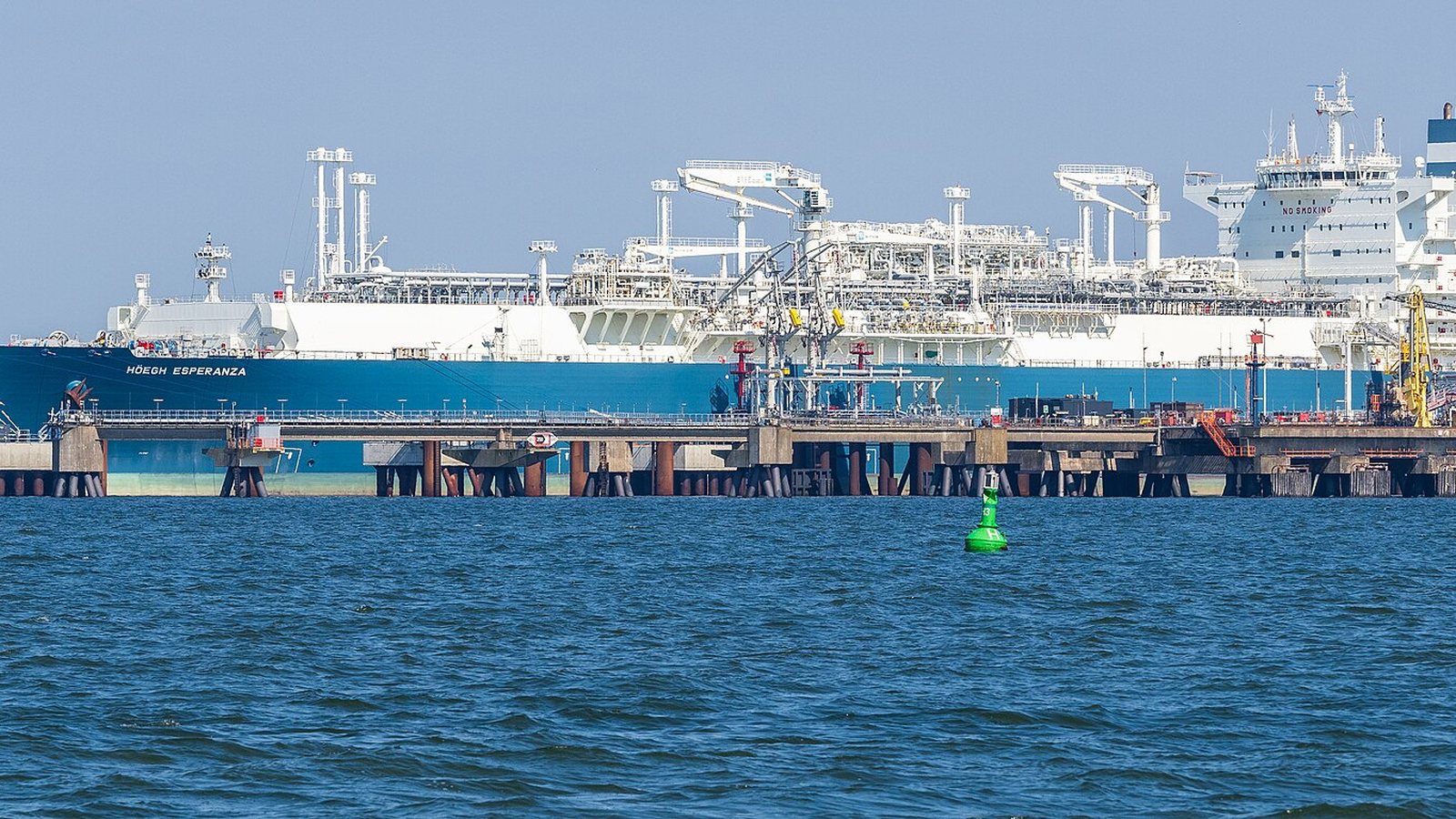
Illustrative image. Photo: JoachimKohler-HB, CC BY-SA 4.0, via Wikimedia Commons — source