Where Does South Korea Get Its LNG?

Last updated: 20 October 2026 · Last verified: 20 October 2026
South Korea imported a record 46.7 million tonnes of LNG in 2025, and its supply base is now being tested from two directions at once: a Qatari force majeure that knocked out part of Doha’s export capacity, and a US push for a politically charged — and so far mostly unconfirmed — multibillion-dollar commitment to the Alaska LNG project. Korea Gas Corporation (KOGAS), the state gas utility, is also one of only two buyers worldwide still receiving sanctioned Russian LNG under time-limited Western carve-outs, the same arrangement covering Japan. This page tracks who actually supplies South Korea’s LNG, and what is changing.
South Korea’s LNG Supply Mix
Korea Customs Service trade data, as compiled by S&P Global Commodity Insights and MEES, shows Australia extending its lead as Korea’s top LNG supplier in 2025, a record import year overall.
| Supplier | Volume (2025) | Share | YoY change | Source |
|---|---|---|---|---|
| Australia | 14.67 million tonnes | 31.4% | +28.7% (record) | S&P Global Commodity Insights, Korea Customs Service data |
| Malaysia | 7.51 million tonnes | ~16.1% | n/a | LNG Prime, Korea Customs Service data |
| Qatar | 6.97 million tonnes | 14.9% | -22% (16-year low) | MEES, Korea Customs Service data |
| United States | 4.38 million tonnes | 9.4% | -22.2% | S&P Global Commodity Insights |
| Oman | 1.92 million tonnes | 4.1% | n/a | MEES, Korea Customs Service data |
| UAE | 245,397 tonnes | 0.5% | n/a | MEES, Korea Customs Service data |
Total 2025 imports came to roughly 46.68-46.72 million tonnes depending on the outlet (a minor rounding difference across reports citing the same customs dataset), up about 1% year-on-year and a new record. The remaining 10-11 million tonnes — covering Indonesia, Brunei, Russia’s Sakhalin-2 project and spot cargoes — was not broken out by country in available reporting. Through the first nine months of 2026, total imports fell 6.4% year-on-year to 32.9 million tonnes, according to TASS citing Korean customs data, a decline tied directly to the Qatari supply disruption below.
Qatar’s Force Majeure Is Reshaping the Mix
QatarEnergy declared force majeure on LNG contracts to South Korea, China, Italy and Belgium around March 2026, after missile damage tied to the wider Iran conflict knocked out roughly 17% of its export capacity at Ras Laffan. Industry reporting put repair timelines at three to five years for the affected 12.8 million tonnes/year of capacity, and the force majeure has been extended repeatedly through 2026 — reported again in July and September. Korea’s presidential office said in March 2026 that Qatar supplies about 14% of the country’s annual LNG needs and that reserves and alternative sourcing from Australia, Southeast Asia and North America were sufficient to avoid a shortage. The disruption is tracked on the exporter side on The Daily Energy’s Who Buys Qatar’s LNG? and Qatar’s North Field LNG Expansion pages.
Despite the disruption, KOGAS’s underlying Qatari contract book is long-term and continues on paper: three term sale-and-purchase agreements for a combined 6.1 million tonnes/year.
| Contract | Volume | Term | Status |
|---|---|---|---|
| RasGas/QatarEnergy SPA | 2.1 million tonnes/year | 2007-2026 | Operational (subject to 2026 force majeure) |
| RasGas/QatarEnergy SPA | 2.0 million tonnes/year | 2013-2032 | Operational (subject to 2026 force majeure) |
| Qatar Petroleum/QatarEnergy SPA | 2.0 million tonnes/year | 2025-2044 (signed July 2021; deliveries began Jan 2025) | Operational (subject to 2026 force majeure) |
No new Qatari term contract has been reported for 2025-2026; the existing book is what force majeure is currently interrupting.
Alaska LNG: Pledged Billions vs. One Signed Deal
Reports since late September 2026 — part of a broader $350 billion US-Korea trade and investment package that also includes $150 billion in shipbuilding commitments, tied to a 15% US tariff rate on Korean goods — have described South Korea as committing $54 billion (some reports say $50 billion) to Alaska LNG as part of a $200 billion US energy package. South Korea’s own trade minister pushed back on 22 September 2026, saying only the Texas-related portion of the broader deal was finalized and that the Alaska LNG investment had not been finalized, a position echoed by a ruling-party official. Treat the headline figure as a disputed political pledge, not a signed commitment.
The one concrete deal on the table is smaller and from a different company: POSCO International, a Korean trading house (not KOGAS), signed a 20-year, non-binding Heads of Agreement with project developer Glenfarne in September 2025 for 1 million tonnes/year of Alaska LNG on an FOB basis — explicitly “subject to board approvals” and definitive agreements, and still the first Alaska LNG offtake deal announced by anyone. KOGAS itself has signed no Alaska offtake or equity deal; its only link is a non-exclusive 2017 memorandum of understanding with the Alaska Gasline Development Corporation. Glenfarne, which holds 75% of the project (AGDC holds the rest), said in March 2026 it still needs about 3 million tonnes/year of further offtake commitments — against a 20 million tonne/year design capacity — before reaching a final investment decision.
The Russia Exception: Sakhalin-2 Under Parallel UK and EU Carve-Outs
KOGAS is South Korea’s sole importer of Sakhalin-2 LNG, under a 20-year sale-and-purchase agreement for 1.5 million tonnes/year signed in 2005 — the same project, under the same sanctions logic, that supplies roughly 9% of Japan’s LNG. The EU’s 21st sanctions package, adopted 23 July 2026, exempted Sakhalin-2 LNG shipped to South Korea and Japan from new shipping, technical, brokering, insurance and financial-service restrictions through 31 March 2028; without that exemption, the EU’s earlier 19th package would have blocked EU-company servicing of the trade from January 2027. Korea’s Ministry of Trade, Industry and Energy confirmed the exemption on 24 July 2026, estimating about 2 million tonnes still to be delivered over the remaining contract period.
On 1 October 2026, the UK issued two parallel General Trade Licences — one for Japan, one for South Korea — authorizing continued maritime transport, financing, brokering and related legal services for Sakhalin-2 LNG under contracts concluded before 17 June 2025, effective from 1 January 2027 through 31 March 2028. Combined Japan-Korea Sakhalin-2 imports ran to about 4.8 million tonnes through 2026 year-to-date, roughly 5.9% of their combined LNG imports, according to S&P Global Commodity Insights. The Daily Energy tracks the equivalent Japanese exposure on its Where Does Japan Get Its LNG? page.
What to Watch Next
Three things will shape Korea’s supply mix into 2027: whether QatarEnergy’s Ras Laffan repairs track toward the low or high end of the reported three-to-five-year window, and how much of the shortfall Korea continues covering with Australian and Southeast Asian cargoes; whether Glenfarne secures the roughly 3 million tonnes/year of additional Alaska LNG offtake it says it needs to reach a final investment decision, which would determine whether POSCO International’s non-binding Heads of Agreement — and the much larger government-level pledge — convert into anything contractual; and whether the UK and EU Sakhalin-2 carve-outs are extended again past their current March 2028 expiry or allowed to lapse once Qatari capacity is restored.
Frequently Asked Questions
Where does South Korea get most of its LNG?
Mostly from Australia, which supplied 31.4% of Korea’s LNG in 2025 — a record 14.67 million tonnes — followed by Malaysia (~16.1%) and Qatar (14.9%), according to Korea Customs Service data compiled by S&P Global and MEES.
Does South Korea import LNG from Russia?
Yes. KOGAS is Korea’s sole importer of Sakhalin-2 LNG, under a 1.5 million tonnes/year contract signed in 2005. The EU and UK have both issued carve-outs allowing this trade to continue, for Korea and Japan alike, through March 2028.
How much LNG does South Korea import from Qatar?
Qatar supplied about 6.97 million tonnes in 2025, roughly 14.9% of Korea’s total LNG imports, through three long-term KOGAS contracts totaling 6.1 million tonnes/year. A QatarEnergy force majeure declared around March 2026, after missile damage at Ras Laffan, has since disrupted part of that supply.
Is South Korea actually investing $54 billion in Alaska LNG?
Not confirmed. That figure, reported from US government sources since late September 2026, was disputed by South Korea’s own trade minister, who said only a separate Texas-related investment was finalized. The only signed Alaska LNG document involving a Korean company is a non-binding 20-year Heads of Agreement between POSCO International and developer Glenfarne for 1 million tonnes/year, not a government commitment.
Which country is South Korea’s biggest LNG supplier, Australia or Qatar?
Australia, by a wide margin. It supplied 31.4% of Korea’s LNG in 2025 versus Qatar’s 14.9%, and Australian volumes grew 28.7% year-on-year to a record while Qatari volumes fell 22% to a 16-year low.
Will the Qatar LNG force majeure cause a shortage in South Korea?
Korean officials said in March 2026 that it would not, citing reserves and the ability to source more from Australia, Southeast Asia and North America — though total 2026 imports were already running 6.4% below 2025’s record pace through September, partly reflecting the disruption.
Related The Daily Energy Pages
- Where Does Japan Get Its LNG? (Who Powers Who? series)
- Who Buys Qatar’s LNG? (Who Powers Who? series)
- Who Supplies Türkiye With Natural Gas? (Who Powers Who? series)
- Qatar’s North Field LNG Expansion: Project Tracker
- QatarEnergy: Ownership, Leadership and Major Assets
- Trump Says South Korea Will Put $54 Billion Into Alaska LNG Pipeline; Seoul Calls It Premature
- What Is LNG and How Does It Work?
Sources
- S&P Global Commodity Insights, “South Korea sees no LNG shortages despite Middle East supply disruptions” (5 March 2026), Korea Customs Service data
- MEES, “Korea imports record LNG for 2025 but MENA share down” (23 January 2026)
- LNG Prime, Korea Customs Service 2025 import data (January 2026)
- TASS, Korea customs data analysis, January-September 2026 LNG imports
- Korea Times, “Korea says LNG supply stable despite Middle East risks” (20 March 2026)
- Qatar Tribune, “QatarEnergy declares force majeure on some LNG contracts due to Iran war” (2026); Tank Terminals, Baird Maritime, Gas Processing News, force majeure extension coverage (July-September 2026)
- Gulf Times / Qatar Tribune / Offshore Energy, Qatar Petroleum-KOGAS 20-year SPA announcement (July 2021)
- Korea Times (15 October 2026) and Alaska Public Media (30 September 2026), Trump administration Alaska LNG investment claims
- Businesswire / PGJ Online, “Alaska LNG secures first offtake deal as Glenfarne, POSCO sign partnership” (11 September 2025); “Alaska LNG needs 3 mmtpy of offtake to reach final investment decision” (March 2026)
- South Korea Ministry of Trade, Industry and Energy, statement on EU Sakhalin-2 exemption (24 July 2026)
- UK Government, General Trade Licences — Maritime Transportation of LNG, South Korea and Japan (published 1 October 2026); S&P Global, Squire Patton Boggs, LexisNexis coverage of the licences
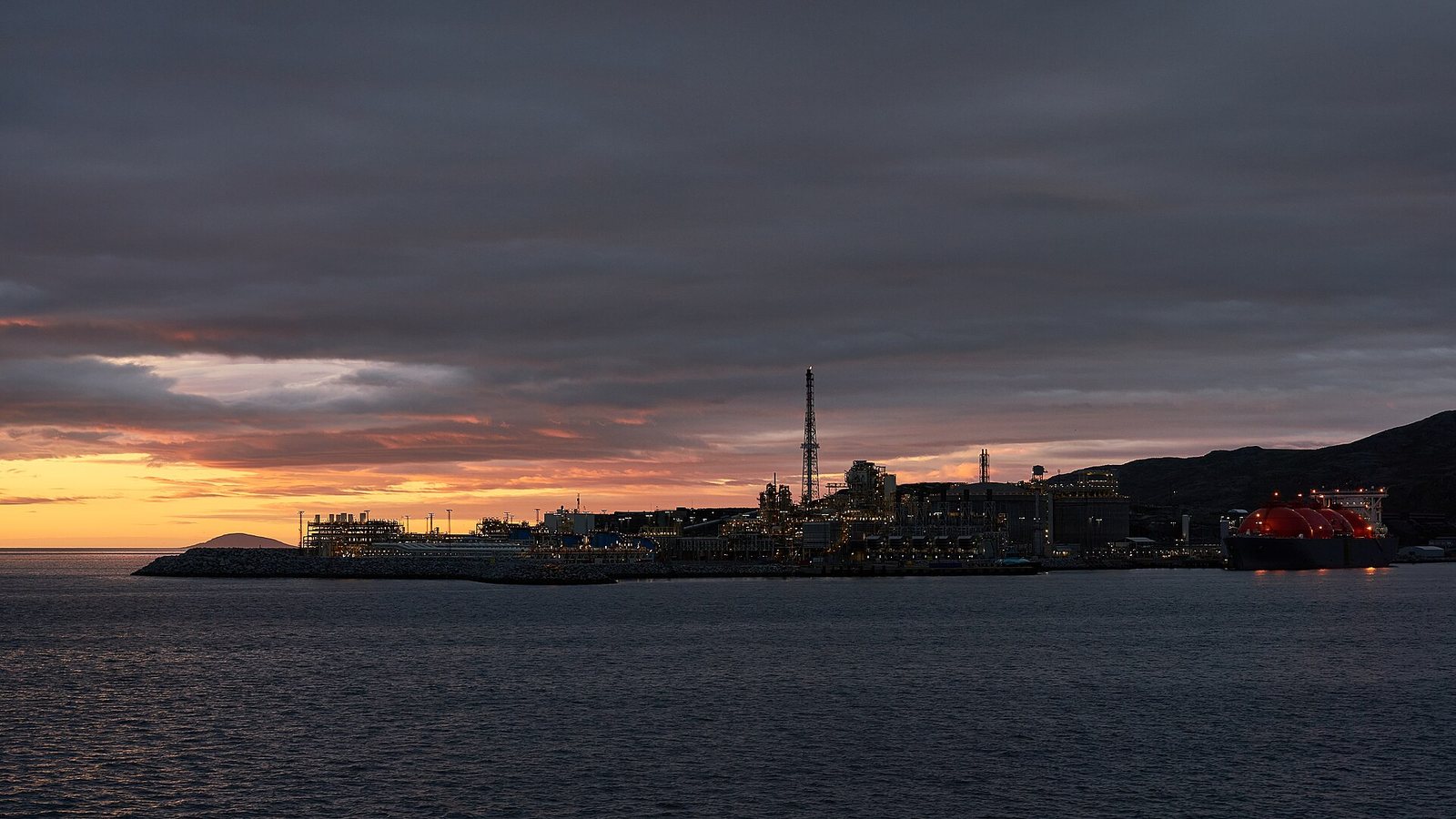
Illustrative image. Photo: Virtual-Pano, CC BY-SA 4.0, via Wikimedia Commons — source