


Where Does Japan Get Its LNG?

Last updated: 6 October 2026 · Last verified: 6 October 2026
Japan is the world’s second-largest importer of liquefied natural gas, behind only China, and has almost no pipeline gas of its own — nearly every cubic metre it burns arrives by LNG carrier. For decades that supply base was dominated by a small group of Asia-Pacific and Middle Eastern sellers. In 2026 that mix is shifting again: Japan’s largest buyer, JERA, has signed a wave of new contracts with Qatar and the United States, while a Russian supply line that was supposed to be winding down under sanctions has instead become one of the few pillars still standing during the Strait of Hormuz disruption. This page tracks who actually supplies Japan’s LNG today, and where that is changing.
Japan’s LNG Supply Mix
Japan’s imports are reported monthly in Ministry of Finance trade statistics. The most recent full month on record shows Oceania — overwhelmingly Australia — still supplying more LNG to Japan than the rest of the world combined, with Southeast Asia (mainly Malaysia) a clear second.
| Supply Region | Main Country | Volume | Share | Source |
|---|---|---|---|---|
| Oceania | Australia | 2.70 million tonnes | 43.8% | Japan Ministry of Finance Trade Statistics, January 2026 |
| Southeast Asia | Malaysia | 1.60 million tonnes | 25.0% | Japan Ministry of Finance Trade Statistics, January 2026 |
| Middle East | Qatar, Oman | 712,300 tonnes | 11.4% | Japan Ministry of Finance Trade Statistics, January 2026 |
| Russia & CIS | Russia (Sakhalin-2) | 573,300 tonnes | 9.2% | Japan Ministry of Finance Trade Statistics, January 2026 |
| North America | United States | 537,000 tonnes | 8.6% | Japan Ministry of Finance Trade Statistics, January 2026 |
That month’s total of roughly 6.2 million tonnes was down 4.5% from the previous month, part of a broader slide: Japan’s full-year LNG imports fell 1.4% in 2025 to 64.98 million tonnes, according to Ministry of Finance provisional data reported in January 2026 — a decline driven mainly by nuclear restarts and slower industrial demand, not supply problems. Over a full year, Australia typically supplies close to 40% of Japan’s LNG and Malaysia around 15%, with the United States the fastest-growing single source. Month-to-month shares can swing well outside those long-run averages, which is why this table should be read as a current snapshot rather than an annual average.
JERA Is Actively Diversifying — Qatar and the US Both Gained Ground in 2026
JERA, Japan’s largest power generator and the country’s biggest single LNG buyer, has spent 2025–2026 locking in new supply from both the Middle East and the United States, explicitly citing data-centre and semiconductor-driven power demand as the reason it needs a larger, more diversified book.
| Supplier | Volume | Term | Status | Source |
|---|---|---|---|---|
| QatarEnergy | 3.0 million tonnes/year | 27 years, DES basis, from 2028 | Contract (SPA signed 4 February 2026, LNG2026 conference, Doha) | JERA press release; TheEnergyYear; Baird Maritime; Oil & Gas Journal |
| NextDecade (Rio Grande LNG, Texas) | ~2.0 million tonnes/year | Long-term SPA | Contract (signed 2025) | Oil & Gas Journal; Rigzone |
| Commonwealth LNG (Louisiana) | 1.0 million tonnes/year | Long-term SPA; first LNG expected 2029 | Contract (signed 2025) | Oil & Gas Journal; Rigzone |
| Sempra Infrastructure & Cheniere Marketing | Remaining share of a combined ~5.5 million tonnes/year of new US volume | Long-term | Framework agreement (Heads of Agreement, pre-SPA) | Oil & Gas Journal; Offshore Technology |
| Freeport LNG & Cameron LNG (existing) | 3.5 million tonnes/year combined | Long-term, already running | Operational | Oil & Gas Journal |
| Venture Global CP2 (existing) | ~1.0 million tonnes/year | Long-term | Contract; project under construction | Oil & Gas Journal |
| Alaska LNG (Glenfarne / AGDC) | 1.0 million tonnes/year | 20 years, FOB basis | Letter of Intent only — not a binding SPA; project has not reached a final investment decision | World Oil; TheEnergyYear; BIC Magazine |
Industry press describes the combined new US commitment as the largest-ever single-buyer LNG offtake from the United States, and Japan’s largest cumulative US LNG commitment since the country’s first-ever LNG import — from Alaska — in 1969. The Alaska LNG line item is the least advanced of the group: it is a non-binding letter of intent for a project whose pipeline and export components had, as of this writing, not reached final investment decision, which separates it from JERA’s signed QatarEnergy and other US SPAs. The QatarEnergy contract is also tracked from the seller’s side on The Daily Energy’s Who Buys Qatar’s LNG? page.
The Russia Exception: Sakhalin-2 Keeps Flowing Under Sanctions Waivers
Japan has not followed the full Western sanctions line on Russian energy. It continues to import LNG from the Sakhalin-2 project — supplying roughly 3.6–3.9 million tonnes a year, around 9% of Japan’s total LNG imports — making Japan the project’s largest single buyer. Western governments have carved out specific exemptions to keep that trade legal: the US Treasury’s sanctions waiver covering Sakhalin-2 cargoes to Japan has been extended to 18 December 2026, with Washington citing constrained global LNG supply “amid the continued closure of the Strait of Hormuz,” and the UK has issued a parallel general trade licence allowing continued involvement in Sakhalin-2 shipping to Japan and South Korea through March 2028, for contracts concluded before 17 June 2025. Japanese gas-industry officials have publicly said it would be difficult to give up Russian LNG given how tight the broader market has become.
That dependence is now intersecting with the same Hormuz disruption covered on The Daily Energy’s Strait of Hormuz chokepoint page and Who Buys Qatar’s LNG?: with Qatari cargoes largely unable to transit the strait since March 2026, a Russian supply line that Tokyo might otherwise have been under pressure to wind down has instead become harder to walk away from.
What to Watch Next
Three things will shape Japan’s supplier mix over the next year: whether the Alaska LNG project reaches a final investment decision and converts JERA’s letter of intent into a binding SPA; whether the Sakhalin-2 sanctions waivers are extended again past their current December 2026 and March 2028 deadlines, or allowed to lapse once Hormuz traffic normalises; and how much of JERA’s new ~8.5 million tonnes/year of combined Qatari and US commitments actually displaces, rather than adds to, existing Australian and Malaysian volumes once the new contracts start delivering from 2028–2029.
Frequently Asked Questions
Where does Japan get most of its LNG?
Mostly from Australia. In the most recent monthly data, Oceania (almost entirely Australia) supplied 43.8% of Japan’s LNG imports, with Southeast Asia (mainly Malaysia) second at 25.0%, according to Japan’s Ministry of Finance trade statistics.
Does Japan still import LNG from Russia?
Yes. Japan imports roughly 3.6–3.9 million tonnes a year from the Sakhalin-2 project — about 9% of its total LNG imports — under specific US and UK sanctions carve-outs that have been extended into 2026 and 2028, respectively, partly because of supply pressure from the Strait of Hormuz closure.
Why is Japan signing new LNG deals with Qatar and the United States?
JERA, Japan’s largest power generator, says it needs a larger and more diversified LNG portfolio to meet rising electricity demand from data centres and semiconductor manufacturing. It signed a 27-year, 3 million tonnes/year contract with QatarEnergy starting 2028 and a combined roughly 5.5 million tonnes/year of new US supply deals in 2025–2026.
Will Japan import LNG from Alaska?
Not yet under a binding contract. JERA signed a non-binding 20-year letter of intent for 1 million tonnes/year from the proposed Alaska LNG project, but the project had not reached a final investment decision as of this writing, so the volume is not guaranteed.
How much LNG does Japan import each year?
About 64.98 million tonnes in 2025, down 1.4% from 2024, making Japan the world’s second-largest LNG importer after China, according to Japanese Ministry of Finance provisional trade data.
Related The Daily Energy Pages
- Who Buys Qatar’s LNG? (Who Powers Who? series)
- Who Supplies Türkiye With Natural Gas? (Who Powers Who? series)
- What Happens When the Strait of Hormuz Closes?
- What Is LNG and How Does It Work?
- What Is Natural Gas and How Is It Used?
- QatarEnergy: Ownership, Leadership and Major Assets
- Trump Says South Korea Will Put $54 Billion Into Alaska LNG Pipeline; Seoul Calls It Premature
Sources
- Japan Ministry of Finance, Trade Statistics (貿易統計), via opengov.jp, data through January 2026
- LNGPrime / Gas Processing News, “Japan’s LNG imports down 1.4 percent in 2025,” 22 January 2026
- JERA press release; TheEnergyYear; Baird Maritime; Oil & Gas Journal — JERA-QatarEnergy SPA, February 2026
- Oil & Gas Journal; Rigzone; Offshore Technology — JERA US LNG offtake agreements, 2025–2026
- World Oil; TheEnergyYear; BIC Magazine — JERA-Alaska LNG letter of intent, September 2025
- S&P Global Commodity Insights — UK/US Sakhalin-2 sanctions carve-outs for Japan and South Korea
- UK Government, General Trade Licence (maritime transportation of LNG, Japan), gov.uk
- AdnKronos interview with Japanese gas industry executive, 29 January 2026
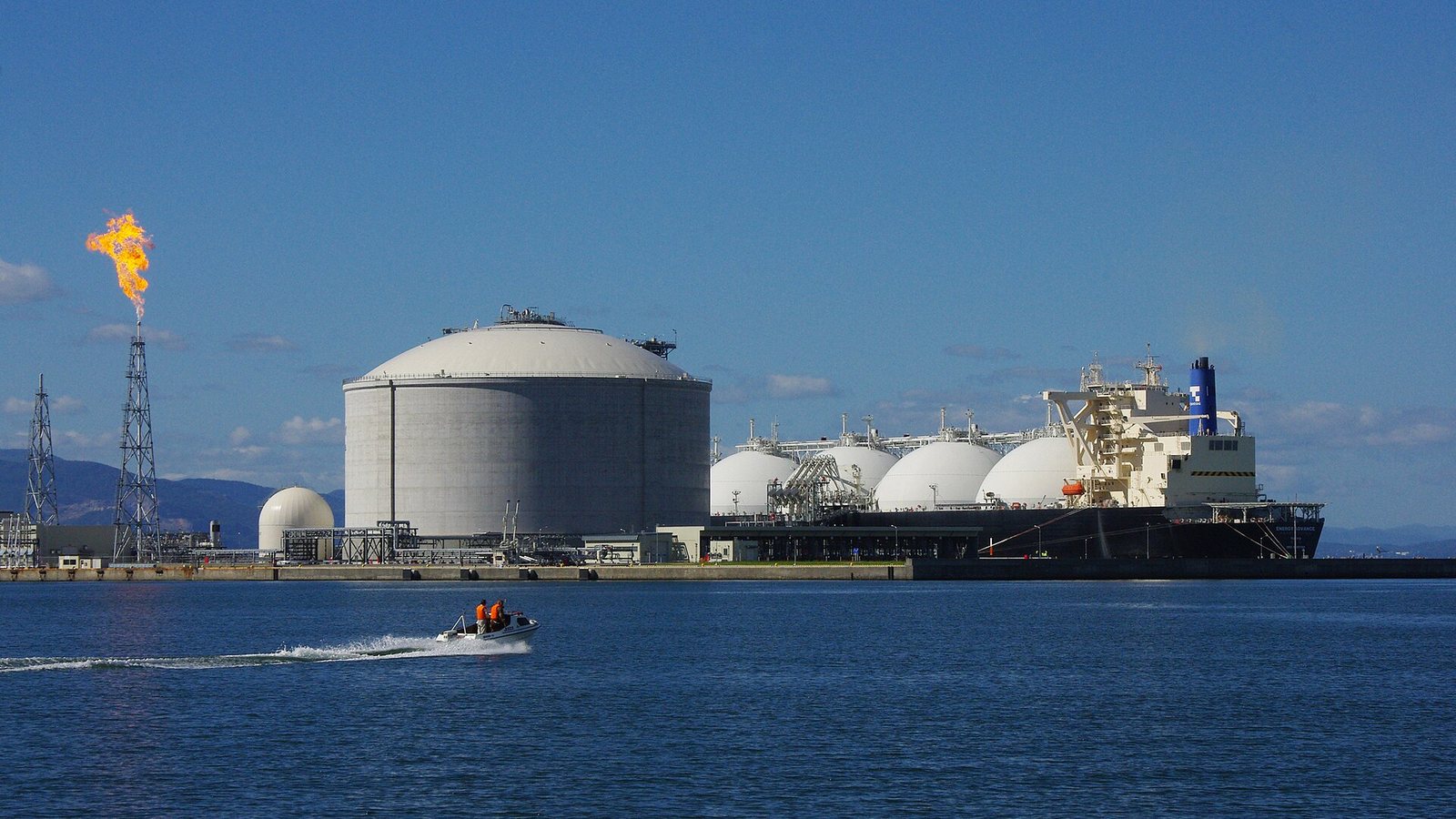
Illustrative image. Photo: とまりん♪, CC BY-SA 2.1 jp, via Wikimedia Commons — source


