Hurricane Isaias Shuts In a Quarter of US Gulf of Mexico Oil Output


US offshore producers had shut in about 25% of Gulf of Mexico oil production and 16% of its natural gas output as of Wednesday, 7 October, as Isaias strengthened into the first hurricane of the 2026 Atlantic season and tracked toward a weekend landfall on the northern Gulf Coast. Shell and Chevron were among the operators evacuating staff and halting output at deepwater platforms, according to company statements reported by Reuters.
Roughly 511,000 barrels a day offline
Figures from the Marine Minerals Administration, the Interior Department agency that now oversees offshore leasing and safety, put shut-in oil production at 25.08% and shut-in gas production at 16.37% of current Gulf output as of Wednesday, Reuters reported. The Associated Press, citing the same agency, said the oil curtailment amounted to about 511,000 barrels per day, and that eight of the Gulf’s 371 manned production platforms had been evacuated.
The Gulf accounts for almost 15% of annual US crude production, the AP noted, which makes the region one of the largest single sources of supply in the country. Shut-in figures typically rise as a storm approaches and operators move crews ashore, so Wednesday’s numbers are a snapshot rather than a peak.
The Marine Minerals Administration is new to most readers of these storm reports. It was established by Secretarial Order 3451 on 10 July 2026, folding the Bureau of Ocean Energy Management and the Bureau of Safety and Environmental Enforcement, the two agencies created after the 2010 Deepwater Horizon disaster, into a single bureau, according to a legal summary by Liskow & Lewis.
Which operators are pulling back
Shell said it was evacuating all personnel and shutting in production at its Mars, Olympus, Ursa, Vito and Appomattox assets, and had already moved non-essential workers off its Stones facility, Reuters reported. Chevron said it had started shut-in procedures at four of the Gulf facilities it operates and was moving some additional personnel onshore, while output at its other five Gulf facilities remained at normal levels. Several of Shell’s affected platforms sit in the deepwater Mars corridor, a cluster that has been curtailed in previous storm seasons; the company’s wider portfolio is outlined in our Shell company profile.
No other operators had published production figures in the reports reviewed by The Daily Energy, and neither Shell nor Chevron quantified the volumes affected.
Where the storm is heading
Isaias had maximum sustained winds of about 75 mph (120 km/h) on Thursday and was roughly 445 miles (715 km) south-southwest of the mouth of the Mississippi River, according to the US National Hurricane Center (NHC). The NHC expects further strengthening and forecasts that Isaias will remain a strong hurricane as it nears the northern Gulf Coast on Friday night, Reuters reported. The AP said landfall was expected somewhere between the Mississippi coast and the Florida Panhandle late Friday or early Saturday, with heavy rain and possible flash flooding.
Alabama Governor Kay Ivey declared a state of emergency for 40 counties, and Florida Governor Ron DeSantis did the same for 25 Panhandle and Big Bend counties, the AP reported. The storm’s timing is unusual: Isaias formed more than four months into the season, close to the record for the latest first Atlantic hurricane, set in 1905 when that year’s first hurricane formed on 8 October. A strong El Niño has suppressed Atlantic activity this year.
Refineries are the bigger market question
Analysts so far see the upstream disruption as manageable. “I would characterize the oil market risk as moderate, but rising,” Jim Burkhard of S&P Global Energy said in an email quoted by the AP. He said a stronger concern would be a landfall close to Gulf Coast refineries. The projected landfall zone includes the Mississippi coast, home to Chevron’s Pascagoula refinery; none of the reports reviewed mentioned refinery shutdowns as of Thursday morning. The forecast zone lies east of the large refining clusters in Louisiana and Texas, so the final track over the next 48 hours will largely decide whether the storm stays an upstream event or becomes a fuel-supply problem.
The storm arrives at a sensitive moment for fuel markets. US distillate inventories, which cover diesel and jet fuel, stood at 105.14 million barrels in the week to 2 October, well below the five-year range for the time of year, while commercial crude stocks fell 3.2 million barrels to 424.1 million barrels, according to Energy Information Administration data cited by Reuters. Federal emergency barrels are also stretched after this year’s drawdowns, which have left the US Strategic Petroleum Reserve at its lowest level since 1982.
Internationally, crude was already rising for other reasons. Brent traded above $102 a barrel on Thursday morning as attacks on tankers in the Strait of Hormuz intensified, and governments are still working through the emergency stock releases agreed by the IEA and the G7’s 100-million-barrel diesel and crude pledge. A prolonged outage in the US Gulf would remove supply from a region that has been one of the few reliable sources of incremental barrels during the Middle East disruption. How the Gulf fits into overall US output is set out in our US energy profile.
Operators normally begin restarting shut-in platforms once a storm passes and inspections are complete, so the duration of the outage will depend on Isaias’s final track and intensity. The NHC’s next advisories will determine whether additional platforms are evacuated over Thursday and Friday.
Sources
- Associated Press via Ideastream Public Media, “Isaias strengthens into the first hurricane of the Atlantic season”, 8 October 2026 — ideastream.org — 511,000 b/d shut in, platforms evacuated, Gulf share of US output, landfall window, state emergencies, Burkhard quote, 1905 record.
- Reuters via Investing.com, “Isaias intensifies into first Atlantic hurricane of 2026”, 8 October 2026 — investing.com — 25.08% oil and 16.37% gas shut-in figures, NHC position and forecast.
- Reuters via AOL, “Shell, Chevron cut Gulf of Mexico output as Tropical Storm Isaias approaches”, 7–8 October 2026 — aol.com — Shell and Chevron asset-level actions.
- Reuters via Investing.com, “Oil rises as Middle East supply concerns persist amid shipping attacks”, 8 October 2026 — investing.com — EIA inventory data, Brent price.
- Liskow & Lewis via Mondaq, “Establishment of the Marine Minerals Administration”, 2026 — mondaq.com — creation of the MMA by Secretarial Order 3451.
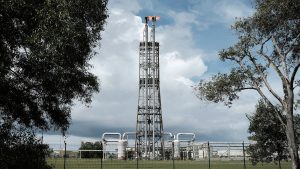
Illustrative image. Photo: GuavaTrain, CC0, via Wikimedia Commons — source