


Saudi Arabia Restarts East-West Pipeline as Yanbu Exports Set to Resume


Saudi Arabia has restarted its East-West crude pipeline and could resume oil exports from the Red Sea port of Yanbu as soon as this week, according to Reuters and Bloomberg reports citing people familiar with the matter, more than a week after drone strikes forced the kingdom to shut the line down. Saudi Aramco and the Saudi government have not issued a public statement confirming the restart or a timeline, and the reporting rests on unnamed sources rather than an official announcement — a distinction worth keeping in view given how much global oil pricing has moved on the pipeline’s status over the past two weeks.
The pipeline, formally the East-West Crude Oil Pipeline and widely known as Petroline, was shut on September 11 after drone strikes damaged multiple pumping stations. Saudi Arabia has blamed the attack on Iran-backed militias operating from Iraq, in the context of a broader regional war that has disrupted Middle East energy infrastructure and shipping since Israeli and U.S. strikes on Iran in late February.
Why This Pipeline Matters
Petroline runs roughly 1,200 kilometers from Saudi Arabia’s eastern oil fields near Abqaiq across the Arabian Peninsula to Yanbu on the Red Sea, giving the kingdom a way to export crude without sending tankers through the Strait of Hormuz — the narrow chokepoint between Iran and Oman through which a large share of Gulf oil normally flows. With Hormuz transit severely restricted since the February strikes, Petroline has functioned as one of the few remaining large-volume alternatives, which is why its shutdown two weeks ago rattled markets more than a similarly sized outage might have in calmer conditions.
Estimates of the pipeline’s capacity vary by source: shipping and trade analytics firm Kpler put pre-attack throughput at roughly 5.5 million barrels per day, with actual crude exports through Yanbu closer to 4.5 million bpd; other reporting has cited the line’s nameplate maximum capacity at up to 7 million bpd, with recent monthly flows well below that ceiling. Aramco is reportedly targeting a pumping rate of around 4 million bpd as it brings the line back online, though multiple outlets report the restart began at a low, ramping rate rather than immediately reaching that target.
What “Restart” Means So Far
Sources briefed on the matter told Reuters that Saudi Arabia restarted pipeline operations on September 22 and that one crude cargo was scheduled to load at Yanbu as a first indicator of resuming exports. That is meaningfully short of a full return to normal operations: Kpler’s own damage assessment estimated four to six weeks for full restoration of the pumping stations hit in the attack, with a partial recovery of roughly 2 to 2.5 million bpd achievable within about a month through bypass construction around the damaged sections.
In the interim, Saudi Arabia leaned on maritime routes to keep crude moving: seven supertankers carrying a combined 14 million barrels were loaded from Gulf terminals over the weekend of September 19-20, according to Kpler, an unusually large volume that reflects the kingdom routing more crude through the contested Strait of Hormuz corridor while Petroline was offline.
Market Reaction
Brent crude fell to $97.81 a barrel and West Texas Intermediate to $89.50 on the restart reports on September 22 — the first time Brent had dropped below $100 in several weeks — as traders read the pipeline news as easing, though not eliminating, supply-disruption risk. That move followed a run-up that had earlier taken Brent above $100 in the immediate aftermath of the pipeline’s September 11 shutdown. Kpler’s analysis notes the global crude market has been running a supply deficit of only about one to two million bpd through the disruption — significant, but short of the kind of imbalance that would point to a much larger price spike, which helps explain why prices have moved on headlines about the pipeline rather than spiraling continuously higher.
Freight markets have also reflected the disruption: tanker owners were commanding premiums of roughly $30 a barrel for Middle East Gulf-to-Asia routes and about $10 a barrel specifically tied to Hormuz transit risk, per Kpler, as ship-to-ship transfer hubs at Fujairah and Sohar ran at or near capacity handling the rerouted volumes.
What Remains Unconfirmed
Neither Saudi Aramco nor the Saudi Ministry of Energy has publicly confirmed the pipeline restart, the current pumping rate, or a timeline for full export resumption as of this writing; all operational detail in circulation traces back to unnamed sources cited by Reuters and Bloomberg, republished across numerous outlets without independent verification of the underlying figures. The Daily Energy is treating those figures as reported rather than confirmed, and will update this story if Aramco or Saudi authorities issue an official statement.
Sources
- Reuters (via BOE Report and U.S. News), “Saudi Arabia restarts East-West oil pipeline, to resume exports from Yanbu, sources say,” September 22, 2026 — restart date, sourcing caveat, target pumping rate, cargo loading detail.
- Kpler, “Yanbu pipeline attack ripples across crude, freight and gas markets,” September 17-23, 2026 — pipeline capacity estimates, damage/repair timeline, freight-rate premiums, supply-deficit estimate.
- The National, “Saudi Arabia restarts East-West pipeline for crude exports,” September 22-23, 2026 — independent confirmation of restart reporting and Brent/WTI price levels.
Related The Daily Energy Coverage
- What Is Saudi Aramco? Ownership, Leadership and Production — background on Aramco’s production capacity and role in Saudi oil policy.
- What Is OPEC? Members, History and How It Sets Oil Policy — Saudi Arabia’s position within OPEC+ output management.
Related: What Happens When the Strait of Hormuz Closes? — our living tracker on Gulf oil transit, alternative pipeline routes, and verified flow data.
Related: How Much Oil Does Saudi Arabia Produce? — the full production numbers, from January’s pre-war 10.1 mb/d to August’s 6.24 mb/d low.
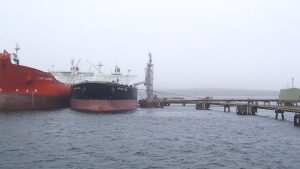
Illustrative image. Photo: Roger Davies, CC BY-SA 2.0, via Wikimedia Commons — source



[…] Saudi Arabia restarts East-West pipeline as Yanbu exports resume […]
[…] coverage: Saudi Arabia Restarts East-West Pipeline as Yanbu Exports Set to Resume | What Is ADNOC and Who Owns It? Ownership, Leadership and […]
[…] August even though the war itself was already five months old. Saudi Arabia and Aramco reportedly restarted Petroline on September 22 and are targeting a ramp toward roughly 4 mb/d of throughput, though multiple outlets describe the […]
[…] Saudi Arabia Restarts East-West Pipeline as Yanbu Exports Set to Resume (news) […]
[…] and AMNI recently took final investment decision on the Ima gas field, to the Middle East, where Saudi Arabia has just restarted its East-West crude pipeline to restore export flexibility. For Eni, Sapukala is a low-cost way to add exploration optionality […]