39 Countries Now Back Plan to Triple Nuclear Capacity by 2050, WNA Says at COP31


Support for a pledge to triple global nuclear generating capacity by 2050 has grown to 39 countries, after Togo signed on at the World Nuclear Symposium earlier this year, the World Nuclear Association (WNA) said this week as it pressed the case at COP31 in Antalya, Türkiye.
The “Net Zero Nuclear” declaration was launched at COP28 in Dubai in 2023 with 22 government signatories. Its core commitment is a shared ambition to at least triple nuclear capacity from 2020 levels by 2050, framed by supporters as a contribution to decarbonisation and the Paris Agreement goals. The WNA, an industry association representing the global nuclear sector rather than a government or regulatory body, held a dedicated session on the declaration’s progress on 12 November at the France Pavilion in Antalya, where COP31 is running from 9 to 20 November.
Industry, Banks and Tech Buyers Line Up Behind the Same Target
According to the WNA, the tripling goal now has backing beyond national governments. The association points to a parallel pledge from the nuclear industry itself, along with declared support from some of the world’s largest banks and from large energy users, including major technology companies — a reference to the data-centre operators that have signed nuclear power deals over the past two years. Because this framing comes from an industry body with a direct commercial stake in nuclear expansion, it is worth reading as the sector’s own case for its growth prospects rather than as an independent assessment of what will actually get built.
The WNA’s own modelling, published in its World Nuclear Outlook Report 2026, argues the tripling goal is achievable: if governments deliver on their stated plans and existing reactors keep operating as expected, the association projects global nuclear capacity could reach roughly 1,450 gigawatts-electric (GWe) by 2050, which it says would exceed the tripling target by more than 200 GWe. That projection assumes planned builds proceed broadly on schedule — an assumption that recent project experience, including schedule and cost pressure on first-of-a-kind small modular reactor builds in Canada and elsewhere, suggests cannot be taken for granted.
Why Antalya Is a Fitting Stage for the Announcement
Türkiye’s own nuclear build-out gives the host country a direct stake in the declaration it is hosting. Rosatom’s four-unit Akkuyu plant on the Mediterranean coast is under construction, with the turbine foundation for the fourth and final unit completed earlier this month, and Ankara has separately been negotiating nuclear financing and technology arrangements with South Korea and, more recently, exploring CANDU reactor deployment with Canada’s AtkinsRéalis. Türkiye has also set out a broader energy investment plan running to 2040 that leans in part on expanding nuclear generation to cut reliance on imported fuel. The country’s nuclear diplomacy has been on display elsewhere at COP31 too, where it signed an electricity memorandum of understanding with Saudi Arabia covering a 5 GW renewables plan.
That domestic context does not make Türkiye unusual among tripling-pledge signatories: most backers are countries either operating, building or actively planning new reactors, which is itself evidence that the declaration mainly formalises intentions governments had already stated rather than creating new commitments. What the WNA figure of 39 signatories mainly demonstrates is the breadth of that existing political alignment, not a guarantee that reactor construction will accelerate fast enough to meet it.
What to Watch Next
The declaration carries no binding targets or enforcement mechanism, and the WNA has not published a country-by-country breakdown of capacity contributions behind its 2050 projection. Whether the tripling ambition narrows the gap between pledges and actual construction will depend on project-level progress — including how OPG’s ongoing cost and schedule review of its Darlington SMR in Canada resolves, and how quickly countries such as Türkiye move their own plants from construction to operation.
Sources
- World Nuclear Association, “More global support for nuclear at COP as six new countries sign up to the tripling pledge” and related COP31 programme pages — for the 39-country figure, the declaration’s origin at COP28, and the 12 November Antalya session.
- World Nuclear Association, World Nuclear Outlook Report 2026 — for the roughly 1,450 GWe 2050 capacity projection.
- Foro Nuclear, “38 countries support the goal to triple global nuclear capacity by 2050” — for corroborating detail on signatory growth and the declaration’s scope.
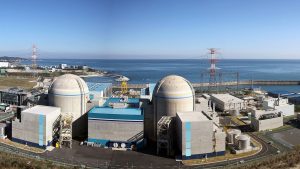
Illustrative image. Photo: Rosatom Digital Press Office/АО «Аккую Нуклеар», CC BY 4.0, via Wikimedia Commons — source