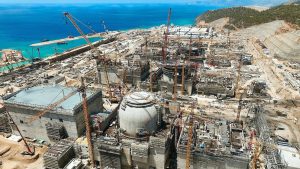
Akkuyu Completes Turbine Foundation for Fourth and Final Reactor Unit


Construction crews at Turkey’s Akkuyu nuclear power plant have completed a continuous concrete pour for the turbine building foundation of Unit 4, the fourth and final reactor at the site, according to World Nuclear News. The pour used more than 2,240 cubic meters of concrete and took just over a day with nine concrete pumps working simultaneously, following the earlier installation of more than 308 tonnes of reinforcing steel. Turkish financial newswire Foreks separately confirmed the completion on November 6, adding that roughly 69 tonnes of embedded parts were installed as part of the preparatory work.
The last of four turbine foundations, now all complete
Akkuyu Nuclear, the Rosatom-led company building and will operate the plant under a build-own-operate model, said the Unit 4 pour marks the fourth turbine-building foundation completed at the site — meaning all four of Akkuyu’s planned VVER-1200 units have now reached this stage of construction. “For the project team, this is already the fourth turbine foundation at Akkuyu NPP,” said Akkuyu Nuclear chief executive Sergei Butskikh, adding that “the reliability of a turbine set is established as early as the construction of its foundation.”
What has to happen before the turbine itself goes in
The concrete needs roughly 60 days to cure to its design strength. Only after a commission that includes inspectors from Turkey’s Nuclear Regulatory Authority (NDK) signs off on the foundation can crews begin installing the turbine-generator set itself — the equipment that converts the reactor’s steam into electricity. Unit 4 first received concrete in July 2022, and the project has since moved from basic civil structures into the equipment-foundation phase that precedes mechanical installation.
Where the wider Akkuyu project stands
Akkuyu is Turkey’s first nuclear power plant and, once complete, will house four VVER-1200 pressurized-water reactors with a combined capacity of 4,800 MWe — enough, according to Akkuyu Nuclear, to cover around 10% of the country’s electricity needs. Construction began in 2018 under a licence tied to a 2010 intergovernmental agreement between Russia and Turkey that set a goal of commissioning the first unit within seven years of receiving all required permits. Unit 1 received its first nuclear fuel delivery in April 2023 and is currently targeted to start supplying the grid by the end of 2026, though World Nuclear News’s report on Unit 4 does not state whether that target has been met.
Why a fourth-unit milestone still matters for Turkey’s energy plans
Akkuyu is only the first step in Ankara’s nuclear buildout. Turkey is also planning a second nuclear plant at Sinop and has held talks with China over a possible third plant in the Thrace region, alongside a longer-term ambition to add 5 GWe of small modular reactor capacity by 2050. Those plans sit inside a broader push to cut energy-import dependence that Ankara detailed in its recently announced $500 billion energy plan through 2040. For a project financed and built entirely by a foreign state-owned company under a BOO arrangement, each completed construction milestone — however technical — is also a signal of how closely Turkey’s energy security is now tied to the pace of Rosatom’s work on the Mediterranean coast.
Related: Turkey’s Energy Sector: Mix, Imports and Investments and Turkey Unveils $500 Billion Energy Plan to Cut Imports by 2040 cover how Akkuyu fits into the country’s broader energy strategy.
Sources
- World Nuclear News, “Concrete work completed for Akkuyu 4’s turbine unit,” November 9, 2026 — concrete volumes, reinforcement, curing timeline, executive quotes, plant-wide status. world-nuclear-news.org
- Foreks, report on the completion of Akkuyu Unit 4’s turbine foundation concreting, November 6, 2026 — independent confirmation, embedded-parts tonnage. foreks.com
Illustrative image. Photo: Rosatom Digital Press Office/АО «Аккую Нуклеар», CC BY 4.0, via Wikimedia Commons — source