


Can Microreactors Power Military Bases?


Last updated: November 1, 2026
The US Air Force and US Army have started paying private nuclear companies to build small reactors directly on military bases — not as research projects, but under real contracts with delivery deadlines. Three Air Force installations (in Texas, Colorado and Montana) and five Army installations (from North Carolina to New York) now have a developer, a reactor design and a target date attached to them, backed by up to $2.2 billion in Army funding alone. The bases stay connected to the civilian grid throughout; the reactors are meant to supplement it, not replace it, and none will be owned by the military itself. The push follows a broader run of base-energy investment that has also brought leased small modular reactors, fuel cells and battery storage to six other Army installations and that was on display at the Pentagon’s 2026 Energy Innovation Expo — part of a wider effort to manage how much power US bases actually draw (see how much energy military bases consume).
What the “ANPI” Program Actually Is
On April 10, 2025, the Defense Innovation Unit (DIU) — working with the Air Force and Army — named eight companies eligible for contracts under the Advanced Nuclear Power for Installations (ANPI) program: Antares Nuclear, BWXT Advanced Technologies, General Atomics Electromagnetic Systems, Kairos Power, Oklo, Radiant Industries, Westinghouse Government Services and X-Energy. Being named “eligible” is not the same as winning a contract — it created a pre-vetted vendor pool that the Air Force and Army could then draw on separately for their own, differently structured programs.
ANPI’s stated demonstration goal is modest by utility-scale standards: get at least one microreactor in the 3-10 MWe range operating at one US installation by 2030. That goal shapes everything that follows — the companies picked are building first-of-a-kind units sized to power a slice of a base, not the whole thing. For comparison, the civilian small modular reactor designs chasing grid-scale power — including some built by the same vendor pool — are typically rated in the hundreds of megawatts (see what a small modular reactor is).
The Air Force’s Three Picks
On April 22, 2026, the Department of the Air Force selected three of the eight ANPI-eligible vendors to proceed with site-specific design work:
| Base | State | Company | Reactor | Rated output | Target date |
|---|---|---|---|---|---|
| Joint Base San Antonio | Texas | Antares Nuclear | R1 (sodium heat-pipe-cooled) | Not yet published | Powering base assets by 2029 (company target) |
| Buckley Space Force Base | Colorado | Radiant Industries | Kaleidos (gas-cooled, portable) | 1 MWe | Early 2028 (on-contract delivery target) |
| Malmstrom Air Force Base | Montana | Westinghouse Government Services | Not yet published | Not yet published | Not yet published |
Of the three, Radiant has disclosed the most detail. Its Kaleidos unit is a high-temperature, gas-cooled microreactor designed to run up to five years before refueling, and in July 2026 the Department of Energy awarded Radiant a second allocation of HALEU (high-assay low-enriched uranium) earmarked to fuel the Buckley unit. Antares’ R1 uses sodium heat pipes rather than a conventional coolant loop; the company has said it is targeting Joint Base San Antonio’s Lackland site, though an Engineering News-Record report lists the adjoining Randolph installation — the exact site had not been finalized as of this writing. Westinghouse has said the least publicly about its Malmstrom design.
A fourth Air Force site predates the formal ANPI selections: Eielson Air Force Base in Alaska, where the service moved separately to award Oklo a contract for a 5 MWe reactor meant to supplement the base’s existing 23 MWe coal plant. That project has run about 18 months behind schedule after formal protests of the vendor-selection process, and as of mid-2026 the Air Force had not set a new completion date beyond a general hope of finishing “before 2030.”
The Army’s Separate, Bigger-Money Program: Janus
The Army runs a parallel but distinct effort, also built on the ANPI vendor pool and also structured through DIU as “other transaction” agreements rather than conventional procurement contracts. On August 27, 2026, the Army announced up to $2.2 billion in milestone-based awards to five companies, each paired with a specific base:
| Base | State | Company | Disclosed award |
|---|---|---|---|
| Fort Bragg | North Carolina | Antares Nuclear | Not disclosed |
| Fort Campbell | Kentucky | BWXT Advanced Technologies | Not disclosed |
| Fort Hood | Texas | General Atomics Electromagnetic Systems | Not disclosed |
| Fort Benning | Georgia | Radiant Industries | Up to $750 million |
| Fort Drum | New York | Westinghouse Government Services | Not disclosed |
A presidential executive order set a hard deadline: each contractor must have at least one reactor operating by the end of September 2028, which Army officials have publicly called “aggressive but plausible.” The Army expects private capital — “possibly billions of dollars,” by its own characterization, without further detail — to cover most construction cost; the government’s milestone payments fund the build and the reactor’s first year of operation, after which the Army takes over paying for electricity and the contractor keeps paying for maintenance. The Army has said it eventually expects more than 20 microreactors to be operating across its installations, though it has not published a full site list beyond the first five. Radiant, separately, has said it plans to deploy 15 reactors for the Army by 2030 on top of its Buckley Space Force Base commitment — a number the Army itself has not confirmed.
Why None of These Reactors Are Owned by the Military
Every program described above uses the same basic financial structure: the contractor designs, builds, owns and operates the reactor, obtains its own Nuclear Regulatory Commission licensing (routed through an Army- or Air Force-run review process meant to track DOE and NRC timelines), and sells the electricity back to the installation under a long-term power agreement — not unlike a private company putting solar panels on a base roof and selling the base the power. The Pentagon’s balance sheet never shows reactor ownership; it shows a multi-decade electricity contract. That model exists because it lets the military avoid holding commercial nuclear-operator liability and licensing burden directly, while still getting a resilience benefit if the civilian grid is cut or attacked — the declared rationale across Army and Air Force statements for pursuing on-base nuclear power at all.
Where This Technology Shows Up in Civilian Energy
The build-own-operate, sell-the-power model used on these bases is close to identical to the one the same companies are using to sell microreactors to civilian customers — data centers above all. Oklo, the Eielson AFB vendor, is pursuing a civilian pipeline of “powerhouse” projects aimed at data-center and industrial customers using the same Aurora design family. Kairos Power, an ANPI-eligible vendor not yet assigned a base, has active civilian agreements with Google and the Tennessee Valley Authority for its Hermes reactor line. X-Energy, also ANPI-eligible, has civilian commitments with Dow’s Seadrift, Texas chemical plant and Amazon. On the larger end of the same supply chain, Westinghouse, BWXT and General Atomics — all three now holding military microreactor contracts — are simultaneously selling nuclear components and services into the civilian small modular reactor market (see our coverage of which defence companies are investing in energy technologies and of why Rolls-Royce is building SMRs). Military contracts are, in effect, subsidizing the first-of-a-kind licensing and construction costs that the whole advanced-reactor industry has struggled to finance commercially — a pattern with a direct historical parallel in naval reactor technology, which seeded the civilian SMR vendor base decades earlier (see how a nuclear-powered submarine works).
What Could Still Go Wrong
The Eielson AFB delay is the clearest cautionary example: an 18-month slip driven not by engineering problems but by formal protests over how the Air Force ran its vendor selection. Every site discussed here still needs National Environmental Policy Act review and final siting approval, and at Buckley Space Force Base a local Aurora, Colorado city councilmember has publicly noted that the city has no authority over what the Air Force builds on federal land — a preview of the kind of community friction that siting a first-of-a-kind reactor next to a metro area can generate, even without a safety incident. None of the companies involved has a licensed, operating microreactor on US soil yet; every timeline in this piece is a target set by either the company or the service, not a completed fact.
FAQ
Can nuclear microreactors actually power a military base today?
Not yet. As of November 2026, no ANPI or Janus microreactor has been licensed or connected to a base’s power system. The programs are in design, siting and early-construction stages, with the first units targeted for 2028-2030.
Who owns the reactors on US military bases?
The private contractor — not the Army, Air Force or federal government. Each company builds, owns, licenses and operates its reactor and sells the electricity to the installation under a long-term power agreement, similar to a commercial power-purchase deal.
What is the difference between the Air Force’s ANPI program and the Army’s Janus program?
Both draw on the same eight-company vendor pool named eligible by the Defense Innovation Unit in 2025, but they are separately funded and managed. The Air Force’s effort (ANPI) targets three sites — Joint Base San Antonio, Buckley Space Force Base and Malmstrom AFB — plus the earlier, separately contracted Eielson AFB project. The Army’s Janus program is a larger, five-base, up-to-$2.2-billion effort announced in August 2026 with a September 2028 deadline set by executive order.
Why would the military want nuclear reactors on its bases instead of relying on the civilian grid?
The stated rationale across Army and Air Force statements is energy resilience: officials argue that fuel for diesel generators or power from the civilian grid cannot always be guaranteed to reach a base during a crisis or conflict, and an on-site reactor would keep critical functions running if outside power were cut.
Sources
- Defense Innovation Unit, “DOD Selects Eligible Companies for the Advanced Nuclear Power for Installations Program,” April 2025 — diu.mil
- American Nuclear Society, “Air Force selects three microreactor developers for ANPI,” April 23, 2026 — ans.org
- Business Wire, “Antares Selected for Proposed Deployment of Nuclear Microreactor at Joint Base San Antonio Under Department of the Air Force ANPI Initiative,” April 22, 2026
- Radiant Industries, “Air Force selects Radiant to deliver microreactors to Buckley Space Force Base” — radiantnuclear.com
- Axios Denver, “How one company plans to put a nuclear microreactor at Buckley,” May 26, 2026
- Air & Space Forces Magazine, coverage of the Eielson AFB / Oklo microreactor project
- Federal News Network, “Army awards $2.2B in contracts for nuclear microreactors,” August 26, 2026 — federalnewsnetwork.com
- ExchangeMonitor, “Army selects 5 companies to build Janus reactors at military sites,” August 27, 2026
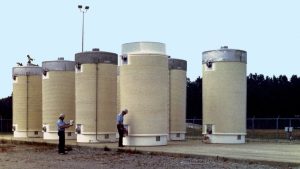
Illustrative image. Photo: Christian David, CC BY-SA 4.0, via Wikimedia Commons — source




[…] Janus Program (Army microreactors) […]
[…] bases and contractors for on-site microreactors under the ANPI and Janus programs — see Can Microreactors Power Military Bases? for the full base-by-base […]