MOL and Deutsche ReGas Sign Long-Term FSRU Charter for Germany’s Mukran LNG Terminal


Japan’s Mitsui O.S.K. Lines (MOL) and Germany’s Deutsche ReGas have signed a long-term time charter covering a floating storage and regasification unit (FSRU) that will serve the Deutsche Ostsee LNG terminal at Mukran, on the Baltic island of Rügen. The deal, signed at a ceremony in Tokyo on October 29, will see an existing LNG carrier converted into an FSRU at the Hudong-Zhonghua Shipbuilding yard in China, with the charter due to begin in 2028.
A charter, not a sale
The agreement is a time charter: MOL will own and operate the converted vessel and lease its capacity to Deutsche ReGas, rather than selling the unit outright or building a newbuild FSRU from scratch. Converting an existing carrier rather than ordering a new ship is typically faster and cheaper, and the practice has become common among LNG terminal operators seeking to bring import capacity online more quickly than a purpose-built FSRU would allow.
MOL describes the project as its first FSRU conversion undertaken as its own sole initiative, rather than as part of a joint venture or a project led by a third party. Jotaro Tamura, MOL’s President and CEO, called the agreement “a major strategic milestone for MOL,” while Suryan Wirya-Simunovic, the company’s Managing Executive Officer, framed it as a landmark for MOL’s business across Europe and Africa.
Restoring Mukran’s permitted capacity
Deutsche ReGas operates the Mukran terminal, which the company describes as the only LNG import terminal in eastern Germany. According to Deutsche ReGas, the new FSRU is intended to help restore the terminal’s fully permitted capacity — language that points to existing constraints on throughput, though neither company has published a specific volume figure for the chartered unit. Ingo Wagner, Deutsche ReGas’s CEO, described Mukran as “critical infrastructure for security of supply.”
Mukran is not new to large energy players: Norway’s Equinor separately booked regasification capacity at the terminal in 2025, underlining the facility’s role in Germany’s post-2022 LNG import buildout.
Part of a wider German LNG push
Germany moved quickly to build LNG import capacity after it cut off most pipeline gas imports from Russia starting in 2022, standing up or converting terminals at locations including Wilhelmshaven, Brunsbüttel and Stade alongside Mukran. The Mukran charter adds another long-term commitment to that buildout, this time anchored by a Japanese shipping major rather than a European utility. For background on the country’s broader import mix, see Where Does Germany Get Its LNG?
Germany’s gas-security push has also included commercial supply deals further down the chain: trading house Trafigura recently agreed to supply Germany’s SEFE with gas under a $1.5 billion arrangement, part of the same broader effort to diversify and secure the country’s gas supply after the loss of Russian pipeline volumes.
Sources
- Offshore Energy, Melisa Cavcic, “MOL and Deutsche ReGas shake hands on FSRU for German LNG terminal,” October 29, 2026, offshore-energy.biz (charter terms, conversion yard, 2028 start date, Mukran’s role, Equinor booking, all quotes)
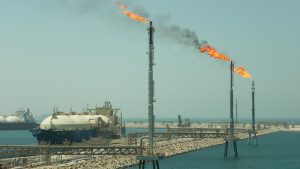
Illustrative image. Photo: Gordon Leggett, CC BY-SA 4.0, via Wikimedia Commons — source