Canada’s Ksi Lisims LNG Signs Binding 20-Year Deal With Germany’s SEFE


Ksi Lisims LNG, the proposed floating liquefied natural gas export project on Canada’s northern British Columbia coast, has converted a preliminary supply arrangement with Germany’s SEFE into a binding, 20-year sale and purchase agreement. Western LNG, the project’s lead developer, and SEFE (Securing Energy for Europe) both confirmed the deal on October 26. Under its terms, SEFE will buy 1 million tonnes per annum (mtpa) of LNG on a free-on-board basis, with deliveries expected to begin once the terminal is built in the early 2030s.
From Heads of Agreement to Binding Contract
The new sale and purchase agreement (SPA) upgrades a heads of agreement the two companies signed in May 2026, which had been contingent on negotiating binding terms. According to BC news outlet Black Press Media, which cited Western LNG, the SEFE contract brings the project’s total binding commitments to 7 mtpa of its planned 12 mtpa of capacity, or about 58%. Other binding offtake already in place includes a sale and purchase agreement with Shell dating to January 2024 and a 20-year deal with TotalEnergies for 2 mtpa. Uniper signed what it called a “landmark” long-term supply agreement in July, while Centrica and Australia’s Santos have each signed heads of agreement — for supply volumes that, unlike SEFE’s, have not yet been converted into binding contracts.
Germany’s Search for Supply Beyond Russia
SEFE is the renamed successor to Gazprom Germania, nationalized by Berlin in 2022 after Russia’s invasion of Ukraine severed most of Germany’s pipeline gas supply. Since then, Germany has built floating LNG import terminals at sites including Wilhelmshaven and Brunsbüttel and signed a string of long-term purchase deals with suppliers in the United States and Qatar to replace lost Russian volumes. A direct, long-term contract with a Canadian export project would give SEFE a new, geographically distinct source outside its existing Gulf Coast and Qatari supply lines — a diversification goal German officials have repeatedly cited as a lesson from the 2022 gas-supply shock.
The Remaining Gap to a Final Investment Decision
LNG developers typically look to lock in long-term contracts for roughly three-quarters of a project’s nameplate capacity before committing the capital for construction. At 58% committed, Ksi Lisims still needs an additional stretch of firm volume — roughly the 2 mtpa currently covered only by the non-binding Centrica and Santos agreements — to clear that threshold. A Western LNG spokesperson said the project remains on track to reach full commercialization by the end of 2026, according to Black Press Media’s report. The project itself envisions two floating liquefaction and storage units moored off Pearse Island, on Nisga’a Nation land near Prince Rupert, with first LNG targeted for the early 2030s. Canada’s federal Major Projects Office has flagged Ksi Lisims for potential fast-tracking.
Political Backing, and Opposition From Neighboring Nations
Federal Energy Minister Tim Hodgson welcomed the SEFE agreement as a step toward diversifying Canada’s trade and strengthening transatlantic energy security, Black Press Media reported. Eva Clayton, president of the Nisga’a Lisims Government, said each new agreement “brings Ksi Lisims LNG closer to construction.” British Columbia’s premier-elect, Lorne Doerkson, whose Conservatives won the province’s October 24 election, has pledged to double the province’s natural gas production by 2032 and triple it by 2035, arguing the push would create jobs and billions of dollars a year in public revenue. Not every First Nation in the region backs the project, however: neighboring communities, including the Lax Kw’alaams Band, have pursued legal challenges against both Ksi Lisims LNG and the associated Prince Rupert Gas Transmission pipeline that would feed it.
Ksi Lisims would be Canada’s second major LNG export project after LNG Canada’s Kitimat terminal, which began shipping cargoes in 2025; Shell and its partners sanctioned a second phase at Kitimat in September 2026 that would double that facility’s capacity. For more on how Canada is fast-tracking other energy export infrastructure, see TDE’s coverage of the Pacific Link pipeline project.
Sources
- Western LNG, press release, “Ksi Lisims LNG signs binding 20-year agreement with Germany’s SEFE,” October 26, 2026 — deal confirmation, terms.
- SEFE, press release, “SEFE signs supply agreement with Canada’s Ksi Lisims LNG,” October 26, 2026 — deal confirmation.
- Black Press Media (Vic News), “B.C. North Coast LNG project draws nearer to final investment decision,” October 26, 2026 — contracting percentage, quotes, political reaction.
- Western LNG / SEFE, press release, May 27, 2026 — original heads of agreement terms.
- TheDailyEnergy.com, “Where Does Germany Get Its LNG?” — background on Germany’s post-2022 LNG sourcing.
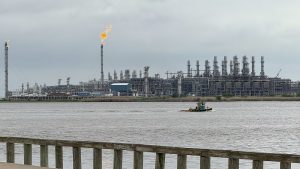
Illustrative image. Photo: Gordon Leggett, CC BY-SA 4.0, via Wikimedia Commons — source