


What Is LNG and How Does It Work?


Last updated: September 24, 2026
LNG (liquefied natural gas) is natural gas that has been cooled to about −162°C (−260°F), turning it into a liquid roughly 1/600th the volume of the gas at room temperature. Shrinking it this much lets producers ship gas by sea in specialized tankers to markets that have no pipeline connection, then turn it back into gas at an import terminal before it enters the grid. Global LNG trade reached about 411 million tonnes in 2024, according to the International Gas Union.
Definition
LNG is not a different substance from the natural gas that flows through pipelines — it is the same gas, mostly methane, that has been purified and then liquefied by cooling rather than by compression. Liquefaction removes the need for a continuous pipeline between producer and buyer: once loaded onto a purpose-built LNG carrier, the cargo can be shipped anywhere in the world with a receiving terminal. At the destination, the liquid is warmed back into gas (regasified) and injected into the local pipeline network.
This distinguishes LNG from LPG (liquefied petroleum gas), which is propane and butane liquefied under moderate pressure at near-ambient temperature, and from CNG (compressed natural gas), which stays gaseous but is compressed for use mainly in vehicles and short-haul distribution.
How It Works
The LNG value chain has four stages:
- Production and treatment: raw gas is extracted and processed to remove water, carbon dioxide, and other impurities that would freeze during cooling.
- Liquefaction: the treated gas is cooled in stages, typically using large refrigeration trains, to about −162°C, at which point it becomes liquid at atmospheric pressure.
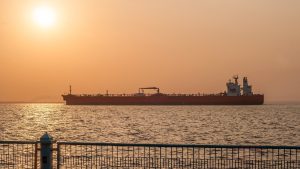
- Shipping: LNG is loaded onto double-hulled, cryogenically insulated LNG carriers and transported by sea, sometimes for weeks, with continuous refrigeration and boil-off management.
- Regasification: at the receiving terminal, the LNG is warmed — often using seawater or ambient-air heat exchangers — back into gas and sent into the pipeline network. Floating regasification units, known as FSRUs, allow countries to import LNG without building a fixed onshore terminal.
Why It Matters
LNG decouples gas supply from geography. A country with no pipeline link to a gas-producing region — Japan, South Korea, or an island state, for example — can still import gas by ship from Qatar, the United States, or Australia. This has turned natural gas from a largely regional fuel, tied to fixed pipeline corridors, into a globally traded commodity that responds to price signals set by regional benchmarks such as Henry Hub (US), TTF (Europe), and JKM (Japan-Korea Marker, the Asian spot benchmark). LNG has also become central to energy security debates: Europe leaned heavily on LNG imports after pipeline gas from Russia was curtailed following 2022, and Asian buyers increasingly sign long-term contracts to lock in supply.
Where It Is Used
LNG supplies power generation, industrial heat, residential and commercial heating, and, in some markets, transport fuel for ships and heavy trucks. The largest importing regions are East Asia (Japan, China, South Korea) and, more recently, Europe, which sharply increased LNG imports after 2022 to offset lower pipeline volumes.
Key Characteristics
| Metric | Value |
|---|---|
| Liquefaction temperature | Approximately −162°C (−260°F) |
| Volume reduction vs. gaseous state | About 600:1 |
| Main component | Methane (typically 85–95%), with minor ethane, propane and nitrogen |
| Global LNG trade, 2024 | ~411.2 million tonnes (IGU); ~406 million tonnes (GIIGNL) |
| Global liquefaction capacity, end-2024 | 494.4 million tonnes/year |
| Top exporter, 2024 | United States, ~88.4 million tonnes |
Sources: International Gas Union, 2025 World LNG Report; GIIGNL Annual Report 2025. Figures differ slightly between the two industry bodies due to methodology.
Related Technologies
- FLNG (floating liquefied natural gas): a vessel that liquefies gas produced offshore without a pipeline to shore.
- FSRU (floating storage and regasification unit): a ship-based import terminal that regasifies LNG, used where building fixed onshore infrastructure would be slower or costlier.
- LNG carrier: a purpose-built, cryogenically insulated tanker; most modern vessels use membrane-type containment systems.
- Boil-off gas management: because perfect insulation is impossible, LNG carriers use boil-off gas as fuel or re-liquefy it during the voyage.
Real-World Examples
- Qatar’s North Field is the world’s largest non-associated natural gas field and the anchor resource for QatarEnergy’s LNG export program, run through terminals at Ras Laffan.
- The United States became the world’s largest LNG exporter in 2023 and held that position through 2024, exporting from terminals such as Sabine Pass and Corpus Christi, built on the back of the shale gas boom.
- Japan was the founding large-scale LNG importer, receiving its first cargo from Alaska in 1969, and remains one of the top three LNG-importing countries.
FAQ
Is LNG the same as natural gas?
Chemically, yes — LNG is natural gas that has been cooled into a liquid for transport. Once regasified, it is indistinguishable from pipeline gas.
Is LNG the same as LPG?
No. LNG is liquefied methane, cooled to a cryogenic temperature. LPG is liquefied propane and/or butane, which liquefies under moderate pressure at ordinary temperatures and is used differently (heating cylinders, autogas).
Why is LNG shipped instead of piped everywhere?
Pipelines are cheaper over land and short sea crossings, but building one across an ocean or through hostile terrain is often impossible or uneconomic. LNG lets gas move by ship to any coastal market with a regasification terminal.
Which countries export the most LNG?
In 2024 the largest exporters were the United States (~88.4 million tonnes), Australia (~81.0 million tonnes) and Qatar (~77.2 million tonnes), together accounting for 60% of global LNG exports, per the IGU.
Related The Daily Energy Pages
Sources
- International Gas Union, 2025 World LNG Report (igu.org)
- GIIGNL, 2025 Annual Report (giignl.org)
- U.S. Energy Information Administration, Natural Gas Explained (eia.gov)
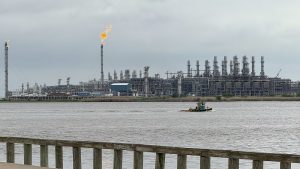
Illustrative image. Photo: Gordon Leggett, CC BY-SA 4.0, via Wikimedia Commons — source


[…] LNG — how gas becomes a globally shipped commodity, part of the wider energy-market context OPEC’s oil quotas sit in […]
[…] remains structurally reduced compared with pre-2022 levels, leaving European buyers more reliant on LNG cargoes and other pipeline sources to fill storage — a dependence that also ties European prices […]
[…] yapısal olarak düşük seyrediyor; bu da Avrupalı alıcıları depoları doldurmak için LNG kargolarına ve diğer boru hattı kaynaklarına, örneğin TotalEnergies ve AMNI’nin […]
[…] What Is LNG and How Does It Work? […]
[…] LNG — how liquefied natural gas is shipped globally, relevant to Aramco’s growing gas business […]
[…] What Is LNG and How Does It Work? — background on liquefaction trains and how feed gas projects like Ima connect to export capacity. […]
[…] transfers staged off the coast of Oman to bypass the most contested stretch of the strait; LNG carriers, which keep cargo cryogenically cooled to around minus 162°C, are far harder to transfer […]
[…] and as a chemical feedstock for fertilizer, plastics, and hydrogen production. It also underpins LNG (liquefied natural gas), in which gas is cooled to about -162°C to shrink its volume roughly 600-fold so it can be shipped […]
[…] in the Montney shale basin, and the company’s evaluation of a Phase 2 expansion of the LNG Canada export terminal, in which Shell holds a 40% interest. Earlier in his career, as Managing […]
[…] LNG — the liquefied natural gas business that links ExxonMobil’s Qatar, Mozambique and Papua New Guinea interests to global markets […]
[…] What Is LNG and How Does It Work? […]
[…] What is LNG? Liquefied natural gas explained […]
[…] LNG (liquefied natural gas) — core to Shell’s Integrated Gas business […]
[…] What Is LNG and How Does It Work? […]
[…] gas, both domestically within Russia and for export via pipeline and, through group companies, as LNG. It also sells gas condensate and, through Gazprom Neft, crude oil and refined products. […]
[…] What Is LNG and How Does It Work? […]
[…] liquids), then either piped directly to consumers or, for export over long distances, cooled into liquefied natural gas (LNG) for transport by specialized carriers. Midstream also includes underground and tank storage that […]
[…] LNG — background on the liquefied natural gas market ADNOC is expanding into via Ruwais LNG and Rio Grande LNG […]