What Is the Strait of Hormuz and Why Does It Matter?

Last updated: November 4, 2026
The Strait of Hormuz is a narrow sea passage between Iran and Oman that connects the Persian Gulf to the Gulf of Oman and the open ocean. It is the world’s single most important oil chokepoint: in the first half of 2025 it carried roughly 20.9 million barrels per day (b/d) of crude oil, condensate and petroleum products — about 20% of global petroleum liquids consumption — plus roughly 11.4 billion cubic feet a day of liquefied natural gas, according to the US Energy Information Administration (EIA). Since early 2026, repeated Iranian attacks on tankers and mine incidents around the strait, amid a wider US-Iran military confrontation, have pushed Brent crude above $100 a barrel and put the waterway at the center of global energy-security coverage.
Where Is the Strait of Hormuz?
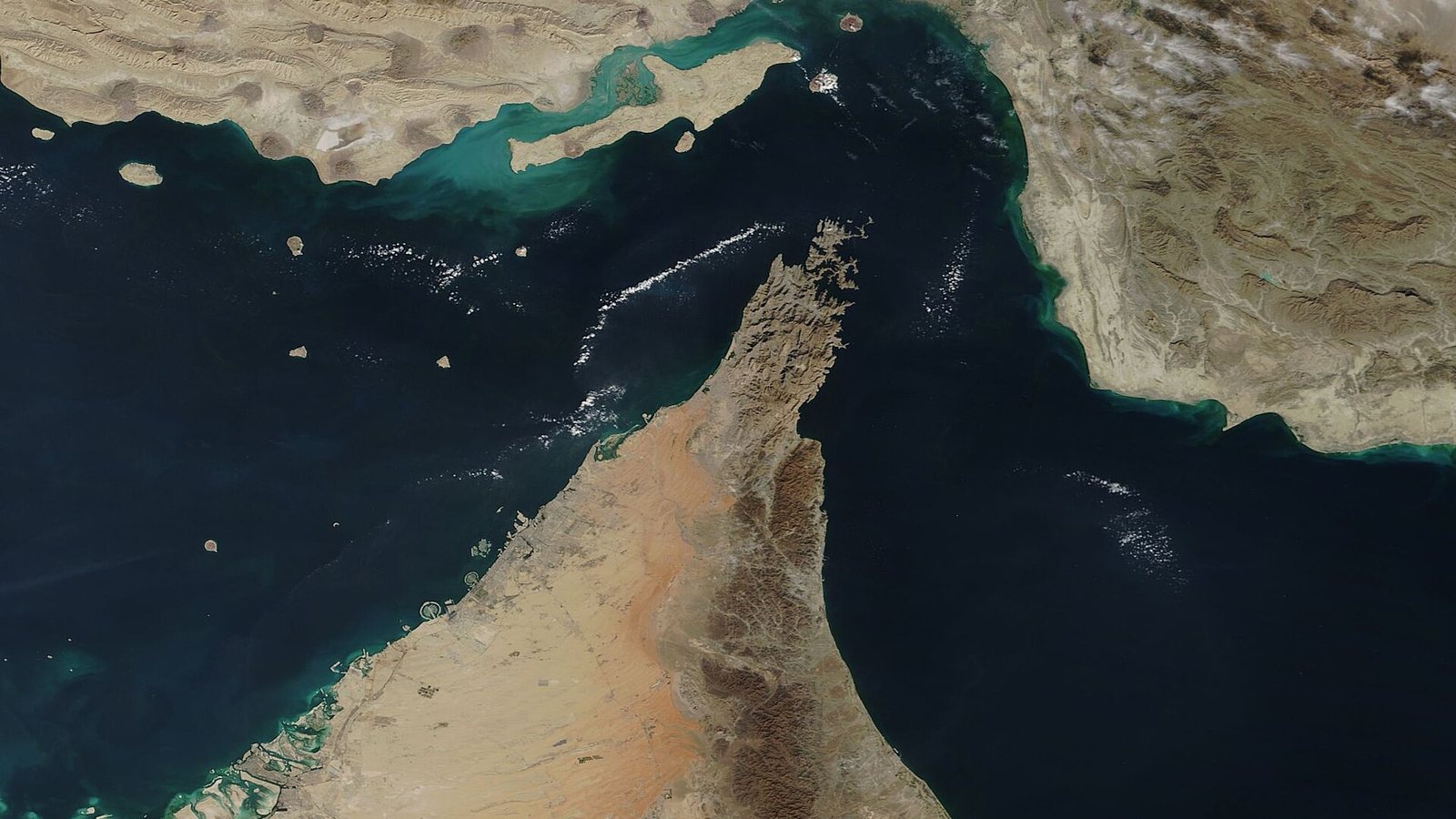
The strait sits between Iran’s southern coast and the Musandam Peninsula, an exclave of Oman, linking the Persian Gulf to the Gulf of Oman and, beyond that, the Arabian Sea and Indian Ocean. At its narrowest point it is often cited at about 21 nautical miles (roughly 39 km) wide — the figure most commonly used by the EIA — though some geography sources put the narrowest crossing closer to 30 miles depending on exactly where the measurement is taken. Commercial traffic does not use the full width: vessels follow a two-mile-wide inbound lane and a two-mile-wide outbound lane under an internationally recognized Traffic Separation Scheme, separated by a two-mile buffer zone, because much of the strait is too shallow for deep-draft tankers outside the marked channels. The strait contains several islands, most of them under Iranian control, including Qeshm, Hormuz Island and the three islands (Abu Musa and the Tunbs) disputed between Iran and the UAE. Transit passes through territorial waters claimed by both Iran and Oman.
Why the Strait of Hormuz Matters for Global Energy
Hormuz is the only sea route out of the Persian Gulf, so it is the sole maritime export path for crude oil and condensate from Saudi Arabia, Iraq, Iran, Kuwait and the UAE, and the only export route at all for Qatari LNG. The EIA has long ranked it the world’s most important oil chokepoint, ahead of the Strait of Malacca and the Suez Canal; it also carries over 20% of global LNG trade, concentrated almost entirely on cargoes loading at Qatar’s Ras Laffan terminal. Roughly a quarter of all seaborne-traded crude oil in the world passes through this one waterway, which is why even short-lived disruptions move global prices: Brent crude rose from roughly $86 in the summer of 2026 to above $100 by September as attacks intensified, and traded near $105 in mid-October after a container ship and a tanker were struck inside the strait, according to UK Maritime Trade Operations (UKMTO) reporting.
How Much Oil and Gas Flow Through It
| Metric | Volume | Period / Source |
|---|---|---|
| Total petroleum liquids (crude, condensate, products) | ~20.9 million b/d | 1H 2025, EIA |
| Crude oil only | ~14–15 million b/d | 2025, Kpler / IEA-sourced estimates |
| Share of global petroleum liquids consumption | ~20% | 1H 2025, EIA |
| Share of global seaborne oil trade | ~25% | EIA / industry estimates |
| LNG flow | ~11.4 billion cubic feet/day | 1H 2025, EIA |
| Share of global LNG trade | >20% | 1H 2025, EIA |
Most crude and condensate transiting Hormuz is bound for Asia — China, India, Japan and South Korea are the largest destination markets — while Qatari LNG loaded at Ras Laffan supplies both Asian and European buyers under long-term contracts. These are baseline, pre-crisis figures; actual flows have fluctuated sharply since early 2026 amid attacks and official Iranian closure declarations (see “Current Status” below), and 2026 transit volumes should be treated as a live, disputed figure rather than a stable annual average.
Alternative Routes and Bypass Capacity
Only a few Gulf oil producers have pipeline routes that avoid the strait entirely, and their combined capacity is far short of normal Hormuz volumes. Saudi Arabia’s East-West (Petroline) pipeline can move crude from the Eastern Province to the Red Sea port of Yanbu, and the UAE’s Fujairah pipeline can route Abu Dhabi crude directly to the Gulf of Oman, bypassing Hormuz. Industry estimates put the combined usable bypass capacity of these routes at roughly 3.5 to 5.5 million b/d — well under a quarter of Hormuz’s normal ~20 million b/d of liquids flow. Iraq, Kuwait, Bahrain, Qatar and Iran itself have no non-Hormuz export route for seaborne crude or LNG, which is why those countries are most exposed to any sustained closure or blockade.
History: The Tanker War and Earlier Crises
Hormuz has been a flashpoint before. During the 1980–1988 Iran-Iraq War, both sides attacked tankers and oil infrastructure in what became known as the Tanker War; the US Navy began escorting reflagged Kuwaiti tankers through the Gulf under Operation Earnest Will. After the frigate USS Samuel B. Roberts struck an Iranian mine on April 14, 1988, the US launched Operation Praying Mantis the following day, sinking or crippling several Iranian naval vessels in what the US Navy has described as its largest surface engagement since World War II. Iran has repeatedly threatened to close the strait in later decades — including during the 2011–2012 and 2018–2019 sanctions standoffs — without following through, which is part of why the actions described below mark a departure from the historical pattern of threats alone.
Current Status: The 2026 Iran Crisis
Since US and Israeli strikes on Iranian targets on February 28, 2026, the conflict has repeatedly spilled into the strait. Iran’s Islamic Revolutionary Guard Corps (IRGC) announced a “closure” of Hormuz shortly after the February strikes and has periodically renewed that declaration through the year, warning it would target ships attempting to transit. US Central Command (CENTCOM) has disputed the practical effect of these declarations, saying in October 2026 that it had helped move more than 19 million barrels of crude through the strait in a single day — directly contradicting claims of an effective closure. The two sides also dispute individual incidents: the IRGC has attributed several tanker strikes to mines on routes it says it banned, while CENTCOM said in August 2026 that no vessel had actually struck a mine, and former US officials have accused Iran of exaggerating attacks to push prices higher. On November 4, 2026, Iran said four tankers were hit by mines near the strait, the latest in a string of incidents that TDE and other outlets have tracked through the year. Readers should treat month-to-month attack and closure claims as contested and evolving — this section will be updated as the situation develops, and see TDE’s rolling coverage linked below for the latest incidents.
Military and Security Presence
The US Navy’s Fifth Fleet, headquartered in Bahrain, has primary responsibility for naval security in the Gulf and the strait, operating alongside allied navies in international coalitions such as the Combined Maritime Forces. Iran’s conventional navy and the IRGC Navy — which operates fast attack craft and is believed to control Iran’s mine-laying capability — are the principal Iranian forces in the strait. The UK Maritime Trade Operations (UKMTO) center, run by the Royal Navy, is the main channel through which commercial shipping companies report attacks and threats in the region.
Frequently Asked Questions
How much oil passes through the Strait of Hormuz?
In normal conditions, about 20.9 million barrels per day of crude oil, condensate and petroleum products transited the strait in the first half of 2025, according to the EIA — roughly 20% of global petroleum liquids consumption. Crude oil alone accounts for an estimated 14–15 million b/d of that total.
Can Iran actually close the Strait of Hormuz?
Iran has declared the strait “closed” multiple times in 2026 and has attacked tankers and reportedly laid mines near it, but the US and allied navies dispute that these actions amount to an effective closure; CENTCOM said it moved over 19 million barrels through the strait on a single day in October 2026. A sustained full closure would require either a much larger naval blockade or mining of the main shipping channels, which Iran has threatened but — as of this update — has not durably achieved.
What happens to oil prices if Hormuz is disrupted?
Prices have risen sharply with each escalation in 2026: Brent crude moved from roughly $86 a barrel in July to above $100 by September and traded near $105 in mid-October as attacks intensified, according to oil-market reporting. Because only 3.5–5.5 million b/d of bypass pipeline capacity exists for Gulf producers, a sustained disruption of Hormuz has no straightforward substitute route for most of the oil and virtually all of the LNG that normally transits it.
Why can’t tankers just avoid the Strait of Hormuz?
There is no sea route out of the Persian Gulf that avoids the strait, and only Saudi Arabia and the UAE have pipelines that bypass it by land. Iraq, Kuwait, Bahrain, Qatar and Iran have no alternative export route for seaborne crude or LNG, making them the most exposed to any closure or sustained attack campaign.
Related The Daily Energy Pages
- What Is LNG?
- What Is Brent Crude?
- What Is OPEC?
- Saudi Arabia Energy Profile
- QatarEnergy
- ADNOC
- How Much Oil Passes Through the Turkish Straits?
- Iran Says Four Tankers Hit by Mines Near Strait of Hormuz (Nov. 4, 2026)
- Brent Settles at a Six-Month High as Hormuz Tanker Attack Caps Fourth Monthly Gain
- Oil Prices Dip but Hold Above $100 as Hormuz Tanker Attacks Hit a Monthly Record
Sources
- US Energy Information Administration (EIA), World Oil Transit Chokepoints — Strait of Hormuz, 1H 2025 flow data
- UK Maritime Trade Operations (UKMTO), incident reporting, 2026
- US Central Command (CENTCOM), public statements on Strait of Hormuz transit and incidents, August–October 2026
- US Naval History and Heritage Command, Operation Praying Mantis historical record
- Reuters, Bloomberg and oilprice.com market reporting on Brent crude price moves tied to Hormuz incidents, July–October 2026
- Kpler and IEA-sourced crude transit estimates, 2025
Illustrative image. Photo: MODIS Land Rapid Response Team, NASA GSFC, Public domain, via Wikimedia Commons — source