Iran Says Four Tankers Hit by Mines Near Strait of Hormuz


Iran’s Islamic Revolutionary Guard Corps (IRGC) said on Wednesday that four oil tankers were destroyed after striking mines while using what it called a “prohibited route” south of the Strait of Hormuz, and that its forces had separately halted two other vessels for non-compliance with Iranian maritime rules. The claim, reported by Iranian state media and picked up by international outlets including CBS News and National Security Journal, could not be independently verified, and no flag states, tanker operators or crew conditions were identified in the initial reports.
Part of a pattern of disputed mine claims
Wednesday’s claim is the latest in a string of similar IRGC statements this year: the Guard said three tankers caught fire after hitting mines on an “unauthorized route” on October 29, and reported a separate mine strike east of the strait on October 27. None of those earlier claims were independently confirmed either. The reports have continued despite an announcement in August by US Central Command (CENTCOM), whose chief, Adm. Brad Cooper, said American forces had spent months clearing Iranian mines from the strait’s internationally recognized shipping lanes using Navy divers, special operations units and aircraft, and declared the established transit routes mine-free. Allied governments and the shipping industry reacted with skepticism at the time; the International Maritime Organization had estimated that as many as 80 mines could have been laid across the waterway, and BIMCO, the shipowners’ association, said it still considered the strait “very risky.”
A chokepoint under strain since the Iran-Israel-US conflict
The Strait of Hormuz carries roughly a fifth of global seaborne oil and a large share of the world’s LNG exports, and it has become a recurring flashpoint since the Iran-Israel-US conflict escalated earlier this year. The IRGC’s latest statement came a day after Iranian officials said the United States had struck targets inside the country, including a reported raid on Qeshm island, which sits inside the strait — a claim that, like the mine reports, has not been independently verified. Despite the fresh claims, oil prices moved in the opposite direction Wednesday morning: Brent crude fell toward $100 a barrel as traders bet on progress toward a US-Iran settlement, a sign that markets are currently weighing diplomatic signals as heavily as the latest reports of attacks.
The Daily Energy has tracked repeated disruption claims near Hormuz through the year, including a round of tanker strikes in mid-October that coincided with a stall in Iran war talks, and an attack late last month that helped push Brent to a six-month high and capped its fourth consecutive monthly gain. The recurring pattern — unverified mine or attack claims from Iran, denials or counter-claims from US forces, and volatile but not always directional price moves — has made Hormuz a persistent source of uncertainty for global gas and oil markets even when individual incidents cannot be confirmed.
Sources
- IRGC statement via Iranian state media, November 4, 2026, as reported by CBS News and National Security Journal — claim of four tankers destroyed by mines and two vessels halted; unverified.
- Gulf News and gCaptain, reporting on the August 2026 CENTCOM mine-clearance announcement and subsequent shipping-industry skepticism — background on the disputed state of the strait’s shipping lanes.
- OilPrice.com, “Brent Falls to $100 as Traders Bet on a U.S.-Iran Deal,” November 4, 2026 — same-day market reaction.
- The Daily Energy, “Brent Settles at a Six-Month High as Hormuz Tanker Attack Caps Fourth Monthly Gain,” October 31, 2026 — background on the recurring pattern of Hormuz incidents and price moves.
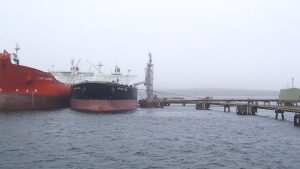
Illustrative image. Photo: NASA Johnson Space Center, Public domain, via Wikimedia Commons — source