


Two More Tankers Hit Near Strait of Hormuz as Iran War Talks Stall


Two more oil tankers were attacked near the Strait of Hormuz on Sunday, deepening a months-long campaign against shipping in the world’s most important oil chokepoint. The latest strikes pushed Brent crude back above $103 a barrel and coincided with data showing crude flows through the strait running roughly 40% below pre-war levels, as mediated talks to end the US-Israel war on Iran remain stalled ahead of elections in both the United States and Israel.
A Suezmax catches fire, two sailors unaccounted for
A Suezmax tanker carrying Iraqi crude that had loaded on October 8 was struck by an unidentified projectile in the strait on Sunday, setting off a fire on board, according to Argus Media, which cited ship-tracking data and India’s top shipping official. Two Indian sailors from the vessel’s crew remained unaccounted for as of the time of reporting. Separately, the UK Maritime Trade Operations centre (UKMTO) said an unidentified projectile struck a second, outbound tanker in the strait on Sunday afternoon; Argus identified that vessel as a product carrier and reported it had been hit by a drone. Neither report named the vessels or their flag states, and no party had claimed responsibility for either strike at the time of writing.
A mine claim Tehran has not had to prove
The Sunday strikes followed a separate incident on Saturday night, when Iran’s Islamic Revolutionary Guard Corps (IRGC) Navy said an unnamed crude supertanker struck a naval mine and caught fire after sailing an “unauthorised route” with its navigation systems switched off, according to Iranian state media cited by Al Jazeera. The mine claim has not been independently verified. The IRGC blamed the tanker’s own routing for the incident and warned that vessels transiting the strait with navigation and identification systems off “will be identified as hostile and will be dealt with severely and decisively.”
Evacuations off the UAE, warnings off Ras al-Khaimah
The same weekend, the UAE coastguard rescued 22 crew members after a fire broke out on a separate, unnamed tanker near the UAE coast; the cause of that fire has not been identified. UKMTO also reported that ship masters anchored near Ras al-Khaimah were ordered by radio to leave their anchorages, one of several advisories issued across the Strait of Hormuz and the Gulf of Oman over the weekend. Al Jazeera reported that at least a dozen ships were attacked in the week ending October 5 — the highest weekly tally since the war began on February 28, when the United States and Israel struck Iranian targets — and that at least one vessel was hit off the northern coast of Qatar, indicating the danger now extends beyond the strait itself.
Washington’s blockade and its reported toll
The attacks are unfolding alongside a US naval blockade of Iran’s southern ports that Washington reimposed in mid-July. US Central Command (CENTCOM) says it has disabled four commercial vessels, turned back 135 ships and destroyed ten tankers it has linked to Iran since the blockade took effect, and that Tehran has not exported oil through the blockade line. CENTCOM also released footage over the weekend of a fighter jet disabling the propulsion of a Panama-flagged cargo vessel in the Gulf of Oman by bombing its stern, which it described as enforcement of the blockade. Aramco’s chief executive warned this month that global oil inventories are already running “scarily thin,” a backdrop that leaves less room to absorb a sustained drop in Gulf exports.
Flows down 40%, a reversal from early October
Shipping-data firm Kpler, cited by CNBC, estimated crude transit through the Strait of Hormuz at an average of 8.5 million barrels per day in the week ending October 7 — about 40% below normal levels. That marks a reversal from the picture less than a week earlier: tanker trackers had reported flows nearing pre-war levels as of October 5, before the latest escalation in attacks pushed Brent back above $102 a barrel on October 8. Following Sunday’s attacks, Brent traded above $103 a barrel and West Texas Intermediate above $90, with the market also digesting an unconfirmed, narrower-than-expected US-brokered energy ceasefire between Russia and Ukraine announced over the weekend. India’s foreign ministry said it was seeking “immediate de-escalation” from all parties and said attacks on commercial vessels and seafarers must stop, given the number of Indian seafarers working on tankers transiting the strait.
Diplomacy stuck ahead of two elections
Mediated efforts to end the war have made no breakthrough, and none is expected before the US midterm elections on November 3 or Israel’s election on October 27, according to Al Jazeera’s reporting from Tehran. Iran is seeking a return to a June memorandum of understanding that has since collapsed, along with US backing for a finalised Iran-Oman arrangement on coordinated entry and exit routes for vessels transiting the strait. On the nuclear track, US Vice President JD Vance said last week that Iran must make a “meaningful” cut to its uranium-enrichment capacity to end the war, a potential softening of Washington’s earlier demand for zero enrichment on Iranian soil. Iranian officials have signalled openness to diluting stockpiles of highly enriched uranium at a later stage but have ruled out abandoning enrichment altogether; atomic energy organisation spokesman Behrouz Kamalvandi said Iran would pursue its interests “through diplomacy if possible, and in the field of battle if not,” while armed forces coordinator Habibollah Sayyari said Iran’s forces were ready to strike again if provoked.
For now, the pattern that has defined the war’s Hormuz phase since mid-summer — a US blockade on one side, intermittent Iranian strikes on shipping on the other, and oil markets reacting to both — shows no sign of easing before the political calendar in Washington and Jerusalem turns later this month.
Sources
- Irina Slav, “Two More Oil Tankers Attacked Near Strait of Hormuz,” Oilprice.com, October 12, 2026 — vessel details, Argus Media and India shipping ministry attribution, market prices. oilprice.com
- Maziar Motamedi, “Hormuz attacks intensify as efforts to end war on Iran stall,” Al Jazeera, October 11, 2026 — IRGC mine claim, UAE rescue, CENTCOM blockade figures, diplomatic and nuclear-track details, official quotes. aljazeera.com
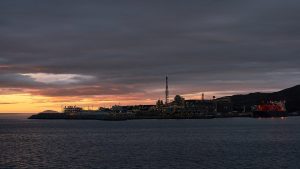
Illustrative image. Photo: NASA Johnson Space Center, Public domain, via Wikimedia Commons — source



[…] Riyadh strikes compound a broader conflict that has already drawn in tanker traffic through the Strait of Hormuz and unsettled global energy markets for weeks. The International Monetary Fund has flagged the […]
[…] The current wave of attacks is the latest chapter in a conflict that began in February 2026, when US and Israeli strikes hit targets inside Iran. The United States and Iran reached a memorandum of understanding in June outlining a framework to end the fighting, but the truce did not hold: renewed Iranian attacks on shipping in the strait prompted a resumption of US military operations over the summer, and diplomatic efforts have been stalled since, as TheDailyEnergy reported earlier this week. […]
[…] link between the Gulf and Japanese utility bills has become a recurring theme this month: tanker attacks near the strait have continued even as talks between Washington and Tehran have stall…, and oil prices have swung within a five-month range as traders weigh the risk of further […]
[…] claims near Hormuz through the year, including a round of tanker strikes in mid-October that coincided with a stall in Iran war talks, and an attack late last month that helped push Brent to a six-month high and capped its fourth […]