Brent Settles at a Six-Month High as Hormuz Tanker Attack Caps Fourth Monthly Gain


Brent crude finished October at its highest level in six months. The expiring December futures contract settled on Friday, October 30, up 2.4% at $117.64 a barrel after briefly touching $118, as a fresh attack on a tanker near the Strait of Hormuz and uncertainty over Washington’s next step against Iran kept a heavy risk premium in prices. US benchmark West Texas Intermediate rose 2.08% to settle at $104.12.
The more actively traded January Brent contract gained 2.37% to $113.43, according to The National’s market report. That leaves a gap of roughly $4 a barrel between the expiring month and the next one, a structure that typically signals scarce prompt supply. Both benchmarks ended the week about 0.8% higher and booked a fourth consecutive monthly gain, with October’s advance running into double digits in percentage terms.
Hull-mounted explosives off Khasab
The latest jolt came late on Thursday. The UK Maritime Trade Operations centre (UKMTO) said a small boat approached an outbound tanker about 25 nautical miles northeast of Khasab, on Oman’s Musandam peninsula, and attached two explosive devices to its hull above the waterline. The blasts set off an engine-room fire that temporarily disabled the ship. UKMTO later said the crew was safe, there was no environmental impact and the fire had been put out, with the vessel continuing to its next port. The agency also corrected an earlier report that the tanker had been struck by a projectile.
Iran’s Islamic Revolutionary Guard Corps (IRGC) has meanwhile claimed that tankers struck naval mines in the strait while using what it called “unauthorised” routes. The number of vessels cited has varied between reports, none of the claims has been independently verified, and the IRGC has disputed statements by US Central Command that the main transit lanes had been cleared. The incidents extend a run of attacks on merchant shipping that hit a monthly record earlier in October, while Houthi forces have continued to target Saudi oil infrastructure.
Washington’s mixed signals
The war with Iran, which began with US military operations on February 28, is now in its ninth month. President Donald Trump has said the United States would not strike Iran before the November 3 midterm elections, while also warning that strikes could resume afterwards. Strategists at ANZ said the prospect of renewed fighting after the vote adds uncertainty to an already fragile physical crude market, Bloomberg reported.
Diplomacy is running in parallel. Qatari mediators returned to Tehran this week to continue efforts toward a US-Iran agreement, The National reported, quoting an Iranian official as saying the country “welcomes any efforts aimed at negotiations, talks or collective consultation.” After regular trading closed on Friday, Trump said: “Peace talks are under way. We have time.” WTI and January Brent gave back part of the day’s gains in after-hours trading, according to Bloomberg, a reminder of how sensitive prices remain to statements from Washington.
Emergency stocks close to fully deployed
Government reserves have been the main policy buffer since the conflict disrupted Gulf exports. On October 29, the US Department of Energy awarded exchange contracts for more than 40 million barrels from the Strategic Petroleum Reserve, to be supplied from the Big Hill and Bryan Mound storage sites in Texas. The department said the awards complete its commitment to release 172 million barrels, the US share of a coordinated 400-million-barrel drawdown by International Energy Agency member countries.
Because the barrels are lent rather than sold, companies must return them with a premium. DOE said it has secured the return of more than 216 million barrels, including 44 million premium barrels, starting early next year. Bloomberg reported that cumulative US releases since the war began have reached 174.1 million barrels, leaving the reserve at its lowest level since 1982, and that Energy Secretary Chris Wright has signalled another drawdown is unlikely. Wright said earlier in the week that releases would “spill into January” before refilling begins. Trafigura and ExxonMobil were among the winning bidders in the final round, Bloomberg reported, citing the department.
OPEC+ core group meets on Sunday
The next scheduled marker is Sunday, November 1, when the seven core OPEC+ producers — Saudi Arabia, Russia, Iraq, Kuwait, Algeria, Kazakhstan and Oman — hold an online meeting to review the market. At their previous session on October 4 they left November targets unchanged. Those quotas carry less weight than usual: OPEC data cited at the time showed the seven pumping about 25 million barrels per day in August, roughly 5 million b/d below February’s pre-war level, with Gulf exports running at 60% to 80% of normal, according to Reuters reporting carried by CNBC. Sources quoted in that coverage said output policy changes were unlikely before 2027, partly because a review of members’ production capacity has been delayed by the war.
Where the higher prices are showing up
The rally is already visible in company results. Refining has been the standout earner this reporting season: Chevron said on October 30 that its US refineries ran at a record 1.09 million barrels per day in the third quarter, while BP and Shell both credited sharply wider refining margins for their profit gains. Brent averaged $97 a barrel in the July–September quarter, according to Chevron’s results release, well below where the benchmark closed October, which suggests the price effect on fourth-quarter results could be larger still if current levels hold.
For importers, the picture is the reverse. With the expiring Brent contract near $118 and the prompt spread wide, buyers that rely on spot cargoes face the steepest costs heading into the Northern Hemisphere winter, when heating and diesel demand peak.
Sources
- The National, “Oil prices set for sharp monthly rise on Hormuz strikes and US threat to hit Iran”, October 30, 2026 — thenationalnews.com — settlement prices for December and January Brent and WTI, weekly change, IRGC mine claim, Qatari mediation and Iranian official’s comment.
- OilPrice.com, “Brent Hits $117 as Tanker Catches Fire in Strait of Hormuz”, October 30, 2026 — oilprice.com — UKMTO details on the location of the attack, the explosive devices, crew safety and the IRGC dispute with US Central Command.
- Bloomingbit, summary of Bloomberg market reporting, “Brent Nears $118, Extends Gains to Fourth Month on Fears of Wider Iran Conflict”, October 30, 2026 — bloomingbit.io — Trump’s after-hours remarks, after-hours price moves and ANZ strategists’ comments.
- US Department of Energy, “Energy Department Awards Contracts from the Strategic Petroleum Reserve as Part of President Trump’s Emergency Exchange”, October 29, 2026 — energy.gov — primary source for SPR award volumes, storage sites, the 172-million-barrel commitment and return volumes.
- Bloomberg via Yahoo Finance, “US Awards Last of Trump’s Massive Strategic Oil Reserve Drawdown”, October 30, 2026 — finance.yahoo.com — cumulative US releases, reserve level versus 1982, winning bidders and Chris Wright’s comments.
- CNBC (Reuters), “OPEC+ agrees to keep November oil output targets steady”, October 4, 2026 — cnbc.com — OPEC+ core membership, November 1 meeting date and August output data.
- Chevron, third-quarter 2026 results (Form 8-K exhibit), October 30, 2026 — sec.gov — average Q3 Brent price and record US refinery throughput.
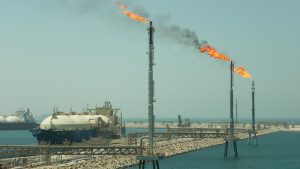
Illustrative image. Photo: U.S. Navy photo by Photographer's Mate 1st Class David C. Lloyd, Public domain, via Wikimedia Commons — source