Oil Prices Dip but Hold Above $100 as Hormuz Tanker Attacks Hit a Monthly Record


Oil prices eased slightly on October 26 but held near five-month highs, with Brent crude at $114.42 a barrel and West Texas Intermediate at $100.97, according to OilPrice.com. The dip comes even as attacks on tankers in the Strait of Hormuz climbed to a record for any single month, underscoring how much of the current price level is now a war-risk premium rather than a reflection of supply and demand fundamentals.
A Record Month for Tanker Attacks
At least 28 vessels have been attacked in the Strait of Hormuz so far in October, according to data from the UK Maritime Trade Operations (UKMTO) and the International Maritime Organization cited by Reuters on October 23. At least 11 of those attacks hit and damaged supertankers, the very large crude carriers that move roughly 2 million barrels each and are already in short supply globally. Because not every attack is reported, the true count is likely higher. Houthi forces based in Yemen claimed fresh strikes on Saudi oil infrastructure and an airport over the weekend, continuing a campaign that has run alongside ongoing hostilities between the Houthis and Saudi Arabia and separate Iranian attacks on tankers transiting the Gulf.
The Strait of Hormuz carries roughly a fifth of global oil consumption, mostly Gulf crude bound for refiners in Asia, which makes it the world’s single most consequential chokepoint for seaborne oil. Damage to 11 supertankers in one month does not just threaten the vessels’ cargo; it also tightens an already-stretched VLCC fleet, which in turn pushes up freight rates and war-risk insurance premiums that are then passed through to the delivered price of crude.
Prices Still Far Above Where They Started 2026
Even after the latest dip, both benchmarks remain dramatically higher than where they began the year: Brent was trading under $60 at the end of 2025, and WTI was below $60 as well. WTI touched a 2026 high above $112 in April. Brent had traded above $116 just the week before this latest pullback. OilPrice.com’s Irina Slav described the pattern as “a series of climbs, interspersed with declines,” with the declines so far consistently smaller than the climbs that preceded them — a trend she called concerning if it continues, since it points to a market that keeps resetting higher even as it occasionally cools off.
Physical crude prices, as distinct from futures, have actually slipped over the past couple of weeks from their earlier-2026 highs, suggesting some of the risk premium already embedded in the market is being worked through even as the attacks themselves escalate. That divergence between a record month for tanker attacks and a modest pullback in spot prices is itself a sign of how much geopolitical risk is already priced in.
Part of a Broader Pattern on The Daily Energy’s Coverage
The escalation tracks closely with developments this site has covered through October: Brent neared $110 on October 21 after Iran claimed new Hormuz attacks and the Houthis claimed strikes on Aramco’s Yanbu and Shaybah facilities, and Saudi Arabia’s crude output hit a record low on October 22 even as its exports rebounded, as the kingdom redirected barrels toward meeting contractual obligations abroad. Japan separately reported its trade deficit nearly doubling as the Hormuz-driven energy cost spike raised its import bill. Together, the data points to a Gulf oil market that is absorbing real, escalating physical risk rather than reacting to a single headline event.
Sources
- OilPrice.com, Irina Slav, “Oil Prices Dip but Hold Above $100 as Middle East Supply Threats Mount,” Oct. 26, 2026 — price levels, tanker-attack data and market commentary
- Reuters, Oct. 23, 2026, cited via OilPrice.com — tanker-attack count sourced from UK Maritime Trade Operations and the International Maritime Organization
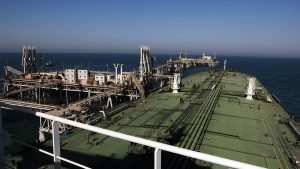
Illustrative image. Photo: U.S. Navy photo by Photographer's Mate 1st Class David C. Lloyd, Public domain, via Wikimedia Commons — source