Shell’s Adjusted Earnings Jump to $10.8 Billion in Q3 2026 as Refining Margins Hit Records

Shell plc reported adjusted earnings of $10.8 billion for the third quarter of 2026, up 10% from the second quarter and more than double the $5.4 billion booked a year earlier, as refining margins reached their highest level since the 2022 energy crisis and the company’s gas business absorbed a full quarter of output from the newly acquired ARC Resources assets in Canada. The London-based major, one of the world’s six integrated oil and gas supermajors, disclosed the results in a Form 6-K filed with the U.S. Securities and Exchange Commission on October 29, 2026, alongside a new $5.0 billion share buyback programme.
Refining did the heavy lifting
Within Shell’s Chemicals and Products division, adjusted earnings rose to $3.86 billion from $2.88 billion in the second quarter and just $550 million a year earlier, with the Products side of that business — mainly fuel refining and trading — contributing $3.75 billion on its own. Shell had flagged the move in an October 7 trading update, estimating its indicative refining margin at roughly $42 a barrel for the quarter, up from $24 in the second quarter and above its previous peak during 2022’s post-invasion fuel crunch. The company attributed the squeeze to constrained fuel flows out of the Middle East and Russia’s restrictions on diesel exports, which tightened European product markets ahead of winter. Refinery utilisation nonetheless slipped to 96% from 102% in the second quarter, partly because low water levels on the Rhine River curbed throughput at Shell’s Rheinland refinery in Wesseling and Godorf, Germany — one of the company’s largest continental European sites.
Gas and upstream added a smaller, steadier gain
Adjusted earnings from Integrated Gas rose to $3.04 billion from $2.69 billion in the second quarter, with Shell citing a full quarter’s contribution from ARC Resources, the Canadian gas producer it completed acquiring in early September, as part of the reason its integrated gas production guidance moved up to between 740,000 and 780,000 barrels of oil equivalent per day. Upstream earnings eased slightly to $3.19 billion from $3.49 billion in the prior quarter but remained far above the $1.80 billion recorded a year earlier. Shell’s Renewables and Energy Solutions division, still its smallest by far, posted $289 million in adjusted earnings against $79 million in the second quarter.
A bigger payout, a lighter capital load for now
Shell said income attributable to shareholders reached $12.1 billion for the quarter, including a $0.4 billion current cost-of-supplies gain, while cash flow from operations held steady at $21.0 billion. Cash capital expenditure nearly doubled to $7.9 billion from $4.2 billion in the second quarter. The company repurchased $3.2 billion of its own shares during the quarter and announced it will run a fresh $5.0 billion buyback programme through its fourth-quarter results announcement, continuing a run of continuous quarterly repurchases that has become a hallmark of Shell’s capital returns policy since 2023.
Marketing and trading held up even as fuel margins ran hot
Shell’s Marketing segment, which sells fuels, lubricants and other products directly to consumers and businesses, posted $1.16 billion in adjusted earnings, down from $1.33 billion in the second quarter but still above the $1.32 billion recorded a year ago, suggesting that higher wholesale product prices squeezed retail margins even as refining itself boomed. The company’s Corporate segment, which captures items such as interest costs and currency effects rather than an operating business, recorded a $705 million adjusted loss, wider than the $617 million loss in the second quarter. Basic earnings per share for the quarter came to $2.15, against $1.94 in the second quarter and $0.91 a year earlier, while adjusted earnings per share reached $1.93.
Shell’s revenue for the quarter was $92.8 billion, essentially flat against the second quarter’s $94.7 billion despite the jump in profitability, reflecting that the earnings gain came from wider margins rather than from higher volumes or prices across the board. The quarter’s net gearing and balance-sheet metrics were not broken out in the headline release, but the near-doubling of capital expenditure to $7.9 billion — alongside the $3.2 billion of buybacks already executed and a further $5.0 billion authorised — points to a company redirecting a larger share of its windfall toward both reinvestment and shareholder returns at the same time, rather than banking the gain as cash.
Part of a wider pattern among Europe’s oil majors
Shell’s jump mirrors what rivals have reported for the same quarter: Eni, for instance, told investors its own adjusted profit doubled to €2.8 billion as its refining margins recovered over the same three months. The common driver across the sector is the same fuel-market tightness that pushed European governments to discuss releasing emergency diesel stocks ahead of winter — a squeeze that, for refiners with spare capacity to run, has translated directly into the strongest margins since 2022. Shell’s results are the first full quarterly release among the supermajors to show the scale of that windfall across both upstream and downstream operations simultaneously.
Sources
- Shell plc, Form 6-K, “Quarterly Results Announcement for the Period Ended 30 September 2026,” filed with the U.S. SEC on October 29, 2026 — for adjusted earnings, segment breakdown, income attributable to shareholders, cash flow, capital expenditure and the new buyback programme.
- Shell plc, Q3 2026 trading update, October 7, 2026 — for the indicative refining margin estimate, refinery utilisation outlook and the Rhine River/Rheinland refinery context.
- Oilprice.com, “Shell Profits Nearly Double to $10.8 Billion as Refining Margins Hit Record,” October 29-30, 2026 — for independent confirmation of the headline figure and market framing.
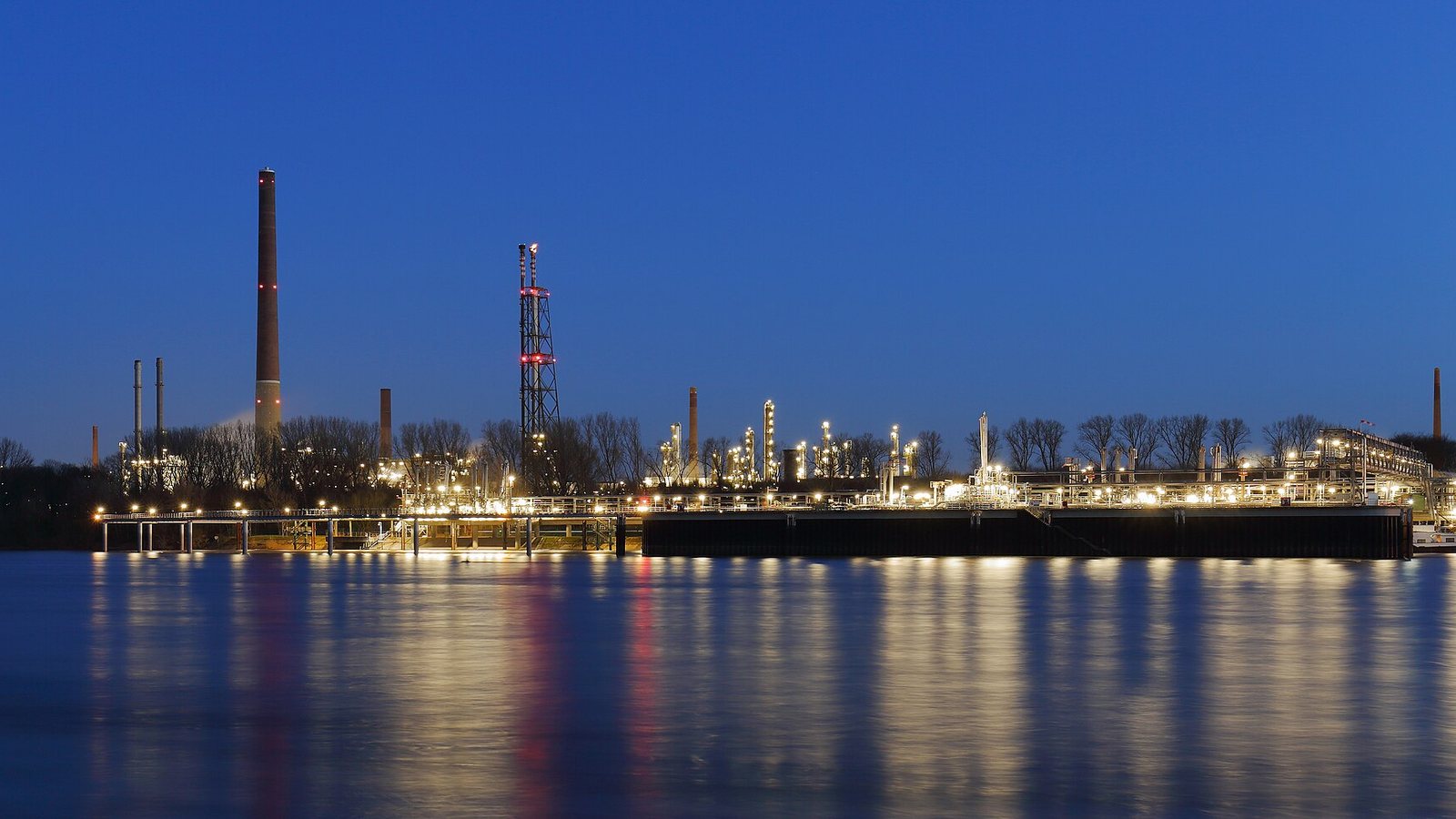
Illustrative image. Photo: Martin Falbisoner, CC BY-SA 4.0, via Wikimedia Commons — source