


How Much Oil Passes Through the Turkish Straits?

Last updated: 2026-10-29
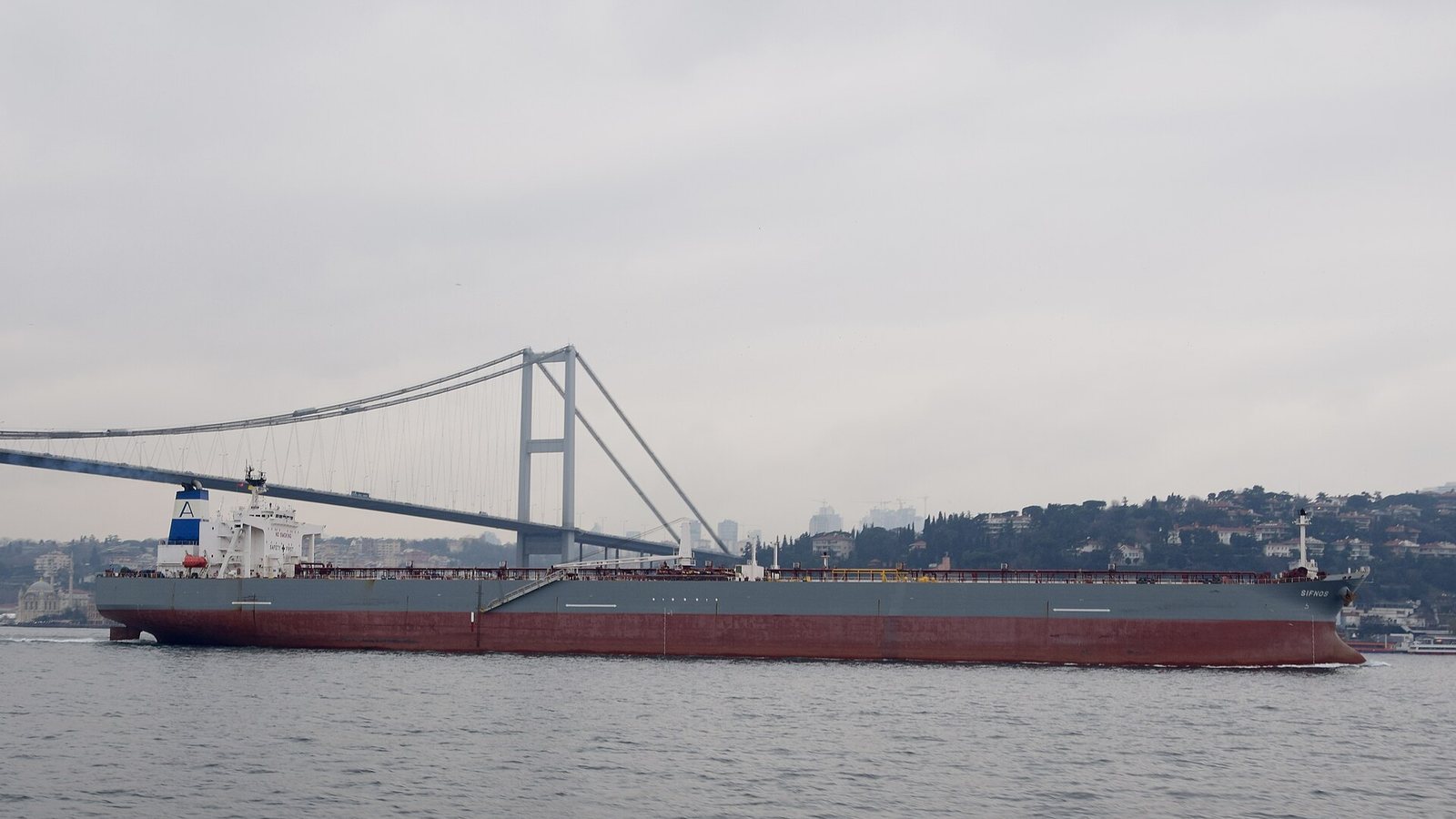
The Turkish Straits — the Bosphorus and the Dardanelles, split by the Sea of Marmara — carried roughly 3.6 million barrels per day (mb/d) of crude and refined products in 2024 and 3.7 mb/d in the first half of 2025, the only seaborne outlet for Black Sea oil (EIA, chokepoint report updated March 2026). Unlike the Strait of Hormuz or Bab el-Mandeb, Turkey cannot legally close the straits to merchant shipping in peacetime: the 1936 Montreux Convention guarantees passage, and Ankara’s leverage runs through safety, insurance and traffic-management rules rather than closure.
Where the straits are and why they matter
The Bosphorus (about 31 km long, as narrow as 700 m) runs through the middle of Istanbul, a city of roughly 16 million people, linking the Black Sea to the Sea of Marmara. The Dardanelles (about 65 km long) connects the Marmara to the Aegean and Mediterranean. Together they are the only maritime route out of the Black Sea for Russian, Kazakh and Romanian crude and products — there is no alternative sea passage, which is what makes the corridor a genuine chokepoint despite carrying less oil than Hormuz.
| Metric | Value | Period | Source |
|---|---|---|---|
| Crude + products transited | 3.6 mb/d | 2024 | EIA World Oil Transit Chokepoints |
| Crude + products transited | 3.7 mb/d | 1H 2025 | EIA World Oil Transit Chokepoints |
| Vessels transited (government count) | 9,195 (–1.7% y/y) | Q1 2026 | Turkish General Directorate of Coastal Safety via Daily Sabah/Türkiye Today |
| Vessels transited, Bosphorus + Dardanelles | 40,988 | 1H 2026 | BTA/Daily Sabah, citing Turkish maritime authorities |
| Satellite-tracked daily Bosphorus transits | ~52–54/day | Sept 2026 | IMF PortWatch (AIS-based) |
| CPC (Novorossiysk) pipeline crude feeding the Black Sea coast | ~1.3–1.7 mb/d | Apr–Dec 2025 | Transneft/CPC via TASS, TradeWinds |
Government vessel counts (port-authority filings) and satellite AIS-based counts use different methodologies and regularly diverge by close to 2x; both are reported here rather than reconciled into one figure. Figures cover all vessel types unless noted; oil-specific transit shares are not separately published by Turkish authorities.
Who exports and who receives
Russia and Kazakhstan are the dominant exporters through the straits. Kazakhstan’s Caspian Pipeline Consortium (CPC) moves the bulk of its crude to the Black Sea terminal at Novorossiysk, from where it loads onto tankers bound through the Bosphorus; CPC shipped more than 65.5 million tonnes in the first eleven months of 2025, with full-year shipments guided to around 72 million tonnes (Transneft/CPC via TASS). Russia also loads crude and products from its own Black Sea ports (Novorossiysk, Taman). On the receiving side, Mediterranean and Southern European refiners (Italy, Greece, Spain) are the largest buyers of Black Sea crude grades, alongside global buyers reached via onward Mediterranean transshipment. Romania (via the Constanța terminal) is a smaller Black Sea exporter.
The legal framework: Montreux, not closure
The straits are governed by the 1936 Montreux Convention, which guarantees merchant vessels freedom of passage in peacetime and gives Turkey security-based discretion rather than a right to close the corridor to civilian shipping. A 2026 legal analysis from Chambers and Partners notes the treaty text itself hasn’t changed, but administrative enforcement has tightened: Turkish Straits Maritime Traffic Regulations in force since August 2019 add reporting and documentation duties, and real-time administrative assessments can delay vessels that meet the formal legal requirements.
Since December 2022, Turkey has required proof of protection and indemnity (P&I) insurance valid for the duration of strait transit from loaded crude tankers — a rule later extended to tankers carrying petroleum products, aimed primarily at vessels carrying Russian-origin oil above the G7 price cap, whose insurers often will not confirm cover (Daily Sabah, Mondaq). The rule doesn’t ban transit outright, but tankers lacking a valid P&I letter have been held in anchorage queues off Istanbul, sometimes for weeks.
Alternative routes
Unlike Hormuz, which has partial bypass pipelines (Saudi East-West, UAE’s Habshan-Fujairah), the Turkish Straits have no seaborne alternative for Black Sea crude — that is precisely why a relatively modest 3.6–3.7 mb/d counts as a chokepoint. The only real substitutes are overland pipelines that avoid the Black Sea loading step entirely: the Baku-Tbilisi-Ceyhan (BTC) pipeline carries Caspian (mainly Azerbaijani) crude directly to a Mediterranean terminal at Ceyhan, bypassing the straits altogether, and Kazakhstan has been expanding non-Russian export options such as the Atasu-Alashankou pipeline to China. Neither can absorb Black Sea-loaded Russian or CPC-blended volumes at scale.
Historical disruptions
- 1979 — Independenta disaster: Romanian tanker Independenta collided with a cargo ship in the Bosphorus and exploded, killing dozens and burning for weeks — still cited in Turkish policy debates on strait safety.
- 1994 — Nassia collision: Tanker Nassia collided with a cargo ship near Istanbul, killing around 30 and spilling oil, prompting Turkey’s first major push for stricter traffic rules.
- December 2022 — insurance-rule tanker backlog: Turkey’s new P&I insurance-proof requirement, introduced as the G7 price cap on Russian oil took effect, left dozens of tankers queued off Istanbul; Bloomberg and Reuters reported waits stretching to two weeks at the peak (Bloomberg, Dec 2022).
- November 2025 — CPC terminal drone strike: A Ukrainian drone struck one of the single-point moorings at the CPC marine terminal near Novorossiysk, halting loadings and pushing Kazakhstan and Russia to seek temporary alternative export arrangements before flows partly recovered in December 2025 (TradeWinds, gCaptain).
- January 2026 — strike on a shadow-fleet tanker off the Turkish coast: An uncrewed surface vessel hit the Palau-flagged tanker Elbus off İnebolu on Turkey’s Black Sea coast; the vessel was reported to be part of Russia’s sanctions-evading “shadow fleet” (Naval News, Jan 2026).
Latest verified developments
| Date | Development | Source |
|---|---|---|
| Oct 2026 | A tracking report found at least 12 sanctioned tankers transmitting falsified AIS positions, in one case showing the Russian-flagged tanker Pirop in two places roughly 800 km apart — one reading placed it near the Bosphorus while the vessel was actually elsewhere on the Turkish coast. | Reporting on GPS/AIS spoofing by sanctioned tankers, Oct 2026 |
| Oct 2026 (as of Oct 10) | Ukraine’s government shadow-fleet tracker listed 1,488 vessel entries, including 545 individually identified ships, as carrying sanctioned Russian-origin crude globally; analytics firm Windward separately estimates roughly 1,229 large tankers (20,000+ deadweight tonnes) belong to the fleet, more than three-quarters already under US, UK or EU sanctions. | Ukraine government “War & Sanctions” tracker; Windward via NPR, Oct 2026 |
| Q1 2026 | Bosphorus vessel traffic fell 1.7% year-on-year to 9,195 transits, continuing a gradual multi-year decline in overall vessel counts even as oil-specific chokepoint volumes have been roughly stable to rising. | Turkish maritime authority data via Türkiye Today/PortsEurope |
What we don’t know
- Turkish authorities do not publish a public, continuously updated breakdown of oil-tanker-specific daily transits separate from total vessel counts, which is why this page cites both port-authority totals and AIS-based estimates rather than a single number.
- The exact current scope of Turkey’s P&I insurance-proof rule (which cargo types and flag states it applies to in practice) has shifted administratively since 2022 without a single consolidated public text; treat any specific scope claim as time-stamped, not standing policy.
- How much shadow-fleet tanker traffic specifically transits the Turkish Straits, as opposed to loading directly from Russian Black Sea ports for shorter regional runs, is not separately reported by any single tracker; the 1,229–1,488 fleet-size figures above are global, not strait-specific.
Frequently asked questions
Can Turkey close the Turkish Straits to oil tankers?
Not to ordinary merchant shipping in peacetime. The Montreux Convention guarantees commercial vessels freedom of passage; Turkey’s leverage comes from safety, environmental and insurance rules — such as the P&I insurance-proof requirement introduced in December 2022 — that can delay or effectively exclude specific vessels without a formal closure.
How much oil passes through the Turkish Straits?
The EIA puts total crude and petroleum-product flows at about 3.6 mb/d in 2024 and 3.7 mb/d in the first half of 2025 — smaller than the Strait of Hormuz but with no seaborne alternative route for Black Sea crude.
What is the “shadow fleet” and why does it matter for the straits?
It refers to tankers — often older vessels bought specifically to move sanctioned Russian oil above the G7 price cap — that frequently operate with unclear ownership, non-standard insurance and, per 2026 tracking reports, falsified AIS position data. Their presence raises Turkey’s enforcement burden and collision/spill risk in a narrow urban waterway.
Why can’t Black Sea oil just use a pipeline instead?
Some can: the BTC pipeline moves Azerbaijani Caspian crude to the Mediterranean without transiting the straits. But the bulk of Russian and CPC-blended Kazakh crude loaded at Novorossiysk has no pipeline bypass with comparable capacity, which is why seaborne transit through the Bosphorus and Dardanelles remains the only practical route for those volumes.
This FAQ answers the terms as commonly searched; treat each figure’s date and source as shown above, not as a live, continuously updated reading.
Related The Daily Energy pages
- What Happens If the Strait of Hormuz Closes?
- What Happens If the Bab el-Mandeb Strait Closes?
- Who Supplies Turkey With Natural Gas?
- Why Is Electricity So Expensive in Turkey?
- Akkuyu Nuclear Power Plant: Project Tracker
- Gazprom: Company Profile
Sources
- U.S. Energy Information Administration, World Oil Transit Chokepoints (updated March 2026)
- Turkish General Directorate of Coastal Safety vessel-transit data, via Türkiye Today and Daily Sabah (2026)
- IMF PortWatch, satellite AIS-based transit estimates (September 2026)
- Transneft/Caspian Pipeline Consortium shipment data, via TASS and TradeWinds (2025)
- Chambers and Partners, “Turkish Straits 2026: From Legal Text to Operational Reality” (2026)
- Daily Sabah and Mondaq, reporting on Turkey’s P&I insurance-proof requirement (2022–2025)
- Bloomberg, reporting on the December 2022 tanker insurance-rule backlog
- TradeWinds and gCaptain, reporting on the November 2025 CPC terminal drone strike
- Naval News, reporting on the January 2026 strike on the tanker Elbus off İnebolu
- Reporting on AIS/GPS position-spoofing by sanctioned tankers (October 2026); Ukraine government “War & Sanctions” shadow-fleet tracker; Windward fleet-size estimate via NPR (October 2026)
Illustrative image. Photo: Ank Kumar, CC BY-SA 4.0, via Wikimedia Commons — source


[…] How Much Oil Passes Through the Turkish Straits? […]