


Where Does China Get Its LNG?

Last updated: 10 November 2026 · Last verified: 10 November 2026
China is the world’s second-largest LNG importer, and in 2026 its supplier mix shifted more sharply than in any recent year. Australia has held onto the top spot, but Qatar — long China’s second-largest source — lost more than half its volume after the Strait of Hormuz closed to tanker traffic from March 2026, while Russia’s sanctioned Arctic LNG 2 project and existing Sakhalin-2 terminal pushed Russian shipments to a multi-year high. Chinese customs data and independent trade trackers broadly agree on the direction of the shift, though they differ on the exact scale.
China’s LNG Supply Mix in 2026
China’s General Administration of Customs (GACC) does not publish a single public country-by-country release; the figures below come from GACC data as reported by TASS, and from two independent trade-data trackers covering an overlapping but not identical period. Readers comparing rows should check the “Period” column — the same supplier’s share can look different depending on whether the window is January–July or January–September.
| Period | Australia | Qatar | Russia | Source |
|---|---|---|---|---|
| January–September 2026 (cumulative volumes) | 15.01 Mt, largest supplier (–1.1% y/y) | 4.88 Mt (–65.5% y/y) | 7.19 Mt, 2nd-largest (+44.3% y/y; $3.92bn, +38.5%) | China General Administration of Customs (GACC), via TASS (undated GACC release reported ~Oct 2026) |
| January–July 2026 (cumulative, shares) | 35.6% / 12.6 Mt (+6.3% y/y) | 13.3% / 4.7 Mt (–57.6% y/y) | 12.3% / 4.3 Mt (+31.3% y/y) | Bancosta Weekly Market Report (Week 35/2026), via Global LNG Hub (2 September 2026) |
| January–July 2026 (cumulative, separate dataset) | Remained top supplier (share not restated in this release) | 14.5%, down from 30.7% a year earlier | Share rose to ~12.5%, from 9.5% a year earlier | S&P Global Platts customs-based analysis (11 September 2026) |
Malaysia (6.2 Mt, +26.1% y/y) ranked third in the January–September GACC-based figures, ahead of Qatar. Indonesia supplied 2.46 Mt (–22.8% y/y), and the United States remains a marginal supplier at 0.231 Mt (–11% y/y) — well under 1% of the total. The two January–July datasets also diverge on smaller flows: Global LNG Hub’s breakdown credits ASEAN producers collectively with a 20.0% share and Canada with 4.0% (a new flow, with no cargoes recorded in the same period of 2025), while the S&P Global analysis does not break out those origins. China’s total LNG imports for January–July 2026 are reported as 35.3 million tonnes by Global LNG Hub (down 2.5% y/y) and 33.79 million tonnes by S&P Global (down 4.6% y/y) — a reminder that these are trade-data trackers’ estimates rather than a single official total, though both show imports contracting slightly from 2025. That contraction continues a longer trend: Global LNG Hub put full-year 2025 imports at 68.2 million tonnes, down 13.3% from 2024.
Why Qatar’s Share Collapsed
Qatar’s drop is the single largest change in China’s 2026 supplier mix. Global LNG Hub and S&P Global both tie it to the closure of the Strait of Hormuz to LNG tanker traffic from March 2026, which halted the bulk of Qatari exports that normally transit the chokepoint from the North Field. The two trackers put Qatar’s January–July share at 13.3% and 14.5% respectively — both roughly half of its 30.7% share in the same period of 2025 — and the year-on-year volume decline is reported at –57.6% (Global LNG Hub) to –65.5% for the longer January–September window (TASS/GACC). Qatar has not disappeared from the Chinese market, but 2026 marks the clearest break yet in a long-term supply relationship that had made it China’s second-largest LNG source for most of the previous decade.
Russia’s Rising Share
Russia’s shipments to China grew fastest among all major suppliers in 2026, rising 44.3% y/y in the January–September GACC-based data and 31.3% in the overlapping January–July Global LNG Hub dataset. Two Russian projects are driving the increase. Sakhalin-2, an established, unsanctioned terminal, continues regular deliveries to China’s Rudong terminal (operated by PetroChina) alongside South Korea’s Tongyeong terminal. Arctic LNG 2 — sanctioned by the United States and still constrained by a shortage of ice-class carriers able to serve it — has ramped up more slowly, but ship-tracking reports cited by trade press through mid-2026 describe its cargoes as going almost exclusively to Chinese buyers, who have been willing to take sanctioned volumes that Japanese and European buyers have avoided. Russia’s share of China’s LNG imports is still well behind Australia’s, but the gap with Qatar has narrowed sharply over the course of the year.
Why Australia Still Leads
Australia has kept its position as China’s largest LNG supplier throughout 2026, with volumes essentially flat (–1.1% y/y in the GACC-based data) even as China’s overall imports have declined. That stability contrasts with Australia’s exports to other Asian buyers — Japan and South Korea have both increased their purchases of Australian LNG in 2025–2026, while China’s intake from Australia has held steady rather than grown, consistent with China diversifying its marginal supply toward Russia and Malaysia rather than its base-load Australian contracts.
What to Watch Next
Whether Qatar can rebuild its China share will depend on how fully — and for how long — Strait of Hormuz tanker traffic normalizes; if restrictions persist into 2027, the 2026 drop could harden into a permanent reduction in Qatar’s position rather than a temporary disruption. Russia’s trajectory depends heavily on Arctic LNG 2’s ability to secure more ice-class tankers free of US sanctions exposure, which has been the project’s main bottleneck rather than production capacity. Any broader US-China trade or tariff shifts could also affect the marginal LNG volumes China sources from the United States, currently its smallest major supplier at well under 1% of total imports.
Frequently Asked Questions
Where does China get most of its LNG?
Australia is China’s largest LNG supplier in 2026, with roughly 35% of imports in trade-tracker data for January–July, followed by Russia, Malaysia and a sharply reduced Qatar.
Why did Qatar’s LNG exports to China drop in 2026?
Independent trade trackers attribute the drop mainly to the closure of the Strait of Hormuz to LNG tankers from March 2026, which halted most Qatari cargoes that transit the chokepoint; Qatar’s share of China’s imports fell from roughly 30% in January–July 2025 to 13–14.5% in the same period of 2026.
Is Russia replacing Qatar as a supplier to China?
Russia’s shipments to China grew faster than any other major supplier in 2026 (up 31–44% year-on-year depending on the dataset), driven by Sakhalin-2 deliveries and the ramp-up of the sanctioned Arctic LNG 2 project, but its total volume remains below Qatar’s pre-2026 levels and well behind Australia’s.
Does China still import LNG from the United States?
Yes, but only marginally — US volumes fell a further 11–72% year-on-year depending on the period measured, and the US accounted for roughly 0.2% of China’s LNG imports in January–July 2026.
How much LNG does China import in total?
Estimates for January–July 2026 range between 33.8 and 35.3 million tonnes depending on the trade-data tracker, down 2.5–4.6% year-on-year; full-year 2025 imports were about 68.2 million tonnes.
Related The Daily Energy Pages
- Who Buys Russia’s LNG? (Who Powers Who? series)
- Who Buys Qatar’s LNG? (Who Powers Who? series)
- Where Does Japan Get Its LNG? (Who Powers Who? series)
- Where Does South Korea Get Its LNG? (Who Powers Who? series)
- What Is the Strait of Hormuz and Why Does It Matter?
- China Energy Profile: Coal, Oil, Gas and Power (2026)
- What Is LNG and How Does It Work?
Sources
- China General Administration of Customs (GACC) LNG import data, via TASS, “China’s LNG Imports From Russia Up 44.3% in January-September” (~October 2026)
- Global LNG Hub, “China LNG Imports Fall as Supply Mix Shifts,” citing Bancosta Weekly Market Report Week 35/2026 (2 September 2026)
- S&P Global Platts, “Russia Strengthens Foothold in China LNG Market as Qatar Loses Share,” customs-based analysis (11 September 2026)
- Reuters and trade-press ship-tracking reports on Arctic LNG 2 cargo destinations (cited via Baird Maritime, 2026)
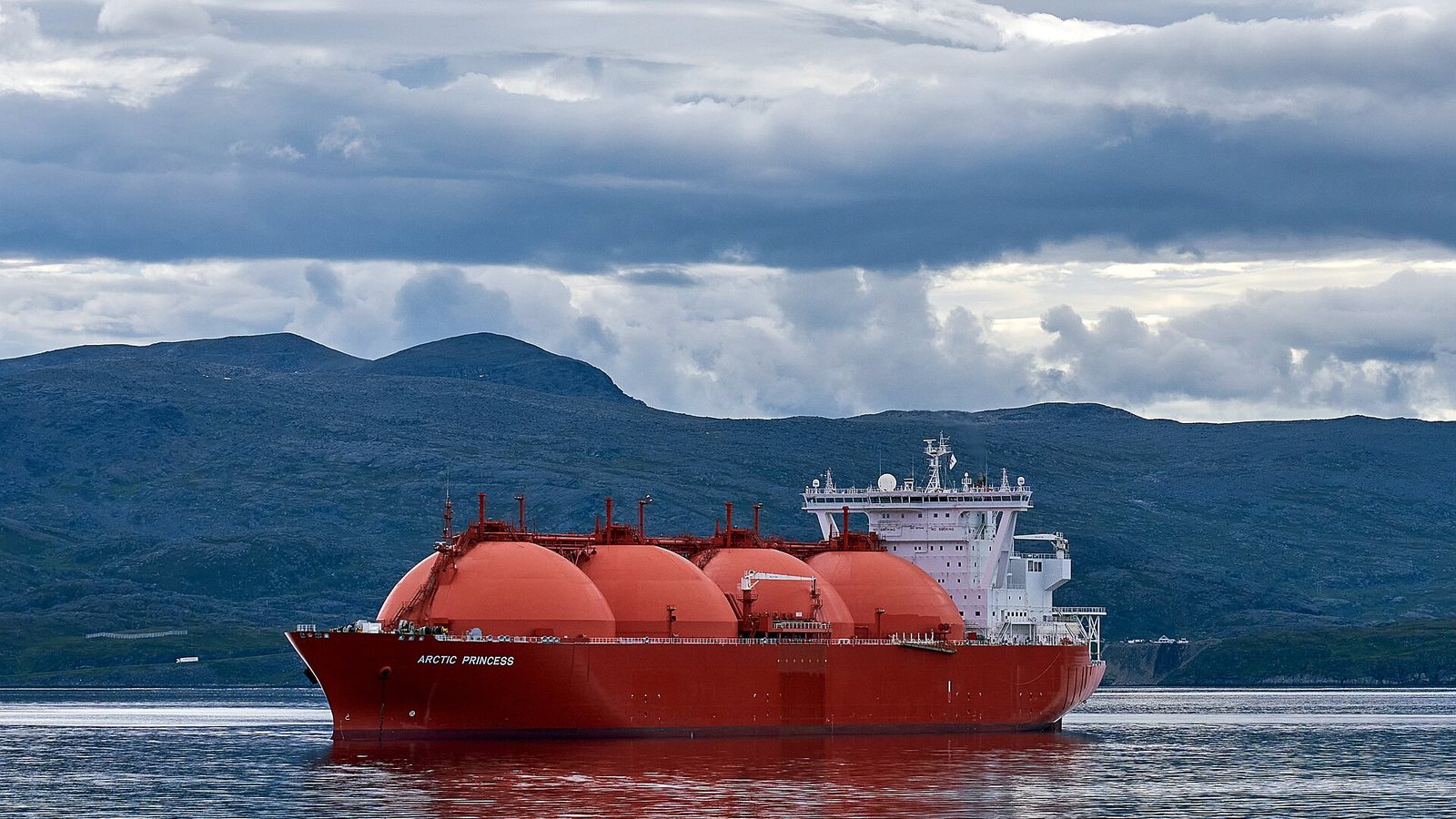
Illustrative image. Photo: Virtual-Pano, CC BY-SA 4.0, via Wikimedia Commons — source




[…] destinations as almost exclusively Chinese, a pattern discussed in more detail on this site’s China LNG importer page. The project has delivered roughly 1.6 million tonnes in the first half of 2026 and about 2 million […]
[…] Where Does China Get Its LNG? (Who Powers Who? series) […]