Inside the North Field, the World’s Biggest Gas Field

Last updated: November 18, 2026
The North Field is a supergiant offshore natural gas reservoir off Qatar’s northeast coast, shared with Iran’s South Pars field as part of a single geological structure the two countries have never jointly developed. QatarEnergy says the Qatari side alone holds roughly 900 trillion cubic feet of recoverable gas — the basis for nearly all of Qatar’s LNG exports and for its ranking as the world’s third-largest holder of proved natural gas reserves.
Where Is the North Field?
The North Field (also called North Dome) lies offshore in the Persian Gulf, roughly 80 km north-northeast of Qatar’s coast, straddling the maritime boundary with Iran. The combined North Dome/South Pars structure covers about 9,700 square kilometres, of which Qatar’s North Field accounts for roughly 6,000 sq km and Iran’s South Pars the remaining 3,700 sq km. Despite sitting on a single reservoir, Qatar and Iran have never unitised production — each country drills and produces from its own side independently, which has periodically raised questions about reservoir depletion and pressure effects crossing the maritime line.
Discovery and Development History
Qatar Shell discovered the field in 1971. For nearly a decade afterward, low gas prices and the absence of a nearby export market led international assessments, including US Geological Survey work, to treat the find as commercially marginal. That changed through the 1990s: Qatar built its first LNG trains at Ras Laffan Industrial City under the Qatargas venture (first LNG cargo in 1996–97) and later RasGas, created in 1993, as Asian buyers — especially Japan and South Korea — signed long-term contracts that justified the capital cost of liquefaction.
In 2005, Qatar imposed a self-declared moratorium on new North Field development, saying it needed time to study reservoir pressure and depletion rates before approving further offtake. The moratorium held for twelve years; QatarEnergy (then Qatar Petroleum) lifted it in April 2017, clearing the way for the North Field Expansion projects now under construction.
Operator and Ownership
QatarEnergy, the state hydrocarbons company, holds the upstream concession and operates the offshore field from platform complexes including North Field Bravo (NFB) and RasGas Alfa (RGA). Onshore, the LNG trains at Ras Laffan are run by QatarEnergy LNG — the company formed by the 2018 merger of Qatargas and RasGas and rebranded from “Qatargas” in September 2023. Individual LNG trains and the new expansion phases are held through separate joint-venture companies in which QatarEnergy typically retains 65–75% and international majors hold the balance: ExxonMobil, Shell, TotalEnergies, Eni and ConocoPhillips all hold minority stakes across various North Field ventures and expansion phases, with specific percentages varying by project.
How Big Are the North Field’s Reserves?
Reserve estimates vary depending on methodology and how much of Iran’s adjoining South Pars is counted, so treat the figures below as estimates from different sources rather than a single agreed number.
| Metric | Figure | Source / Year |
|---|---|---|
| Qatar national proved natural gas reserves | ~843 trillion cubic feet (Tcf) | US EIA, as of Dec. 2022 |
| North Field recoverable gas (QatarEnergy estimate) | ~900 Tcf | QatarEnergy; cited as the world’s largest non-associated gas field |
| Additional gas found in new seismic survey | ~240 Tcf | Energy Minister Saad al-Kaabi, 2024 |
| Qatar’s total reserves after revision | >2,000 Tcf | Qatari government estimate, 2024 |
| Combined North Dome / South Pars area | ~9,700 km² (Qatar ~6,000 km², Iran ~3,700 km²) | Industry geological surveys |
The gap between the EIA’s 843 Tcf “proved reserves” figure and QatarEnergy’s 900 Tcf-plus “recoverable” figures reflects different reserve classifications rather than a contradiction — proved reserves are a more conservative, bookable category, while recoverable estimates include gas the operator is confident it can eventually produce. Either way, the North Field alone is consistently ranked as the single largest non-associated natural gas field in the world, meaning it produces gas without being tied to oil production.
From Field to Tanker: Infrastructure
Gas from the North Field flows to Ras Laffan Industrial City, Qatar’s purpose-built energy complex about 80 km north of Doha, where it is processed and liquefied. Before the 2026 disruptions described below, Ras Laffan hosted 14 LNG trains with a combined nameplate capacity of about 77 million tonnes per year (mtpa) — the largest single LNG export complex in the world — alongside Pearl GTL (one of the world’s largest gas-to-liquids plants), domestic gas-fired power generation, and petrochemical and NGL production that supply Qatar’s own economy as well as export markets.
The North Field Expansion: NFE, NFS and NFW
Since the 2017 moratorium lift, QatarEnergy has pursued a three-phase expansion intended to raise total LNG capacity from 77 mtpa to roughly 142 mtpa by the early 2030s.
| Phase | Added capacity | Trains | International partners | Status (as reported) |
|---|---|---|---|---|
| North Field East (NFE) | 32 mtpa | 4 × 8 mtpa | TotalEnergies, Shell, ExxonMobil, ConocoPhillips, Eni (minority stakes) | Under construction; originally targeted for first LNG in 2026, now reported delayed amid 2026 conflict-related disruption |
| North Field South (NFS) | 16 mtpa | 2 × 8 mtpa | TotalEnergies 9.375%, Shell 9.375%, ConocoPhillips 6.25% (25% combined; QatarEnergy holds 75%) | Under construction; original 2027 start date subject to the same disruption risk as NFE |
| North Field West (NFW) | 16 mtpa | Not yet finalised | Not yet announced | EPC contract awarded Feb. 2026; in engineering phase; construction expected to begin around 2027, per the energy minister |
Pre-conflict trade press put NFE and NFS together at roughly 48 mtpa of new capacity, lifting Qatar to about 126 mtpa before NFW’s additional 16 mtpa brings the total toward 142 mtpa. Contractors Chiyoda and Technip Energies have been named on the NFE EPC work; as of mid-2026 reporting, one process train was in commissioning and a second was structurally complete, though timelines have slipped as a result of the events below.
Current Status: War Damage and the Hormuz Bottleneck (2026)
The North Field expansion and Qatar’s existing LNG output have both been disrupted by the wider US/Israel-Iran conflict that escalated after strikes on Iranian targets on February 28, 2026. In March 2026, Iran struck Qatar’s Ras Laffan LNG complex, which QatarEnergy and Qatari officials characterized as retaliation for an Israeli strike on Iran’s adjoining South Pars field. QatarEnergy CEO Saad al-Kaabi said the attack damaged Trains 4 and 6 — about 12.8 mtpa, or roughly 17% of Qatar’s LNG export capacity — along with one of the two process trains at Pearl GTL, and estimated repairs could take three to five years; QatarEnergy indicated it would seek long-term force majeure on affected contracts. Independent analysis from Wood Mackenzie later put the realistic repair window for some of the damaged units at closer to a year, and satellite thermal-imaging analysis cited in trade press suggested a faster, uneven restart was under way by mid-2026.
Construction on North Field East also stopped in the immediate aftermath, with contractor Chiyoda suspending work before reportedly resuming around May 2026. A separate, apparently unrelated incident — an explosion during restart operations at Ras Laffan on June 22, 2026 — killed 13 workers and injured dozens more, adding further uncertainty to the recovery timeline. By August 2026, Wood Mackenzie had estimated the 12 undamaged trains could return to full service, but reporting through September and into November 2026 describes the recovery as partial and fragile rather than complete.
Even where onshore repairs have progressed, the Strait of Hormuz — the only export route for all Qatari LNG — has itself become the binding constraint. Attacks on commercial shipping in and around the strait continued through November 2026: an ADNOC-operated vessel and a separate LPG tanker were both struck on November 11–12, leaving one crew member missing and eleven injured, and Iran and Oman held fresh talks in Muscat on November 17, 2026 aimed at containing the crisis, after October recorded the highest number of reported tanker attacks since the conflict began in February. The knock-on effects reach LNG buyers directly: Pakistan had to relaunch a tender for winter LNG cargoes in mid-November 2026 because Qatari supply remained disrupted. Readers should treat all of the above as a live, disputed situation — see TDE’s Strait of Hormuz page and rolling news coverage for the latest developments.
Why the North Field Matters
The North Field is the foundation of Qatar’s position as one of the world’s two or three largest LNG exporters, and hydrocarbon revenue — overwhelmingly gas-derived — has accounted for roughly 83% of Qatari government revenue in recent reporting. Because the field is Qatar’s only major gas resource and Ras Laffan is its only LNG export point, with the Strait of Hormuz the only sea route out, the North Field illustrates how a single geological structure, a single industrial complex and a single maritime chokepoint can concentrate an outsized share of global gas supply — and how exposed that supply becomes when any one of the three is disrupted.
Frequently Asked Questions
How big is Qatar’s North Field?
QatarEnergy estimates the Qatari side of the field holds about 900 trillion cubic feet of recoverable natural gas, making it the world’s largest non-associated gas field. A 2024 government estimate, after new seismic surveys, put Qatar’s total gas reserves (including later finds) above 2,000 Tcf.
Is the North Field the same as South Pars?
They are part of the same geological structure, known jointly as North Dome/South Pars, which straddles the maritime boundary between Qatar and Iran. Qatar calls its roughly 6,000 sq km share the North Field; Iran calls its roughly 3,700 sq km share South Pars. The two countries have never unitised production from the shared reservoir.
Why was there a moratorium on North Field development?
Qatar halted new North Field development from 2005 to 2017 to study reservoir pressure and depletion before approving further production increases. QatarEnergy lifted the moratorium in April 2017, which paved the way for the North Field East, South and West expansion projects.
How has the 2026 Iran conflict affected the North Field and Qatar’s LNG exports?
Iranian strikes on Ras Laffan in March 2026 damaged two LNG trains (about 17% of capacity) and halted North Field East construction for a period; QatarEnergy’s CEO estimated years for full repair of the damaged trains. Even where onshore facilities have partially recovered, continuing attacks on shipping in the Strait of Hormuz — Qatar’s only export route — have kept LNG deliveries disrupted into November 2026.
Related The Daily Energy Pages
- What Is LNG?
- QatarEnergy
- QatarEnergy Explained: LNG Giant and Global Strategy
- Strait of Hormuz
- Qatar’s Energy Sector: LNG, North Field and Exports
- Inside Ghawar, the World’s Largest Oil Field
- ExxonMobil
- Pakistan Relaunches LNG Tender for Winter Cargoes as Qatari Supply Stays Disrupted
Sources
- US Energy Information Administration (EIA), Qatar Country Analysis Brief (reserves data as of Dec. 2022)
- QatarEnergy and QatarEnergy LNG official statements and corporate-structure disclosures
- Statements by Qatari Energy Minister Saad Sherida al-Kaabi, 2024 and 2026
- Wood Mackenzie analysis on North Field expansion and 2026 conflict impact, reported via Hellenic Shipping News, World Oil and LNG industry press
- Argus Media and MEES reporting on North Field East/South contractor status (Chiyoda, Technip Energies), 2026
- Reuters, S&P Global Commodity Insights, gCaptain, Oman Observer and Al Jazeera reporting on the 2026 Strait of Hormuz crisis and Ras Laffan strikes
- The Daily Energy reporting: ADNOC tanker attack (Nov. 18, 2026), Iran-Oman Hormuz talks (Nov. 17, 2026), Pakistan LNG tender (Nov. 13, 2026)
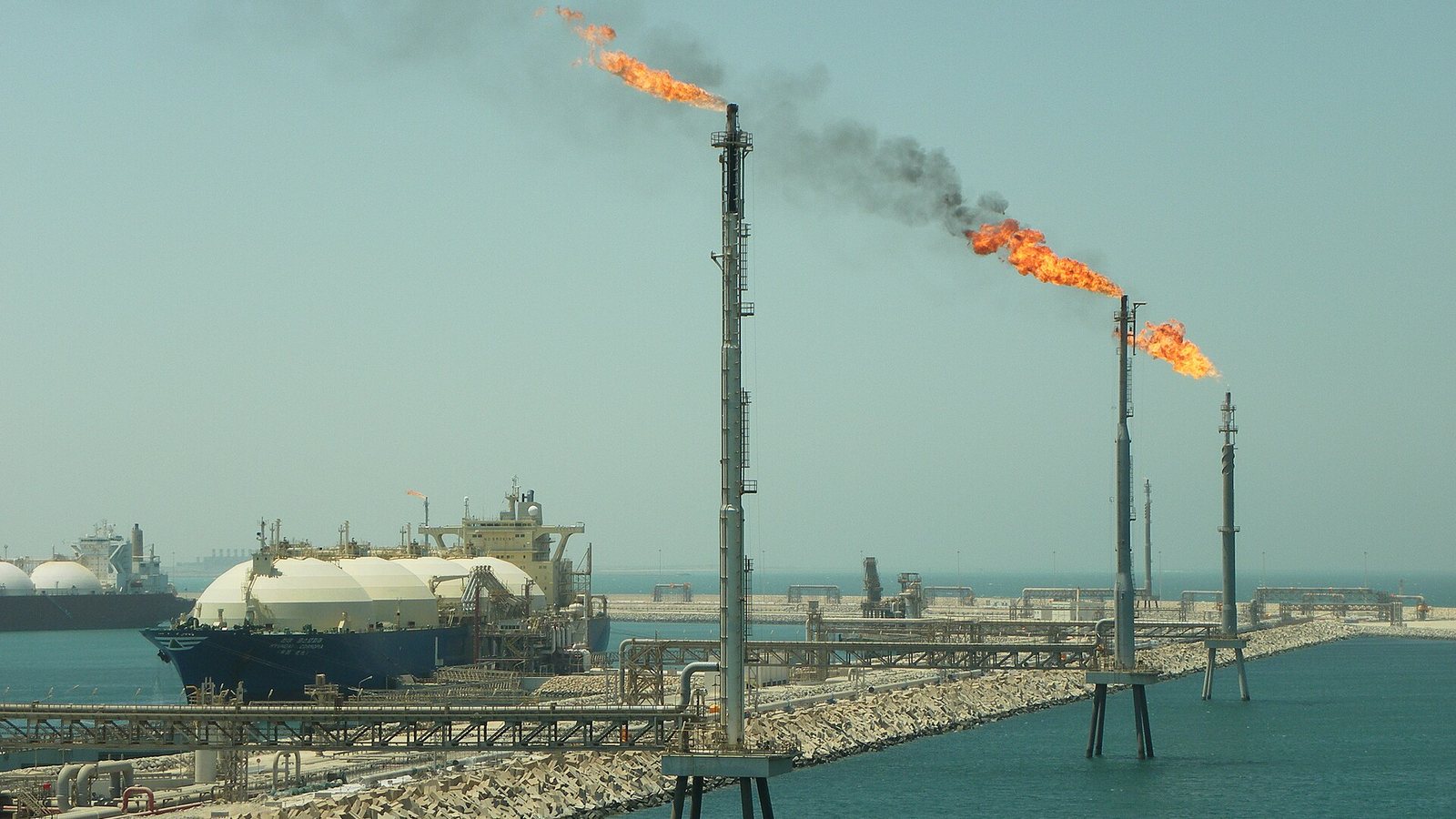
Illustrative image. Photo: Matthew Smith @ Flickr, CC BY 2.0, via Wikimedia Commons — source