


Ukraine Drone Strikes Knock Out Two Russian Refineries in Perm and Rostov


Ukrainian drones knocked two Russian oil refineries offline on Friday, September 25, in one of the most geographically dispersed strikes yet in Kyiv’s monthslong campaign against Moscow’s fuel-processing infrastructure. The Lukoil-operated refinery in the Perm region of the Ural Mountains and the Novoshakhtinsk refinery in the Rostov region, roughly 1,500 kilometers apart, were both forced to halt operations, regional governors confirmed, deepening the strain on a Russian refining sector already squeezed by an extended domestic diesel export ban.
Two refineries, one night, 1,500 kilometers apart
Perm region governor Dmitry Makhonin and Rostov region governor Yury Slyusar each confirmed the strikes on their respective facilities via official channels on Friday. Novoshakhtinsk, which processes around 110,000 barrels of crude per day, was damaged and halted operations, Slyusar said. The Perm strike marked one of the deepest penetrations of Ukrainian drones into Russian territory to date, hitting a refinery roughly 1,450 kilometers from the Ukrainian border.
Russia’s Defense Ministry said it intercepted 592 Ukrainian drones nationwide, including over annexed Crimea, between Thursday night and Friday morning, an unusually high figure that underscores the scale of the overnight barrage. Beyond the two refineries, drones also struck an electronics plant in Ulyanovsk that manufactures communications and radio components, and a synthetic rubber facility in Voronezh was reported damaged. Ukrainian officials said at least two people were killed in Russia in connected strikes, one in the Perm region and one in Belgorod, while at least eight were injured in Ulyanovsk.
Part of a sustained refinery campaign
Friday’s strikes extend a systematic Ukrainian effort, running for much of 2026, to degrade Russia’s capacity to refine crude into diesel and jet fuel for its military and domestic market. Kyiv has previously hit refineries near Moscow and in Yaroslavl. In response to the cumulative damage and resulting shortfalls, Russia has kept diesel export restrictions in place since July and has signaled they will extend through October 31, 2026 — a sign that the refinery campaign is having a measurable effect on the country’s fuel-export capacity, independent of the battlefield.
The dual strike also lands awkwardly for Moscow diplomatically. It came even as U.S.-mediated talks between Washington and Tehran over reopening the Strait of Hormuz were unfolding in New York this week, and as separate Russia-Ukraine contacts continue on the margins of the broader war. Neither refinery strike appears connected to the Hormuz talks, but both add to a global oil-supply picture already under pressure from the Gulf standoff.
A campaign that has forced Moscow into rationing
Ukraine’s refinery campaign has been running in waves since early 2026, targeting facilities from the Baltic coast to the Volga basin and now, with Friday’s strike, deep into the Urals. Each successful hit forces Russian operators through the same costly cycle: idling damaged distillation units, rerouting crude to refineries still online, and drawing down fuel stocks that would otherwise be exported. The cumulative effect has been visible in policy rather than headline production figures — Moscow’s decision to keep diesel export curbs in place since July, and to extend them again through the end of October, is widely read by analysts as evidence that the campaign is squeezing exportable surplus even where individual refineries eventually resume partial operations.
Why two mid-sized refineries matter to the market
Neither Novoshakhtinsk nor the Perm plant ranks among Russia’s largest refineries, and neither strike is being described by officials as catastrophic to national output. But the pattern matters more than any single facility: repeated, geographically spread hits force Russian refiners into a costly cycle of repair, rerouting and rationing, and they help explain why Moscow has been unwilling to lift its diesel export ban even as it seeks hard-currency revenue. For traders, the strikes are one more variable layered on top of an oil market already volatile due to the Gulf standoff — a dynamic similar to the one that forced Saudi Arabia to reroute crude via its East-West pipeline earlier this year. Brent crude has traded in the $105-$107 per barrel range this week.
Neither Lukoil nor Russia’s federal energy ministry issued a public statement on the extent of the damage or a timeline for restarting either refinery as of Friday; the account here rests on regional government statements and has not been independently verified by refinery-level data.
Sources
- The Moscow Times, “At Least 2 Killed as Ukraine Strikes Industrial Sites Across Russia,” September 25, 2026
- OilPrice.com, “Ukraine Drone Strike Knocks Out Russia’s Novoshakhtinsk Refinery,” September 25, 2026
- Bloomberg, “Small Refinery in Southern Russia Halts Runs After Attack,” September 25, 2026
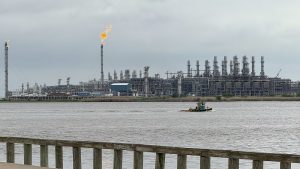
Illustrative image. Photo: Rotafinus, CC0, via Wikimedia Commons — source


[…] Related: Ukraine Drone Strikes Knock Out Two Russian Refineries in Perm and Rostov […]
[…] Ukrainian drone strikes have knocked out Russian refining capacity, including attacks that disabled plants in Perm and Rostov. Both disruptions have pushed more buyers toward European and Mediterranean refiners at the same […]