


Petrobras: Ownership, Leadership and Major Projects

Last updated: November 9, 2026
Petróleo Brasileiro S.A. — Petrobras is Brazil’s state-controlled oil and gas major and one of the world’s largest producers of deepwater crude, built around the pre-salt fields of the Santos and Campos basins. The Brazilian Federal Government has controlled the company since its creation in 1953, and Petrobras remains a publicly traded sociedade de economia mista (mixed-capital company) listed in São Paulo and New York, with 2025 average production of roughly 2.99 million barrels of oil equivalent per day (boe/d).
What Is Petrobras and Who Owns It?
Petrobras was created on October 3, 1953, under Law No. 2,004, signed by President Getúlio Vargas, establishing a state monopoly over oil exploration and refining in Brazil under the slogan “O Petróleo é Nosso” (“The Oil Is Ours”). The monopoly was formally ended by a 1997 constitutional amendment and Law No. 9,478/1997, which opened Brazil’s upstream sector to competition but required the Federal Government to retain at least 50% plus one share of Petrobras’s voting (common) stock — a floor that keeps Petrobras classified as a government-controlled mixed-capital company to this day.
As of a government ownership breakdown reported in August 2026, the Brazilian Federal Government directly holds 50.26% of Petrobras’s common (voting) shares, satisfying that statutory control threshold. Including indirect holdings through the national development bank BNDES and its investment arm BNDESPar, government-linked shareholders controlled roughly 37% of Petrobras’s total capital (common plus preferred shares) as of an October 2025 shareholder breakdown. The remaining shares free-float on Brazil’s B3 exchange under tickers PETR3 (common) and PETR4 (preferred), and as American Depositary Shares on the New York Stock Exchange under PBR (common) and PBR.A (preferred).
Leadership
Petrobras’s top two governance posts have both turned over since 2024:
| Role | Name | Since | Notes |
|---|---|---|---|
| Chief Executive Officer | Magda Chambriard | May 2024 | Named by President Lula after predecessor Jean Paul Prates was removed; 2026 press reports describe a contract extension through 2027 |
| Chairman of the Board of Directors | Guilherme Santos Mello | April 16, 2026 | Elected at Petrobras’s Annual General Meeting as the Federal Government’s nominee; chairs BNDES and serves as Secretary of Economic Policy at Brazil’s Finance Ministry |
The chairmanship changed hands twice in 2026 before Mello’s election: Bruno Moretti resigned as chairman on March 31, 2026 after being named Brazil’s Minister of Planning and Budget, and board member Marcelo Weick Pogliese was elected interim chairman on April 6, 2026 to bridge the gap until the shareholders’ meeting ten days later. Petrobras’s board was fixed at 11 members at the same April 2026 meeting, split between seats chosen by cumulative voting, minority common shareholders, preferred shareholders and a Petrobras employee representative.
Subsidiaries and Business Structure
Petrobras organizes its operations into four main business segments:
- Exploration & Production (E&P): Upstream oil and gas, overwhelmingly concentrated in the pre-salt fields of the Santos and Campos basins offshore Rio de Janeiro and São Paulo states.
- Refining, Transportation and Commercialization (RTC): Brazil’s domestic refining network, logistics, fuel distribution and trading.
- Gas & Energy (G&E): Natural gas processing, pipeline transport, LNG and thermoelectric power generation.
- Petrobras Biocombustível: Biodiesel and renewable-diesel production, part of the group’s lower-carbon fuels push.
Petrobras also holds a roughly 36% stake in petrochemicals producer Braskem, and runs dedicated trading and international units that market crude, products and LNG outside Brazil.
Countries of Operation
Petrobras’s production is overwhelmingly domestic: more than 95% of output comes from Brazil’s offshore pre-salt basins. The company’s international footprint is comparatively small but active in exploration: Petrobras has made a string of offshore gas discoveries in Colombia’s GUA-OFF-0 block (Sirius, Copoazú and the Sandia-1 well, confirmed in August 2026), and Brazilian officials, including President Lula, have discussed a possible Petrobras–Pemex deepwater exploration partnership in Mexico’s Gulf of Mexico waters, though no binding agreement had been announced as of this writing.
Production and Reserves
| Metric | Figure | Notes |
|---|---|---|
| Total production (2025 average) | ~2.99 million boe/d | Up 11% year-on-year; company set a new annual production record |
| Oil production (2025 average) | ~2.4 million bbl/d | — |
| Pre-salt share of output | ~82% (2.45 million boe/d) | Operated production including partners’ shares reached 3.70 million boe/d in 2025 |
| Quarterly production record | 3.34 million boe/d | Set in Q2 2026 |
| Proved reserves added (2025) | 1.7 billion boe | Reserve replacement ratio of 175% |
| Reserves-to-production ratio | 12.5 years | Described by management as the highest proved reserve level in a decade |
| 2026 production target | 2.8 million boe/d (commercial) | Commercial volumes exclude royalty-in-kind and other non-sold output |
Major Assets and Projects
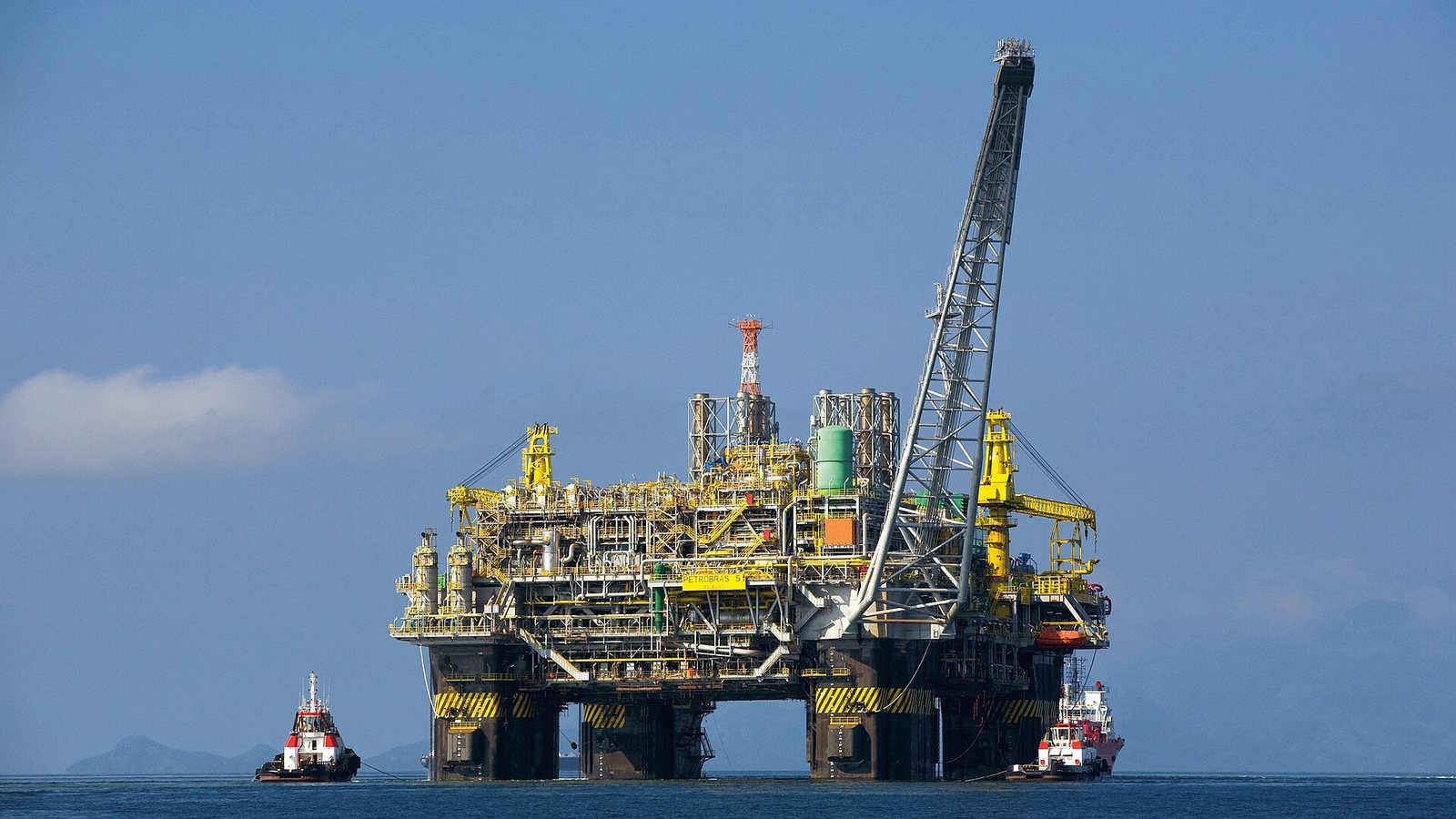
- Búzios (Santos Basin pre-salt): Petrobras’s largest field. The P-79 FPSO started up on May 1, 2026 ahead of schedule, adding 180,000 b/d of capacity and lifting Búzios’s installed production capacity to roughly 1.33 million b/d; gas injection began at the P-78 unit in March 2026, targeting about 1.15 million b/d of field capacity. Búzios first averaged above 1 million b/d in June 2026.
- Mero (Santos Basin pre-salt): Averaged about 740,000 b/d in Q2 2026, with the Alexandre de Gusmão FPSO ramping up production during the quarter.
- Tupi and Atapu (Santos Basin pre-salt): Petrobras’s 2026–2030 plan lists further FPSOs — P-80 and P-82 at Búzios, P-84 at Atapu (targeted from 2029) and P-85 at Sépia (from 2030) — alongside an expected bid for a Tupi-field revitalization FPSO.
- Foz do Amazonas / Equatorial Margin exploration: Brazil’s environmental regulator IBAMA amended Petrobras’s operating license in early September 2026 to allow drilling of three additional wells (Manga, Crotalus and a second well at the Morpho prospect) in block FZA-M-59, after Petrobras confirmed a hydrocarbon discovery at the Morpho well in August 2026. Brazilian federal prosecutors (MPF) have questioned the scope of the amendment on environmental-risk grounds. Petrobras’s 2026–2030 plan envisions up to 15 exploration wells across the Equatorial Margin.
- 2026–2030 Business and Management Plan: Approved by Petrobras’s board on November 27, 2025, with $109 billion in planned capital expenditure — about 71.6% of it ($78 billion) directed to Exploration & Production — and a minimum regular dividend commitment of $45 billion over the five-year period, budgeted on Brent assumptions of $63/bbl in 2026 rising to $70/bbl by 2027.
Employees
Petrobras reported more than 50,000 employees across its consolidated group, including Brazilian and international subsidiaries, in its 2025 annual filing (Form 20-F) with the U.S. Securities and Exchange Commission.
Careers at Petrobras
Petrobras does not run a single global careers portal in the way some international majors do. Hiring for permanent staff positions in Brazil is carried out through public selection processes (concursos públicos) typically administered by third-party organizations such as Cesgranrio, with internship and trainee programs run separately (historically via CIEE). Petrobras has publicly warned that it does not solicit fees or guarantee placement through unofficial channels, and job seekers should verify any vacancy announcement directly against petrobras.com.br. See TDE’s energy careers coverage for how other national oil companies structure recruitment; a dedicated Petrobras careers hub will be added here once a verified, centralized vacancy pipeline is confirmed.
Recent News
Petrobras continued its Equatorial Margin exploration push through 2026, including a second oil zone found at the Morpho well in Amapá — see TDE’s coverage: Petrobras Finds a Second Oil Zone at Amapá’s Morpho Well. The company also posted record 2025 output and a sharply higher net income, helped by foreign-exchange gains, even as its board approved a slightly reduced five-year capital plan amid lower oil-price assumptions.
Related Entities
- Magda Chambriard — Petrobras’s CEO
- Equinor — Norwegian state-linked major with a comparable government-control structure
- Eni — Italian state-linked integrated major
- ADNOC — Gulf national oil company
- Shell — international major active in competing deepwater basins
Frequently Asked Questions
Who owns Petrobras?
The Brazilian Federal Government directly holds 50.26% of Petrobras’s voting (common) shares, satisfying the minimum control stake required by Brazilian law. Including indirect stakes through BNDES and BNDESPar, government-linked shareholders control roughly 37% of total capital; the rest trades as free float on Brazil’s B3 exchange and as ADSs on the NYSE.
Who is Petrobras’s CEO?
Magda Chambriard has been Petrobras’s CEO since May 2024, after a career that included running Brazil’s oil regulator, the ANP, from 2012 to 2016.
Is Petrobras a government company?
Yes. Petrobras is a sociedade de economia mista — a publicly traded, mixed-capital company in which Brazilian law requires the Federal Government to hold at least 50% plus one share of the voting stock.
What are Petrobras’s biggest current projects?
Petrobras’s largest active projects are centered on the Búzios and Mero pre-salt fields in the Santos Basin, with new FPSOs (P-79, P-78, and the planned P-80, P-82, P-84 and P-85) expanding capacity through 2030, alongside exploration drilling on the Equatorial Margin off Brazil’s northern coast.
Sources
- Petrobras Form 6-K — Resolutions of the Annual General Meeting, April 16, 2026 (U.S. SEC filing)
- Petrobras Form 20-F for fiscal year 2025 (U.S. SEC filing)
- World Oil — Petrobras approves $109 billion 2026–2030 business plan
- Yahoo Finance / Offshore Technology — Petrobras 2025 net income jumps 160% to $19.6 billion
- OilNow — Petrobras sets quarterly production record at 3.34 million boe/d in Q2 2026
- Drilling Contractor — IBAMA amends Petrobras operating license for Foz do Amazonas wells, September 2026
- Rio Times Online — Guilherme Mello nominated for Petrobras board chair
Illustrative image. Photo: Divulgação Petrobras / ABr, CC BY 3.0 br, via Wikimedia Commons — source



[…] Maria de Regina Chambriard is the Chief Executive Officer of Petrobras, Brazil’s state-controlled oil and gas major, a post she has held since May 2024. A civil […]