NRC Approves Construction Permit for TVA’s Clinch River Small Modular Reactor


The US Nuclear Regulatory Commission has issued a construction permit to the Tennessee Valley Authority for a GE Vernova Hitachi BWRX-300 small modular reactor at the Clinch River site near Oak Ridge, Tennessee, the agency announced on September 29. It is the first construction permit the NRC has ever granted for a commercial small modular reactor in the United States, and it clears TVA to begin building the 300-megawatt-electric unit on the grounds of a former federal breeder-reactor project that was cancelled decades ago.
A 14-month review that beat its own schedule
TVA docketed its construction permit application in mid-2025, making it the first US utility to seek NRC approval to build a BWRX-300. The agency’s technical staff completed a safety evaluation report in June 2026 concluding the design and site met federal requirements, and a mandatory public hearing was held in Oak Ridge in August under the NRC’s newer, streamlined hearing process. The commission’s final sign-off came in September, roughly 14 months after docketing and, according to the agency, several months ahead of the original review timeline.
NRC Chairman Ho K. Nieh said the decision “demonstrates that the new NRC can make rigorous and credible safety decisions that enable major American nuclear projects to move forward.” A construction permit is not the last regulatory step: TVA still needs a separate operating license before the reactor can load fuel and generate power, a process that typically runs in parallel with construction under the NRC’s two-step licensing framework.
A site with nuclear history
Clinch River is not a new name in US nuclear planning. The site hosted the federal Clinch River Breeder Reactor project in the 1970s and 1980s before Congress cancelled it in 1983. TVA revived interest in the location in 2016, when it applied for an early site permit covering up to 800 MWe of small reactor capacity; the NRC granted that permit in 2019. The construction permit approved this week converts part of that reserved capacity into an actual build commitment for a single BWRX-300 unit, with the early site permit leaving room for additional modules later.
Where the BWRX-300 stands globally
The BWRX-300 is a roughly 300 MWe boiling-water design that GE Vernova Hitachi Nuclear Energy has pitched as a simplified, lower-cost evolution of established boiling-water reactor technology rather than an unproven concept. Ontario Power Generation is currently the furthest along with the design: its Darlington New Nuclear Project reached a final investment decision in May 2026, received its construction licence in April, and has already lowered the reactor building’s foundation into an excavated shaft, with the first of four planned units targeted for service by the end of 2030. Clinch River’s construction permit puts TVA in a similar early-construction phase in the US market, though on a different regulatory track, since Canada’s approval process and the NRC’s are separate systems with their own milestones.
Not every US advanced-reactor project has moved as smoothly. Engineering group Bechtel withdrew from TerraPower’s Natrium sodium-cooled reactor project in Wyoming earlier this year, a reminder that construction permits and vendor commitments do not guarantee a project reaches completion on its original schedule. Supply chains for competing SMR designs are also taking shape elsewhere: in the UK, Škoda JS was named sole supplier of control rod drive systems for Rolls-Royce’s SMR, a different reactor design pursuing a similar first-of-a-kind path through its national regulator.
Part of a broader push to expand US nuclear capacity
The approval lands against a policy backdrop set by a series of executive orders signed in May 2025 that directed federal agencies to work toward quadrupling US nuclear generating capacity, from roughly 100 GW today to a 400 GW target by 2050, and to speed up NRC licensing timelines. TVA, a federally owned utility that supplies power across Tennessee and parts of six neighboring states, has cited rising electricity demand — including from data centers and industrial customers — as part of its rationale for adding nuclear capacity at Clinch River alongside its existing large reactor fleet. Other federal and defense buyers are moving in parallel: the US Army has picked nuclear and fuel-cell power for six domestic bases, part of a wider push by government customers to lock in advanced nuclear supply.
What happens next
With the construction permit in hand, TVA can begin permanent structures at the reactor building, though first-of-a-kind schedules for new reactor designs have slipped before, in the US and elsewhere. The utility has not published a specific in-service date for the Clinch River unit. Attention now shifts to TVA’s operating license application and to whether the roughly four-month schedule improvement seen in this review carries over to the next US utilities lining up BWRX-300 or other SMR designs for construction permits. The NRC is working through a wider docket of nuclear filings at the same time, including its recently completed environmental review for the restart of Three Mile Island Unit 1, another sign of the agency’s expanding nuclear workload.
Sources
- US Nuclear Regulatory Commission, press release 26-079, “NRC Approves Construction of Nation’s First Small Modular Reactor,” September 29, 2026 — construction permit approval, review timeline, chairman’s quote.
- World Nuclear News, “Clinch River application accepted for review” — application docketing timeline and BWRX-300 background.
- American Nuclear Society, “Clinch River construction permit recommendation follows safety evaluation”, July 2026 — safety evaluation report findings and review schedule.
- World Nuclear News reporting on Ontario Power Generation’s Darlington New Nuclear Project — BWRX-300 construction status in Canada.
- World Nuclear News, “Trump sets out aim to quadruple US nuclear capacity” — federal policy target of 400 GW by 2050.
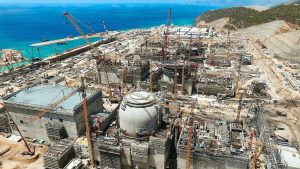
Illustrative image. Photo: Nuclear Regulatory Commission, Public domain, via Wikimedia Commons — source