How Does Geothermal Energy Work?
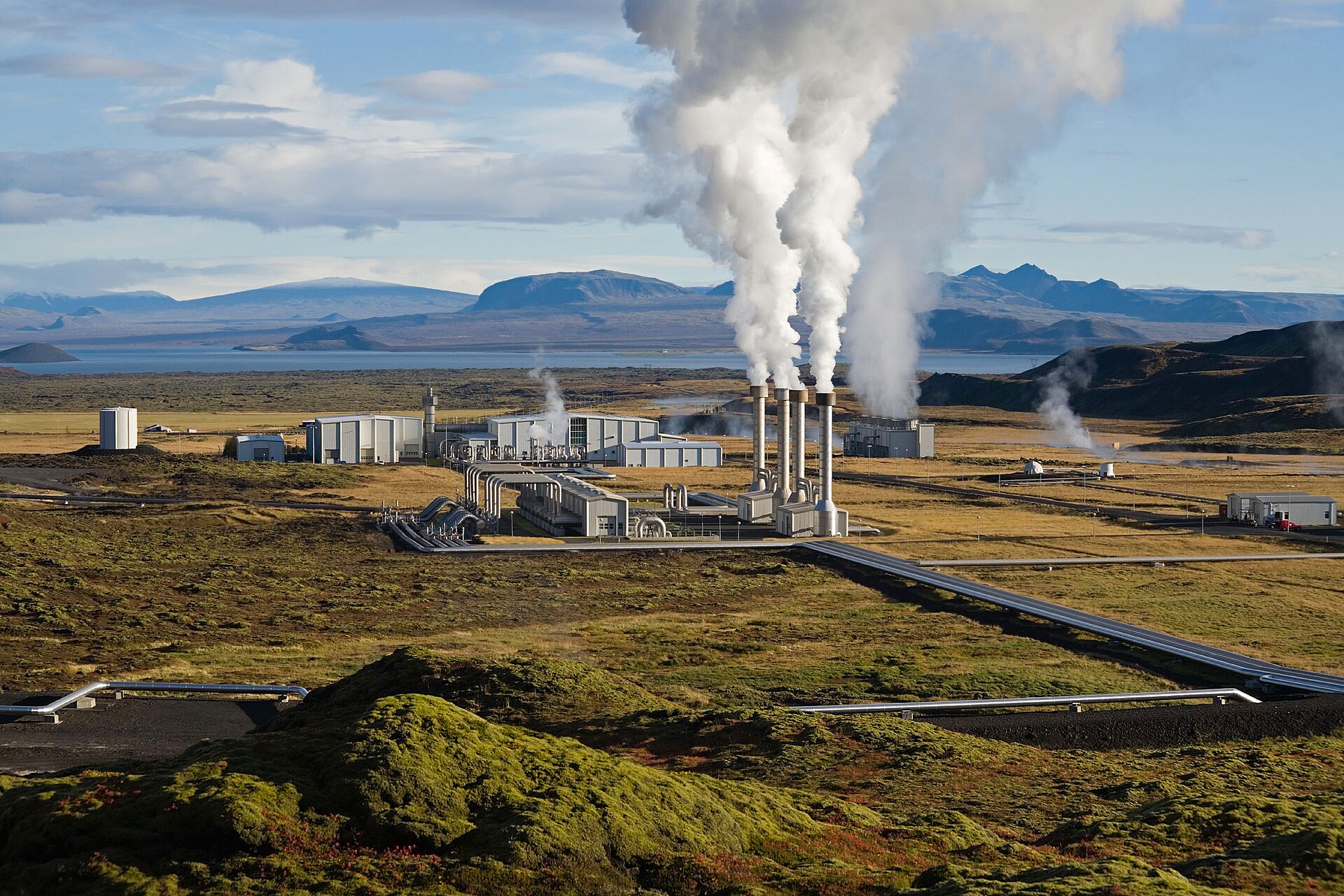

How does geothermal energy work? Wells carry hot water or steam from underground reservoirs to the surface, where the heat is used to spin a turbine for electricity or is piped directly to buildings and industry. The heat comes from the Earth itself, from the planet’s formation and from the slow decay of radioactive elements in the crust. Unlike solar or wind, it is available day and night. This guide explains the process step by step, the main plant types, and the costs, advantages and limits.
What Is Geothermal Energy? A Simple Definition
Geothermal energy is heat stored beneath the Earth’s surface. Temperature rises with depth, by roughly 25 to 30 degrees Celsius per kilometre in typical continental crust. In volcanic or tectonically active regions the rise is much steeper, and hot rock or fluid can sit within a kilometre or two of the surface.
People use this heat in three broad ways:
- Electricity generation from high-temperature reservoirs.
- Direct use of warm water for district heating, greenhouses, fish farming, spas and industrial drying.
- Ground-source heat pumps, which use the stable temperature of shallow ground to heat and cool buildings almost anywhere.
How Does Geothermal Energy Work Step by Step
Although plant designs differ, most geothermal power projects follow the same sequence.
- Exploration. Geologists use surface mapping, geochemistry, gravity and electrical surveys to find a heat source, permeable rock and a fluid. Exploratory drilling confirms the temperature and flow.
- Drilling production wells. Wells reach the reservoir, often between one and three kilometres deep, and bring hot water or steam to the surface under natural pressure or by pumping.
- Conversion. The steam, or a secondary fluid heated by the geothermal water, drives a turbine connected to a generator.
- Cooling. Spent steam is condensed in a cooling system. This is the source of the white plumes visible at many plants, which are mostly water vapour.
- Reinjection. Cooled fluid is pumped back underground through injection wells. This maintains reservoir pressure and prolongs the resource.
- Grid connection. Electricity goes to the transmission network, and in many places leftover heat supplies district heating.
The system is closed or mostly closed in the sense that the geothermal fluid is recycled, which is why well management is as important as the power station.
How Does Geothermal Energy Work in Different Plant Types
The choice of technology depends on the temperature and the chemistry of the reservoir.
Dry steam plants
Where a reservoir produces steam directly, it is sent straight to the turbine. This is the oldest design and is used at The Geysers in California and Larderello in Italy, where geothermal power generation began in the early twentieth century.
Flash steam plants
High-pressure hot water, typically above about 180 degrees Celsius, is released into a lower-pressure tank where part of it flashes to steam. The steam drives the turbine and the remaining water is reinjected. This is the most common type worldwide.
Binary cycle plants
Moderate-temperature water passes through a heat exchanger and heats a secondary fluid with a lower boiling point. That fluid vaporises and drives the turbine in a closed loop, and the geothermal water never contacts the turbine. Binary plants allow development of lower-temperature resources and release very little to the atmosphere.
Enhanced geothermal systems
Where rock is hot but lacks natural permeability or fluid, engineers create fracture networks and circulate water between wells. Enhanced geothermal systems (EGS) could extend geothermal power to many more regions. Demonstration projects, including some using horizontal drilling methods borrowed from the oil and gas industry, are testing whether costs can fall enough for wide use.
Main Advantages and Limitations
| Advantages | Limitations |
|---|---|
| Steady output, day and night, with high capacity factors | High upfront cost and drilling risk |
| Low operating emissions compared with fossil fuels | Best resources are concentrated in certain regions |
| Small land footprint per unit of energy | Possible minor induced seismicity, especially with EGS |
| Heat can be used directly, raising overall efficiency | Reservoir cooling or pressure decline if poorly managed |
| Domestic resource that reduces fuel imports | Some fluids contain gases such as hydrogen sulphide that need treatment |
Geothermal plants are often described as baseload because they run continuously. That makes them a useful partner for variable renewables such as wind and solar, although some plants can also adjust output.
Costs, Efficiency and Market Role
The main cost of geothermal power is at the start. Exploration and drilling take a large share of the budget, and a dry or underperforming well is a real financial risk. Once the field is developed, fuel is free and operating costs are modest, so the energy produced over decades can be cost-competitive in good locations.
Thermal efficiency is lower than at a gas or coal plant because geothermal fluids are cooler than the steam from a boiler. This matters less than it appears, since there is no fuel bill and heat is not wasted if it is also used for heating. Many plants run at capacity factors well above those of wind and solar.
The share of geothermal in the global electricity mix is small. According to figures published by the International Renewable Energy Agency (IRENA), worldwide installed geothermal power capacity is on the order of 15 gigawatts, a fraction of installed wind or solar. Its importance is greater in specific countries and in heating.
Leading Countries and Companies
The United States has the largest installed geothermal power capacity, followed by countries such as Indonesia, the Philippines, Türkiye, New Zealand, Mexico, Kenya, Italy and Iceland. Rankings change as new plants open, so check the latest data from IRENA or the International Geothermal Association.
- Iceland uses geothermal heat for the large majority of its space heating and for part of its electricity.
- Kenya has developed fields in the Rift Valley, and geothermal provides a significant share of its electricity.
- Türkiye has expanded geothermal power substantially, mostly in the Aegean region, with direct-use heating and greenhouses as well.
- Indonesia and the Philippines sit on the Pacific Ring of Fire and have large volcanic resources.
Well-known operators and technology suppliers include Ormat, Enel Green Power, Pertamina Geothermal Energy, KenGen and Calpine, plus oil service companies that supply drilling expertise.
Future Outlook
Interest in geothermal is rising because it offers firm, low-carbon power. The International Energy Agency has described next-generation geothermal as a potential growth area if drilling costs fall. Oil and gas skills, including directional drilling, fracturing and well completion, transfer directly, and several developers have received public and private funding to test these techniques.
Other directions include closed-loop systems that circulate fluid in sealed underground pipes, geothermal heat for industrial processes, and extracting lithium from geothermal brines. Wider adoption will depend on permitting speed, drilling cost and supportive electricity markets.
Frequently Asked Questions About Geothermal Energy
Is geothermal energy renewable?
Yes, when reservoirs are managed well. Heat flows continuously from the Earth’s interior, and reinjection helps sustain the field over decades.
How deep do geothermal wells go?
Conventional power wells commonly reach one to three kilometres. Deeper wells are used in enhanced systems, while heat pump loops are only tens to a few hundred metres deep.
Does geothermal energy produce emissions?
Operating emissions are low, though some fields release natural gases such as carbon dioxide or hydrogen sulphide. Binary plants with full reinjection release very little.
Can geothermal work anywhere?
Power generation needs hot resources, which are concentrated near plate boundaries and volcanic regions. Ground-source heat pumps can work almost anywhere.
Why is geothermal not more widely used?
High upfront costs, resource risk and geography limit its spread, though new drilling technology may widen the options.
Conclusion
So, how does geothermal energy work? It brings Earth’s heat to the surface through wells, converts it into electricity or uses it directly for heating, and returns the cooled fluid underground. It will not replace every other source, but it provides steady, low-carbon power and heat where the geology is right, and new technology may open many more sites.
Sources and further reading
- International Renewable Energy Agency, geothermal data and statistics (irena.org)
- International Energy Agency, renewables analysis (iea.org)
- US Department of Energy, geothermal technologies (energy.gov)
- US Energy Information Administration (eia.gov)
- International Geothermal Association (geothermal-energy.org)