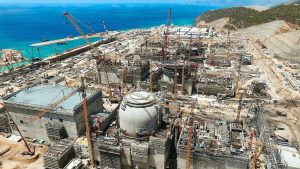
China Connects Tianwan 7 Reactor to the Grid, Nearing 9 GW Site Total


China connected Tianwan Unit 7, a Russian-designed VVER-1200 reactor on the Jiangsu coast, to the national grid on 8 October, China National Nuclear Corporation (CNNC) said, just over a week after the unit first achieved a self-sustaining chain reaction. The milestone moves the reactor into final testing ahead of commercial operation, which CNNC still expects within 2026, and brings the Tianwan site a step closer to becoming one of the largest nuclear complexes in the world.
The last stretch before commercial service
Grid connection is the stage at which a reactor first starts feeding electricity into the wider power network, rather than running in isolation during start-up testing. For Tianwan 7, it followed a sequence that began with hot functional testing completed on 30 December, fuel loading approved by China’s regulator in mid-2026, and the reactor reaching minimum controllable power — its first sustained chain reaction — in late September. CNNC said the unit will now go through further tests to confirm it meets the conditions for full commercial operation, the final step before the plant starts billing power at commercial rates. The company credited the pace of the build to what it called a “rigorous and meticulous work attitude” maintained by all parties through construction, which began in May 2021.
A Sino-Russian reactor design built at scale
Tianwan 7 and its sister unit, Tianwan 8, are VVER-1200 reactors supplied under agreements China and Russia signed in June 2018, the latest step in a technology relationship at the site that dates back to the 1990s. The complex’s first four units are earlier-generation VVER reactors supplied by Russia’s Gidropress, commissioned between 2007 and 2018, while units 5 and 6 are China’s own domestically designed ACPR1000 reactors — making Tianwan one of the few sites anywhere mixing Russian and Chinese reactor technology on the same coastline. Unit 8, also a VVER-1200, began construction in February 2022 and is on a roughly one-year-later schedule, having completed cold testing in January with commercial operation targeted for 2027.
The reactor is operated by Jiangsu Nuclear Power Company, a joint venture in which CNNC holds 50%, China Power Investment Corporation 30%, and Jiangsu Guoxin Group the remaining 20% — an ownership structure that reflects how China typically blends its national nuclear champion with provincial and regional state investors on major build-outs.
Why the scale matters beyond one reactor
Once all eight Tianwan units are in commercial operation, CNNC puts the site’s combined capacity above 9 gigawatts, with annual generation exceeding 70 terawatt-hours and avoided carbon emissions of roughly 57.4 million tonnes a year compared with coal-fired generation of the same output — figures that would place Tianwan among the handful of nuclear complexes anywhere approaching the scale of a mid-sized country’s entire generating fleet. For context, Tianwan 7 reaching grid connection comes in the same week Poland began ordering long-lead components for its first AP1000 reactor and Slovakia moved to take full ownership of its own new-build project company, underlining how much of the industry’s near-term construction activity is now concentrated in a small number of state-backed programmes rather than spread evenly across the sector.
China’s own nuclear fleet has grown faster than any other country’s over the past decade, and Tianwan’s phased build-out — four Russian units, two Chinese-designed units, and now two further Russian-designed units — illustrates a pattern repeated at several Chinese coastal sites: rather than standardising on a single design, operators have added capacity in waves, using whichever technology and financing arrangement was available at the time, while keeping a single site’s grid connections, cooling infrastructure and workforce in place across decades of construction.
Sources
- World Nuclear News, “China’s Tianwan 7 connected to the grid,” 8 October 2026 — grid connection date, CNNC quotes, site capacity figures.
- World Nuclear News, “Key commissioning tests completed at Tianwan 7,” 2026 — hot functional testing and fuel-loading timeline.
- TheDailyEnergy.com, “China’s Tianwan 7 Reactor Reaches Minimum Controllable Power Level,” 29 September 2026 — first criticality milestone.
Illustrative image. Photo: Christian David, CC BY-SA 4.0, via Wikimedia Commons — source