


China’s Changjiang Unit 3 Hualong One Reactor Enters Commercial Operation


Unit 3 of the Changjiang Nuclear Power Plant on China’s southern island province of Hainan has entered commercial operation, China Huaneng, the project’s majority owner, confirmed this month. The reactor is the first of two domestically designed Hualong One (HPR1000) units built as Phase II of the Changjiang site, and it reached full commercial status on September 17 after achieving first criticality on July 10 and connecting to the grid on August 1.
A homegrown reactor design reaching commercial scale
Hualong One is China’s own third-generation pressurised-water reactor, developed jointly by China National Nuclear Corporation and China General Nuclear as a domestic alternative to imported Western and Russian reactor technology, with the stated aim of standardising construction and cutting costs across a large fleet. Changjiang 3 is one of a growing number of Hualong One units now operating or under construction in China, and its move from grid connection to full commercial operation in under seven weeks reflects the design’s maturing construction and commissioning process after more than a decade of development and earlier reference-plant builds elsewhere in the country.
What Phase II is worth, and what it replaces
China Huaneng, which holds a 51% stake in the Changjiang Phase II project, puts the combined investment in units 3 and 4 at roughly CNY 40 billion, or about $5.9 billion. Once both reactors are running, the company expects the pair to generate about 18 billion kilowatt-hours of electricity a year — enough, Huaneng says, to displace more than 6.32 million tonnes of standard coal annually and cut carbon dioxide emissions by roughly 11.6 million tonnes a year. Those figures describe the completed two-unit phase rather than Unit 3 alone; Unit 4 has not yet reached commercial operation.
Part of a broader Chinese nuclear build-out
Changjiang’s Hainan location makes it one of the more geographically distinct nuclear sites in China’s fleet, serving an island grid that has historically relied more heavily on imported fuel and undersea interconnection to the mainland. The plant’s expansion fits into China’s wider pattern of approving and commissioning multiple reactors most years — a pace that has made it the fastest-growing nuclear program in the world by number of reactors under construction, even as most other nuclear-building activity in the West remains concentrated in single, high-profile demonstration projects.
Sources: World Nuclear News, “Third unit at Changjiang site commissioned” and “Chinese reactor enters commercial operation,” Sept. 17-18, 2026 — commissioning timeline and reactor type; NucNet, “China’s Changjiang-3 Hualong One Reactor Begins Commercial Operation,” Sept. 2026 — commercial operation date; China Huaneng project disclosures, cited by World Nuclear News and NucNet — investment figure, annual generation and coal/emissions displacement estimates for the two-unit Phase II.
Related coverage: Italy’s Senate Approves Return to Nuclear Power After 39-Year Ban | Turkey and US Agree to Study Nine Small Modular and Next-Gen Reactor Designs
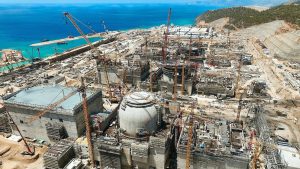
Illustrative image. Photo: IAEA Imagebank, Public domain, via Wikimedia Commons — source



[…] spanning both large pressurized-water reactors and domestic designs such as the Hualong One, whose third unit at Changjiang entered commercial operation earlier this year. For Rosatom, Tianwan 7 and 8 are among its most visible active projects, […]
[…] ülkeden daha hızlı devreye almayı sürdürdüğü bir dönemde geliyor; Hualong One’ın Changjiang’daki 3. ünitesi bu yıl ticari işletmeye geçmişti. Rosatom açısından Tianwan 7 ve 8, Rus devlet nükleer şirketi bazı diğer ihracat […]
[…] المضغوط وصولًا إلى تصاميم محلية مثل هوالونغ ون، التي دخلت وحدتها الثالثة في تشانغجيانغ الخدمة التجارية في وقت سابق من هذا العام. أما بالنسبة لروساتوم، فتُعد […]