Poland’s PEJ Applies for Early Works Permit at First Nuclear Plant Site


Polskie Elektrownie Jądrowe (PEJ), the state-owned company developing Poland’s first nuclear power plant, has applied to the head of the Pomeranian Voivodeship for a permit to begin "early works" at the Lubiatowo-Kopalino site in the Choczewo municipality, where three Westinghouse AP1000 reactors are planned. PEJ said on Monday that the application covers onshore sections of the plant’s cooling-water system and related site infrastructure, work that can proceed under regional permitting without a separate licence from Poland’s National Atomic Energy Agency (PAA).
What the new permit would cover
The early-works scope centers on the onshore portion of the circulating water system — the cooling-water intake and discharge pipelines that will run beneath the beach and seabed, installed using a trenchless method rather than open trenching. The PAA has previously classified this system as not safety-related. The application also covers a retention basin for rainwater and meltwater, internal site roads, and launch pits for the tunnel boring machine that will install the underwater sections. PEJ President Marek Woszczyk said the early-works application "is crucial for at least two reasons," pointing to both the technical lead time the cooling system requires and the need to keep the project’s broader construction schedule on track.
A new legal route created this year
The early-works category did not exist when PEJ began preparing the site. It was created by an amendment, passed on 3 July 2026, to Poland’s law on preparing and executing nuclear power investments, which allows specific categories of preliminary construction work to proceed under regional-government permitting rather than the full nuclear construction licence. Energy Minister Miłosz Motyka said the project remains "the largest energy project in the history of Poland."
Where the project stands in its permitting sequence
The new application is the latest step in a sequence that started in August 2024, when PEJ applied for a two-phase preparatory-works permit covering about 300 hectares of surveying, fencing and vegetation clearance; the second of those two phases is now underway. In August 2026, PEJ handed day-to-day site management to Bechtel, the project’s general contractor, which is also running geological surveys. PEJ has said it still intends to submit its application for the construction permit proper — a separate, far larger filing to the PAA — in 2027.
A schedule that has already slipped once
PEJ is targeting a 2028 construction start, with the first AP1000 reaching commercial operation in 2036 and all three units at full capacity by 2038 — three years later than the government’s earlier target. Poland’s nuclear programme has been costed at roughly PLN192 billion (about $49 billion) for the first plant in prior PEJ disclosures, financed through a mix of state equity and debt, with Westinghouse engaged as technology vendor and Bechtel as EPC contractor. Warsaw selected the AP1000 design in November 2022 and is separately advancing a second nuclear project, EJ2, with PEJ and state utility PGE.
Sources
- World Nuclear News, November 2, 2026 — early-works application, legal basis, permit scope and quotes from Minister Motyka and PEJ’s Marek Woszczyk.
- TheDailyEnergy.com reporting on Poland’s AP1000 long-lead component orders and the project’s 2036 schedule.
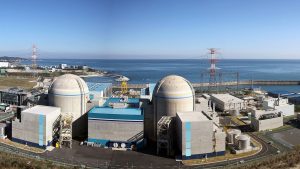
Illustrative image. Photo: Nuclear Regulatory Commission, Public domain, via Wikimedia Commons — source