Countries With the Most Nuclear Reactors

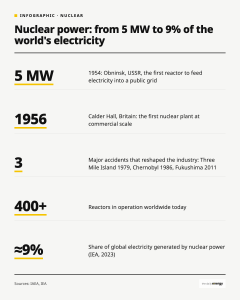
The countries with the most nuclear reactors are the United States, France, China, Russia, Japan and South Korea, in roughly that order of operating units, although the exact ranking depends on how you count. The world has well over 400 commercial reactors, and a handful of nations hold most of them. This article gives an approximate top 10, explains the counting method, and shows why reactor numbers, installed capacity and nuclear share of electricity tell three different stories.
Most Nuclear Reactors: The Ranking at a Glance
The table below shows approximate counts of reactors listed as operating, plus an approximate nuclear share of national electricity generation. Figures are rounded, drawn from the pattern of recent IAEA Power Reactor Information System (PRIS) listings and World Nuclear Association summaries, and they change as units start up or close. Treat them as orientation and verify against the latest PRIS data before quoting them.
| Rank | Country | Operating reactors (approx.) | Nuclear share of electricity (approx.) |
|---|---|---|---|
| 1 | United States | about 94 | about 18 to 19 percent |
| 2 | France | about 57 | roughly 65 percent or more |
| 3 | China | about 55 or more, rising | around 5 percent |
| 4 | Russia | about 36 | around 19 percent |
| 5 | Japan | about 33 listed as operable, fewer running | under 10 percent |
| 6 | South Korea | about 26 | around 30 percent |
| 7 | India | about 20 or more | around 3 percent |
| 8 | Canada | about 17 | around 13 to 15 percent |
| 9 | Ukraine | about 15, with some sites affected by the war | over half before the war |
| 10 | United Kingdom | about 9 | around 14 to 15 percent |
The ranking below the top four shifts depending on whether Japan’s idled units are counted and whether you rank by operable or by generating reactors.
Methodology and Data Sources
Rankings of nuclear reactors by country are less straightforward than they appear. Three decisions change the result.
- Operating versus operable: PRIS distinguishes reactors in operation from those in long-term shutdown. Several Japanese reactors are counted as operable, but only part of the fleet has been restarted after the Fukushima accident.
- Units versus capacity: a country with many small old reactors can have a high count but lower capacity than one with fewer large units.
- Power versus research: only commercial power reactors are counted here, not research reactors or those used for naval propulsion.
The main reference databases are the IAEA’s PRIS and the World Nuclear Association’s reactor tables. For nuclear share of electricity, Ember, the IEA and the Energy Institute Statistical Review provide annual generation data. When articles disagree by one or two units, the difference usually comes from the counting rules above.
Top 10 Breakdown
United States
The US has the largest fleet and generates more nuclear electricity than any other country. Most reactors are pressurised or boiling water designs built decades ago, and many have received licence extensions to run longer. New construction has been slow, but recent interest in small modular reactors and fleet life extension keeps the sector active.
France
France is the classic example of a country built around nuclear power. A standardised programme in the 1970s and 1980s created a fleet of similar reactors that produces the majority of French electricity and supports significant power exports. Maintenance and ageing are key issues.
China
China has the largest construction pipeline in the world and is adding units each year. The nuclear share of its electricity is still low because total demand is so large, so even rapid growth leaves the share modest.
Russia, Japan and South Korea
Russia operates a mix of older and newer designs and exports reactors through Rosatom. Japan shut down its fleet after 2011 and is restarting units gradually under a stricter regulator. South Korea has a domestic industry that builds and exports reactors, with nuclear power as a major source of electricity.
India, Canada, Ukraine and the UK
India has a smaller fleet but plans expansion. Canada relies on CANDU heavy-water reactors, mostly in Ontario. Ukraine’s reactors have been under pressure because of the war. The UK fleet is shrinking as older reactors retire, with new units under development.
Why the Countries With the Most Nuclear Reactors Dominate
Four factors explain the concentration of the most nuclear reactors in a few countries. First, large economies with high electricity demand built reactors early, in the oil-shock decades of the 1970s and 1980s. Second, state-backed industrial programmes, as in France and the Soviet Union, provided financing and standard designs. Third, a domestic supply chain, including fuel cycle services and skilled engineers, lowers the cost of building further reactors. Fourth, policies on energy security pushed countries with little domestic gas or oil, such as France, Japan and South Korea, to choose nuclear power.
Regional Trends and Surprises Beyond the Most Nuclear Reactors
- Asia leads construction: China and India account for a large share of reactors currently being built, along with Russia-supported projects abroad.
- Europe is split: France, Finland, Slovakia and Hungary rely on nuclear power heavily, while Germany completed its phase-out and Belgium and Spain have retirement plans that have been debated.
- New entrants: the United Arab Emirates now operates its four-unit Barakah plant, the first nuclear power station in the Arab world. Turkey is building Akkuyu with Rosatom, Egypt is building El Dabaa, and Bangladesh is building Rooppur.
- Count versus output: countries with fewer reactors can have a higher nuclear share. Slovakia, for example, has only a handful of units yet nuclear power supplies a large part of its electricity.
What the Numbers Mean for Energy Markets
Reading a reactor ranking well means separating three questions: how many units a country runs, how much electricity they produce, and how much of the national supply that represents. The first is about industrial history, the second about size and reliability, the third about energy policy.
Reactor counts matter because nuclear plants provide steady, low-carbon baseload power with little exposure to fuel price swings once built. Countries with the most nuclear reactors can export power, reduce gas imports and meet climate goals with less dependence on weather. But a reactor is a long-term bet: construction takes many years, costs can overrun, and ageing units need heavy investment.
Uranium and enrichment markets also follow the reactor fleet. Demand is concentrated in the same group of countries, and supply chains, especially for enrichment, involve a small number of providers, which is why fuel security has become a policy issue. Anyone using reactor rankings to judge market impact should combine them with capacity factors, fuel contracts and construction pipelines.
Frequently Asked Questions About Nuclear Reactors by Country
Which country has the most nuclear reactors?
The United States, with about 94 operating reactors, followed by France and China.
Which country gets the highest share of electricity from nuclear power?
France has one of the highest shares among large countries, at roughly two-thirds. Some smaller countries, such as Slovakia, also rely heavily on nuclear power.
Which country is building the most reactors?
China has the largest number under construction, followed by India and Russia.
Does Turkey have nuclear reactors?
Turkey’s first commercial nuclear plant, Akkuyu on the Mediterranean coast, is being built with Rosatom. Check the Turkish regulator and PRIS for the current commissioning status of each unit.
Do more reactors always mean more nuclear electricity?
No. Output depends on reactor size, age and how reliably each unit runs, so capacity and generation data matter as much as the count.
Conclusion
The countries with the most nuclear reactors are the United States, France and China, but the ranking looks different if you measure capacity, generation or share of electricity. Use the table in this article as a starting point, check the latest IAEA PRIS figures, and read counts alongside construction pipelines and policy changes, because the ranking shifts as units start up and retire.
Sources and further reading
- International Atomic Energy Agency (IAEA), Power Reactor Information System: iaea.org
- World Nuclear Association, reactor and country profiles: world-nuclear.org
- International Energy Agency (IEA): iea.org
- Ember, electricity data: ember-energy.org
- Energy Institute, Statistical Review of World Energy: energyinst.org