ExxonMobil Starts Uaru Production, Lifting Guyana’s Oil Capacity to 1.1 Million Barrels a Day


ExxonMobil has started oil production at Uaru, the fifth development to come online on the Stabroek Block offshore Guyana, lifting the country’s installed oil production capacity to 1.1 million barrels per day. The company said production began on November 16, 2026, via the Errea Wittu floating production, storage and offloading vessel (FPSO), which joins the Liza Destiny, Liza Unity, Prosperity and ONE GUYANA vessels already operating on the block.
A Fifth FPSO Joins the Stabroek Fleet
Errea Wittu has an initial production capacity of 250,000 barrels per day and is expected to reach that level in the first quarter of 2027, following the pattern of ramp-up seen on the block’s earlier vessels. The FPSO can store up to 2 million barrels of crude. “The startup of Errea Wittu is another major milestone for Guyana and ExxonMobil,” ExxonMobil Upstream Company President Dan Ammann said in the company’s announcement.
Uaru itself targets more than 800 million barrels of recoverable resource and represents an investment of roughly $12.7 billion. The full development calls for up to 10 drill centers and 44 wells, a scale consistent with the subsea architecture ExxonMobil has used across its earlier Stabroek projects.
Uaru’s Place in a Fast-Expanding Portfolio
Uaru is the fifth production start on Stabroek in six years, following Liza Destiny (2019), Liza Unity (2022), Prosperity (2023) and ONE GUYANA (2025). ExxonMobil is not stopping there: the operator has already taken a separate final investment decision on Longtail, its eighth sanctioned project on the block, and has sanctioned Whiptail and Hammerhead, which are expected to start up in 2027 and 2029 respectively. Those decisions mean Uaru’s startup is one step in a sequence rather than a one-off event — the difference between a project reaching first oil and one simply being approved for construction matters for tracking how quickly Guyana’s capacity will keep climbing.
A New Partner at the Table
ExxonMobil operates Stabroek with a 45% interest. The other two partners have changed hands this year: Chevron now holds the 30% stake that belonged to Hess, after completing its roughly $53 billion all-stock acquisition of Hess in July 2025. The deal closed only after an International Chamber of Commerce arbitration panel rejected ExxonMobil’s argument that it held a right of first refusal over Hess’s Stabroek stake when the asset changed hands through a corporate takeover rather than a direct sale; CNOOC, which holds the remaining 25% and had raised a similar objection, was also unsuccessful. ExxonMobil said at the time that it disagreed with the panel’s interpretation but would respect the ruling, and Chevron has since folded Stabroek into its production base as a non-operating partner alongside CNOOC Petroleum Guyana.
Guyana’s Rise From Zero to Over a Million Barrels
The scale of the ramp-up is unusual even by the standards of offshore oil development. Guyana had no commercial oil production until the Liza Destiny FPSO delivered first oil on December 20, 2019, at an initial design capacity of 120,000 barrels per day, since optimized to around 150,000. By early 2024, according to the US Energy Information Administration, combined output from the Stabroek block had reached about 645,000 barrels per day. Government figures put actual crude lifting at roughly 888,000 barrels per day as of May 2026, still below the block’s cumulative installed capacity as newer FPSOs ramp toward their design output — a distinction worth keeping in mind, since capacity and realized production are not the same number.
The economic effect at home has been outsized for a country of fewer than a million people. The International Monetary Fund recorded real GDP growth of 62.3% in 2022, the highest of any economy in the world that year, and the World Bank has reported that Guyana’s nominal GDP more than quadrupled between 2019 and 2024, largely on the back of oil revenue. With installed capacity now above 1.1 million barrels per day, Guyana’s production ceiling is approaching the roughly 1.16 million barrels per day Venezuela pumped in July 2026, according to secondary OPEC data — a comparison Guyanese officials and commentators have increasingly drawn given the two countries’ long-running border dispute over the Essequibo region, though actual Guyanese output still trails that installed-capacity figure for now.
Sources: ExxonMobil, “ExxonMobil starts production at Uaru, raising Guyana’s installed capacity to 1.1 million barrels per day,” press release, Nov. 16, 2026 (investor.exxonmobil.com) — startup date, capacity figure, Ammann quote, FPSO fleet list. World Oil, “ExxonMobil starts Uaru production, lifting Guyana capacity to 1.1 MMbpd,” Nov. 16, 2026 — corroboration of capacity and ramp-up timeline. Oil & Gas Journal, “ExxonMobil Guyana starts production at Uaru,” Nov. 16, 2026 — project investment and reserve figures. Argus Media / Chevron and ExxonMobil statements via Argus and JPT/SPE, “Chevron completes Hess takeover after arbitration win,” July 2025 — Hess-to-Chevron ownership transition and arbitration outcome. US Energy Information Administration, “Guyana becomes key contributor to global crude oil supply growth,” May 2024 — 2019-2024 production trajectory. International Monetary Fund and World Bank data as cited by Reuters and OilNow — Guyana GDP growth figures.
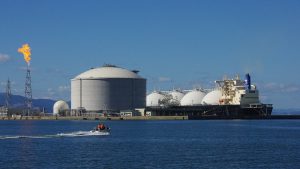
Illustrative image. Photo: GuavaTrain, CC0, via Wikimedia Commons — source