Petrobras Company Profile: Brazil’s National Oil Company

Petrobras is Brazil’s state-controlled oil and gas company and one of the most important deepwater operators in the world. Formally Petróleo Brasileiro S.A., it explores, produces, refines and sells oil, gas and fuels, and it has become the lead developer of Brazil’s giant pre-salt fields. This profile covers its history, ownership, core business, key assets, strategy and career opportunities, using company and public sources.
Petrobras at a Glance
| Item | Summary |
|---|---|
| Full name | Petróleo Brasileiro S.A. |
| Founded | 1953 |
| Headquarters | Rio de Janeiro, Brazil |
| Ownership | Controlled by the Brazilian federal government, with shares traded on the São Paulo exchange (B3) and as depositary receipts in New York |
| Core activities | Exploration and production, refining, gas, power and fuels marketing |
| Best-known assets | Pre-salt fields in the Santos and Campos basins |
Brazil relies on Petrobras for the majority of its crude production, and the company is a major buyer of offshore rigs, floating production vessels and subsea equipment worldwide.
Petrobras History and Ownership
The company was created in 1953 under President Getúlio Vargas, after a political campaign for national control of oil resources. For decades it held a legal monopoly over oil exploration, production and refining in Brazil. That monopoly ended with the Petroleum Law of 1997, which opened the sector to competition and created the National Agency of Petroleum, Natural Gas and Biofuels (ANP) as regulator.
Key phases in the company’s story:
- 1950s to 1970s: building refining capacity and a national supply chain, then early offshore exploration in the Campos Basin.
- 1980s to 1990s: rapid progress in deepwater technology, which later became a signature strength.
- 2000s: the discovery of large accumulations below a thick salt layer, which reshaped Brazil’s oil outlook.
- 2010s: a major corruption investigation known as Operation Car Wash exposed misconduct linked to contracts, leading to governance reforms, leadership changes and asset sales.
- Late 2010s onward: a focus on the most profitable upstream assets and sales of non-core businesses, including the fuel distributor BR Distribuidora.
The federal government holds a controlling stake, while minority shareholders include institutional and retail investors. Because it is state-controlled, political decisions on fuel pricing and investment can influence its performance.
Governance rules were tightened in the years that followed. Brazil’s State-Owned Companies Law of 2016 set requirements for board composition, risk management and transparency at state-controlled firms, and Petrobras built compliance and audit functions on top of it. A separate pre-salt law gave the company a special role as operator of production sharing contracts, a role that later became optional rather than automatic. The company has also sold refineries, such as the Mataripe refinery in Bahia, which went to the Mubadala investment company of Abu Dhabi, as part of a plan to concentrate capital on upstream projects.
Core Business and Revenue Drivers
Petrobras runs an integrated business, but upstream operations drive most of its value.
Exploration and production
This segment produces crude oil and natural gas, mainly offshore. Most output comes from deepwater and ultra-deepwater fields using floating production, storage and offloading vessels (FPSOs). Revenue depends strongly on the oil price and on how efficiently these units are drilled and operated.
Refining and logistics
The company owns a network of refineries, terminals and pipelines across Brazil, and its logistics arm Transpetro operates much of the transport and storage system. Refining margins depend on crude costs, product demand and domestic pricing policy.
Gas and power
Petrobras processes and sells natural gas and has had interests in power generation. Its gas role has changed over time as the government and regulators have sought more competition in the gas market.
Key Assets, Projects and Markets
The pre-salt is the centre of the Petrobras story. These reservoirs lie under a layer of salt that sits beneath the seabed, far offshore, and they hold high-quality light oil in carbonate rocks. Discovery of the Tupi field, later renamed Lula, was announced in 2007, and development followed with a series of large FPSOs. Other important areas include Búzios, Sapinhoá and Mero, several of them developed with international partners under Brazil’s production sharing rules.
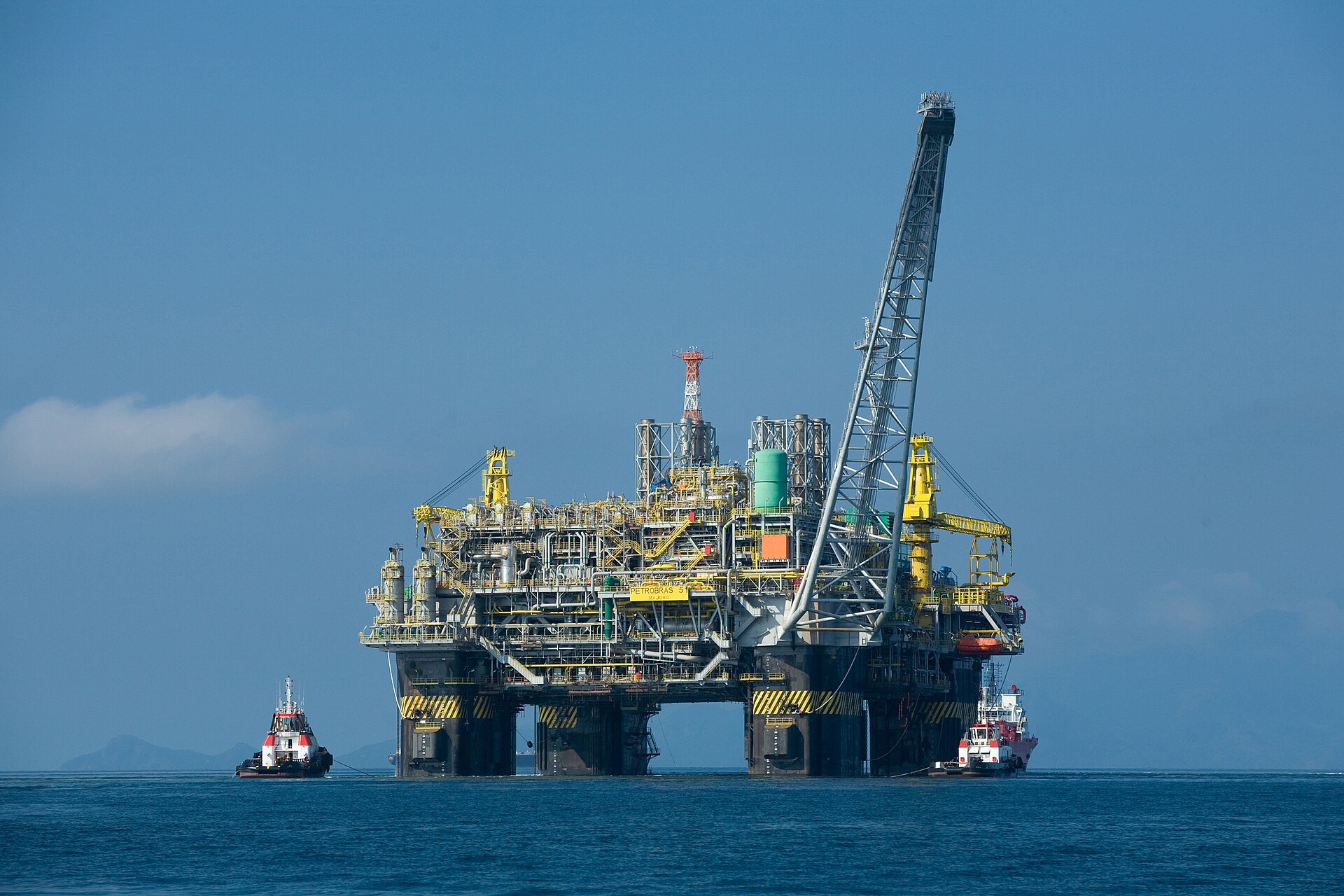
The older Campos Basin remains important, with fields such as Marlim and Roncador and platforms like P-51, which appears in the featured photograph. Many of these fields are mature, so the company works to extend their life through new wells and tie-backs.
Brazil is a significant crude exporter, and Petrobras sells to Asia, Europe and the Americas. Pre-salt oil is valued by refiners for its quality, and its low production cost per barrel at the best fields is a core competitive advantage.
Petrobras Financial Performance and Scale
Petrobras is among the largest companies in Latin America by revenue and one of the biggest corporate investors in Brazil. Its financial results move with oil prices, the exchange rate between the Brazilian real and the dollar, and government policy on domestic fuel pricing. The company publishes audited annual and quarterly results, including production, capital spending and debt, on its investor relations pages.
Three themes recur in analysis of the company:
- Capital discipline: prioritising high-return pre-salt projects over lower-return investments.
- Debt reduction: deleveraging after the heavy borrowing of the 2010s.
- Shareholder returns: dividends influenced by cash flow, policy and the government’s role as controlling shareholder.
For current numbers, read the latest annual report and filings rather than relying on summaries, since production, profit and debt change every quarter.
Petrobras Strategy and the Energy Transition
The company’s stated strategy is to keep investing in low-cost oil and gas, mainly from the pre-salt, while building a lower-carbon portfolio. Public plans have included reducing the emissions intensity of production, capturing and reinjecting carbon dioxide from pre-salt fields, expanding biofuels and biorefining, and studying offshore wind and other renewables.
The strategic debate has two sides. Supporters argue that low-cost, relatively lower-emission barrels from Brazil can remain competitive in a changing market. Critics point out that new exploration, including along Brazil’s northern equatorial margin, raises environmental and climate questions. Licensing decisions and global demand will shape how this balance evolves.
Jobs and Careers at Petrobras
Petrobras employs engineers, geoscientists, operators, technicians, finance and legal professionals. Historically, hiring for permanent roles has been through public competitive examinations, in line with rules for state-controlled companies in Brazil. Contractors and service companies provide large numbers of additional jobs on platforms, in shipyards and in refineries.
Useful skills include Portuguese, offshore safety training, subsea or reservoir engineering, project management and digital skills for operations. Candidates should check the careers section on the official Petrobras website for current openings and exam notices.
Frequently Asked Questions About Petrobras
Is Petrobras owned by the government?
The Brazilian federal government is the controlling shareholder, but the company is publicly listed and has many private shareholders.
What is the pre-salt?
It is a geological formation of oil-bearing carbonate rocks located beneath a thick layer of salt under the seabed offshore Brazil. Petrobras is the lead operator of the largest pre-salt fields.
Where is Petrobras headquartered?
In Rio de Janeiro, Brazil.
Does Petrobras only work in Brazil?
Most of its activity is in Brazil. It has sold many international assets in recent years to concentrate on Brazilian deepwater production.
How can I find reliable financial data?
Use the company’s investor relations reports, its filings with Brazilian and US regulators, and ANP production statistics.
Conclusion
Petrobras combines state backing, advanced deepwater expertise and some of the most productive offshore reservoirs in the world. Its future depends on the oil price, political decisions on fuel policy, the pace of pre-salt development and how convincingly it can diversify into lower-carbon activities. For anyone following Latin American energy, Petrobras remains a central company to watch.
Sources and further reading
- Petrobras annual reports and investor relations (petrobras.com.br)
- National Agency of Petroleum, Natural Gas and Biofuels, ANP (gov.br/anp)
- US Energy Information Administration, Brazil country analysis (eia.gov)
- International Energy Agency (iea.org)