


Qatar’s North Field LNG Expansion: Project Tracker

Last updated: 2026-10-06
Qatar is building the world’s largest LNG expansion, lifting liquefaction capacity from 77 million tonnes per annum (MTPA) to 142 MTPA by 2030 across three phases — North Field East, North Field South and North Field West. The first phase, North Field East, is now pre-commissioning its first train, but QatarEnergy has pushed the start date from its original mid-2026 target to the first half of 2027, citing equipment-delivery delays tied to the Strait of Hormuz disruption.
What Is the Project?
The North Field expansion is QatarEnergy’s program to develop new LNG trains drawing on the North Field, the offshore gas reservoir Qatar shares with Iran’s South Pars field. It has three stages, each named for the acreage it develops and each adding liquefaction capacity at the Ras Laffan Industrial City complex on Qatar’s northeast coast:
| Phase | New capacity | Resulting total capacity | Trains | Status (Oct 2026) |
|---|---|---|---|---|
| North Field East (NFE) | +32 MTPA | 110 MTPA | 4 trains x 8 MTPA | Train 1 in pre-commissioning; first LNG guided to H1 2027 |
| North Field South (NFS) | +16 MTPA | 126 MTPA | 2 trains x 8 MTPA | Under construction; first production guided to 2028 |
| North Field West (NFW) | +16 MTPA | 142 MTPA | Not yet finalized | Announced (Feb 2024); target end-2030, no FID reported yet |
Sources: QatarEnergy announcements reported by Gulf Times and Al Jazeera, February 25, 2024; project-level reporting by JPT/SPE, Reuters and Energy Intelligence, 2026. Pre-expansion baseline of 77 MTPA includes existing trains at Ras Laffan, some of which are separately offline after the March 2026 strikes described below.
The expansion is backed by newly confirmed gas resources: QatarEnergy says additional North Field reserves of around 240 trillion cubic feet lift Qatar’s total gas reserves from roughly 1,760 to more than 2,000 trillion cubic feet (Gulf Times, February 2024).
Where Is It?
The gas itself is produced offshore from the North Field, Qatar’s share of a reservoir it splits with Iran (where the same structure is called South Pars). The LNG trains that liquefy that gas for export are built onshore at Ras Laffan Industrial City, about 80 kilometers north of Doha — the same site where Qatar’s existing 77 MTPA of capacity, including the trains damaged in March 2026, is located.
Who Owns It? Who Operates It?
QatarEnergy, the state energy company, holds the controlling interest in both expansion phases and operates every LNG train at Ras Laffan — the international partners below hold non-operating equity stakes in the upstream/liquefaction joint ventures, they do not run the trains.
| Partner | NFE stake | NFS stake |
|---|---|---|
| QatarEnergy | 75% | 75% |
| ExxonMobil | 6.25% | Not yet published |
| TotalEnergies | 6.25% | 9.375% |
| Shell | 6.25% | Not yet published |
| Eni | 3.125% | Not yet published |
| ConocoPhillips | 3.125% | Not yet published |
Sources: World Oil, S&P Global Commodity Insights, JPT/SPE and Al-Monitor reporting on individual 2022 farm-down deals (NFE); QatarEnergy’s May 2023 announcement of the TotalEnergies NFS stake. QatarEnergy had not published the remaining NFS international allocation as of this update — treat the “not yet published” cells as open, not zero.
Cost
QatarEnergy has not issued one consolidated project budget; the figure most commonly cited for North Field East is about $28.75 billion in total project cost, built up from individual EPC awards: a roughly $13 billion onshore engineering, procurement, construction and commissioning (EPCC) contract to a Chiyoda–Technip Energies joint venture, and a roughly $2 billion EPC package to Samsung C&T for supporting works (JPT/SPE). North Field South’s EPC contract, awarded to a Technip Energies–Consolidated Contractors Company (CCC) joint venture, was valued at about $10 billion when announced by QatarEnergy on May 16, 2023 (Qatar News Agency).
Capacity
Combined, NFE and NFS add 48 MTPA of new liquefaction capacity on top of the 77 MTPA baseline, taking Qatar to 126 MTPA by the end of NFS. North Field West would add a further 16 MTPA, reaching the 142 MTPA figure QatarEnergy has targeted for 2030. For comparison, Qatar’s pre-expansion capacity of 77 MTPA already made it the world’s largest or second-largest LNG exporter depending on the year, alongside the United States and Australia.
Technology
Each of the six new trains across NFE and NFS has a nameplate capacity of 8 MTPA — among the largest single-train LNG capacities in the industry, roughly double the size of a typical standalone LNG train built a decade earlier. The trains use conventional large-scale liquefaction technology rather than floating or modular designs, consistent with the rest of Qatar’s onshore Ras Laffan complex.
Contractors
- North Field East onshore EPCC: Chiyoda Corporation (Japan) and Technip Energies (France), joint venture, contract value approximately $13 billion.
- North Field East supporting EPC: Samsung C&T Corporation (South Korea), approximately $2 billion.
- North Field South EPC: Technip Energies and Consolidated Contractors Company (CCC), joint venture, approximately $10 billion, awarded May 16, 2023.
Financing
QatarEnergy is funding the expansion through a mix of its own balance sheet and the equity contributions of the international partners that bought into the NFE and NFS joint ventures — TotalEnergies, Shell, ExxonMobil, Eni and ConocoPhillips for NFE, and so far TotalEnergies for NFS. In return, those partners typically receive offtake rights to a share of the LNG proportional to their equity, rather than fixed project financing fees. QatarEnergy has not disclosed external project-finance debt facilities for either phase as of this update.
Construction Timeline
- 2017: Qatar lifts its self-imposed development pause on the North Field and announces plans to raise LNG capacity from 77 to roughly 100 MTPA, the project later renamed North Field East.
- 2021: QatarEnergy awards the North Field East onshore EPCC contract to the Chiyoda–Technip Energies joint venture (~$13bn) and a supporting EPC package to Samsung C&T (~$2bn) (JPT/SPE).
- June–December 2022: TotalEnergies, ExxonMobil, Shell, Eni and ConocoPhillips each take non-operating equity stakes in North Field East, totaling 25% (World Oil, S&P Global, Al-Monitor, Enerdata).
- May 16, 2023: QatarEnergy awards the North Field South EPC contract to the Technip Energies–CCC joint venture, valued at about $10 billion (Qatar News Agency).
- 2023–2024: TotalEnergies takes a 9.375% stake in North Field South, the first international partner confirmed for that phase.
- February 25, 2024: QatarEnergy CEO Saad al-Kaabi announces the third phase, North Field West, targeting 142 MTPA of total capacity by the end of 2030 (Gulf Times, Al Jazeera).
- March 19, 2026: Iranian ballistic missile strikes on Ras Laffan Industrial City damage two existing LNG trains (S4 and S6) and one gas-to-liquids unit — part of Qatar’s pre-expansion capacity, not the new NFE/NFS trains — cutting roughly 17% of Qatar’s then-existing LNG export capacity for an estimated 3–5 years and an estimated $20 billion in lost annual revenue; QatarEnergy declares force majeure on affected contracts (Anadolu Agency/AA, GIIGNL, Energy Intelligence).
- December 2025: Middle East Economic Survey reports QatarEnergy is targeting the third quarter of 2026 for first production from the initial North Field East train — later superseded by the guidance below.
- September 2026: Technip Energies reports pre-commissioning progress on the first North Field East train, while QatarEnergy warns that continued Strait of Hormuz disruption — which has delayed the arrival of imported equipment — could push back the remaining trains; guidance for first LNG shifts to the first half of 2027 (LNGPrime, citing Technip Energies; L’Orient-Le Jour, Gulf Business, Offshore Engineer).
- September 28, 2026: Qatar extends existing LNG force majeure notices into December 2026 as Hormuz-related disruption persists — a separate, ongoing issue from the NFE/NFS construction delay (The Daily Energy).
Expected Operation
Company guidance on North Field East’s first train has moved more than once: originally mid-2026, then “third or fourth quarter 2026” per CEO Saad al-Kaabi’s own description to Reuters, then the first half of 2027 in the most recent reporting as of September 2026. North Field South remains guided to start production in 2028. Estimates vary because QatarEnergy has not issued a single fixed, repeatedly confirmed date — this page will update as the company narrows its guidance or confirms first LNG.
Current Status
Two separate things are true about Ras Laffan right now, and they should not be confused with each other:
- The expansion (NFE/NFS/NFW) is a construction-delay story. North Field East’s first train is in pre-commissioning, but the remaining trains’ schedule depends heavily on whether equipment shipments through the Strait of Hormuz keep moving; North Field South is still under construction toward 2028; North Field West has no reported final investment decision yet.
- The March 2026 attack damage is a separate, existing-capacity story. Two of Qatar’s pre-expansion LNG trains (S4, S6) and one gas-to-liquids unit remain offline after the March 19, 2026 strikes, with repairs estimated at three to five years and force majeure in effect on the affected supply contracts, extended into December 2026 as of the latest notice.
Both are downstream of the same underlying Strait of Hormuz crisis, but one is about building new trains and the other is about repairing damaged ones — QatarEnergy has not suggested the two timelines are linked beyond that shared cause.
Related Companies
- QatarEnergy: ownership, leadership and expansion
- Who is Saad al-Kaabi, Qatar’s energy minister?
- Who buys Qatar’s LNG?
Related Country & Chokepoint Profiles
- What happens when the Strait of Hormuz closes? — the shipping disruption behind both the NFE/NFS delay and the Ras Laffan repair timeline.
- Qatar extends LNG force majeure into December 2026
Frequently Asked Questions
What is the North Field East and North Field South expansion?
They are the first two phases of QatarEnergy’s program to raise LNG capacity from 77 to 126 MTPA by adding six new 8-MTPA trains at Ras Laffan — North Field East adds 32 MTPA and North Field South adds a further 16 MTPA. A third phase, North Field West, would add another 16 MTPA to reach 142 MTPA by 2030.
When will Qatar’s North Field East LNG project start production?
QatarEnergy’s guidance has moved from an original mid-2026 target to the first half of 2027 for the first train, after Strait of Hormuz disruption delayed equipment deliveries. No fixed date has been confirmed more than once in a row, so treat any single date as provisional until QatarEnergy repeats it.
How much will Qatar’s LNG capacity increase by 2030?
QatarEnergy’s stated target is 142 MTPA by the end of 2030, up from 77 MTPA before the expansion began — an increase of about 85%, achieved in three phases (North Field East, South and West).
Is the North Field expansion affected by the Strait of Hormuz crisis?
Yes, but indirectly: QatarEnergy says Hormuz-related shipping disruption has delayed the delivery of imported equipment needed for the remaining North Field East trains. This is separate from the March 2026 missile damage to two of Qatar’s existing (pre-expansion) LNG trains, which is a repair issue, not a construction-delay issue.
Who owns the North Field expansion project?
QatarEnergy holds 75% of both North Field East and North Field South, operating every LNG train. The remaining 25% of North Field East is split among ExxonMobil, TotalEnergies and Shell (6.25% each) and Eni and ConocoPhillips (3.125% each); for North Field South, only TotalEnergies’s 9.375% stake has been published so far.
Related The Daily Energy Pages
- What Happens When the Strait of Hormuz Closes?
- What Is QatarEnergy? Ownership, Leadership and Expansion
- Who Is Saad Al-Kaabi, Qatar’s Energy Minister?
- Who Buys Qatar’s LNG?
- Qatar Extends LNG Force Majeure Into December 2026
- What Is LNG and How Does It Work?
- What Is Natural Gas and How Is It Used?
- Sakarya Gas Field: Project Tracker
Sources
- Gulf Times and Al Jazeera, reporting QatarEnergy’s North Field West announcement and 142 MTPA target, February 25, 2024
- JPT/SPE, S&P Global Commodity Insights, World Oil, Al-Monitor and Enerdata, reporting on North Field East EPC awards and 2022 equity farm-downs
- Qatar News Agency (QNA), announcement of the North Field South EPC contract award, May 16, 2023
- Middle East Economic Survey (MEES), reporting on North Field East’s targeted start date, December 2025
- LNGPrime, citing Technip Energies, on North Field East Train 1 pre-commissioning progress, September 2026
- L’Orient-Le Jour, Gulf Business and Offshore Engineer, reporting QatarEnergy’s warning on Hormuz-related expansion delays, September 2026
- Anadolu Agency (AA), GIIGNL and Energy Intelligence, reporting on the March 19, 2026 Ras Laffan missile strikes and their impact on existing LNG capacity
- The Daily Energy, “Qatar Extends LNG Force Majeure Into December 2026,” September 28, 2026
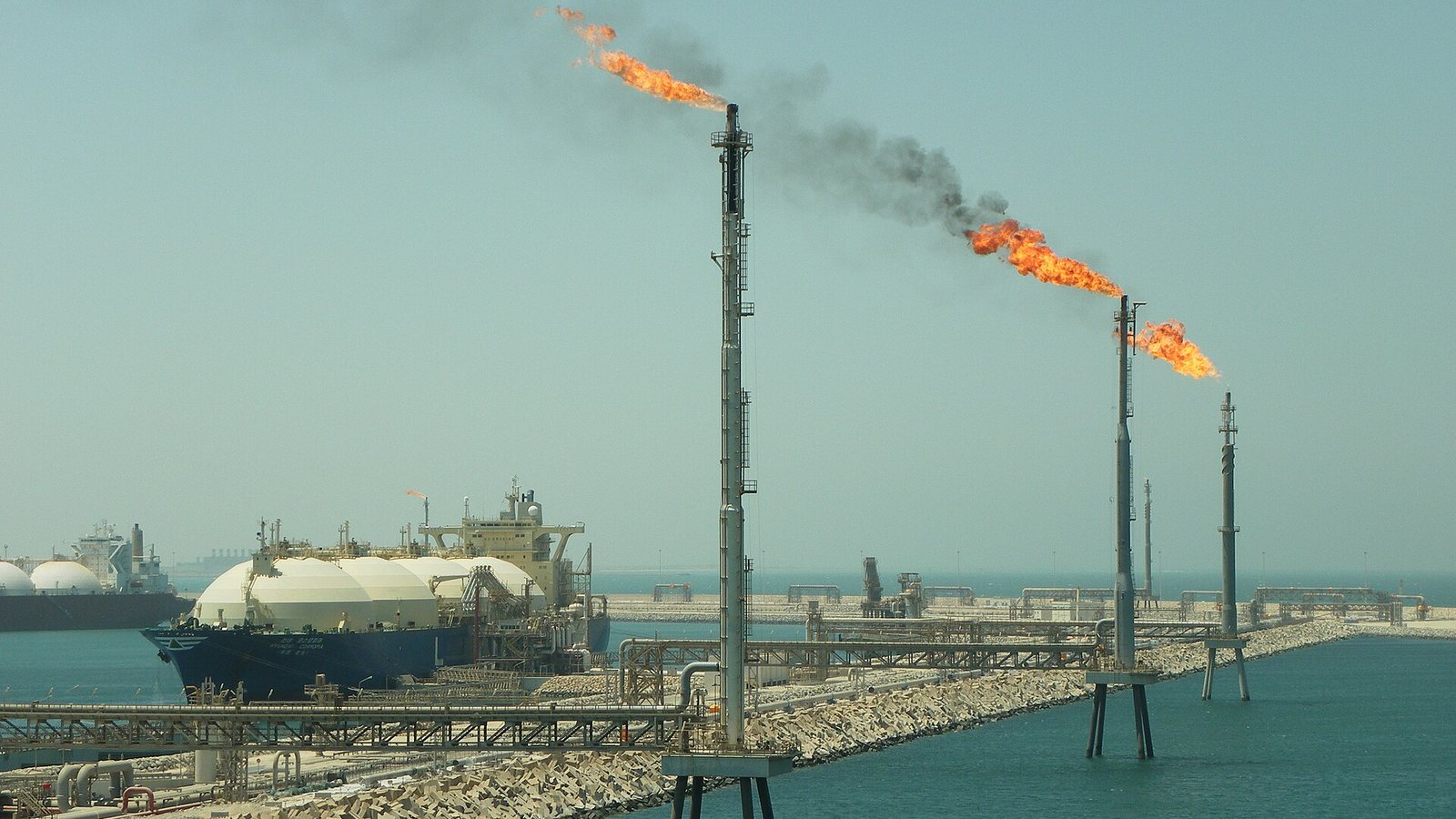
Illustrative image. Photo: Matthew Smith @ Flickr, CC BY 2.0, via Wikimedia Commons — source


[…] therefore matters for European supply security, even if the plant is small next to Qatar’s North Field expansion. Background on Qatar’s role is in our QatarEnergy […]