Poland Delays First Nuclear Plant to 2036, Sets 2040 for Second


Poland’s Council of Ministers has formally adopted an updated version of the country’s nuclear power programme, pushing back the start-up date for the nation’s first reactor by three years to 2036 and setting 2040 as the target for a second plant, according to World Nuclear News. The revision is the clearest sign yet that Warsaw’s nuclear ambitions, first laid out in detail in 2020 and expanded in 2021, are colliding with the practical realities of financing, licensing and supply-chain constraints that have slowed nuclear newbuilds across Europe.
A three-year slip for Lubiatowo-Kopalino
The first plant, at Lubiatowo-Kopalino on the Baltic coast in Pomerania, is being developed by state-controlled Polskie Elektrownie Jądrowe (PEJ) together with Westinghouse and Bechtel using Westinghouse’s AP1000 reactor design. The site is planned for three AP1000 units with roughly 3,750 MWe of combined capacity. Under the government’s previous schedule, the first unit was due to enter commercial operation in 2033; the newly adopted programme pushes that to 2036, with the remaining two units following by 2038. The government’s own explanation, cited in the updated programme, points to a mix of factors rather than any single setback: the shifts in the European energy market since 2022, including the energy crisis that followed Russia’s invasion of Ukraine, and industrial electricity demand that has grown faster than earlier planning assumed.
Money has started moving even as dates slip
The delay has not come with a funding retreat. Poland has earmarked PLN 60.2 billion (about $15.4 billion) for PEJ’s recapitalisation over 2025-2030, through a mix of equity and debt financing drawn from both domestic and international sources. That is a meaningful commitment for a first-of-a-kind nuclear project in a country with no existing commercial reactors, and it suggests Warsaw is treating the schedule change as a timeline problem to manage rather than a reason to scale back the programme.
A second plant, still without a site or a vendor
Poland’s plan has always extended beyond Lubiatowo-Kopalino. A second nuclear power plant, to be built at either Bełchatów or Konin, is still working through a competitive dialogue process involving the United States, France and Canada as potential technology partners. Under the updated programme, the government expects to select a strategic partner and technology around 2027, begin construction near 2032, and bring the first unit online by 2040 — itself a one-year slip from the previous working assumption. Together, the two plants are meant to anchor Poland’s target of 6-9 GWe of nuclear capacity built on proven Generation III+ pressurised water reactors, a goal the government set out when it first updated the nuclear programme in 2020 and expanded in 2021 to cover six large reactor units.
Smaller reactors are moving in parallel
The large-reactor programme is not Poland’s only nuclear track. PGE PAK Energia Jądrowa is separately planning an APR1400 unit at Pątnów, a design already in commercial operation in South Korea and the United Arab Emirates — the same Korean reactor-export industry that has just pledged $120 billion to help build eight new reactors in the United States. A separate venture, SGE, has outlined ambitions for a fleet of up to 26 BWRX-300 small modular reactors, a GE Hitachi design that several European utilities are evaluating as a way to add nuclear capacity in smaller increments than a traditional gigawatt-scale plant, similar in spirit to the SMR-300 safety filing Holtec recently advanced in the United States. None of these SMR plans has reached a construction decision, and they sit outside the large-reactor programme the cabinet just updated.
Why the slippage is not unusual, but still matters
A three-year delay for a country’s first nuclear reactor is, in relative terms, a modest slip by the standards of recent Western nuclear newbuilds — Finland’s Olkiluoto 3 and the UK’s Hinkley Point C both saw schedules stretch by considerably longer. But for Poland, the 2036 date matters because it is tied directly to the country’s coal phase-out planning. Coal (hard coal and lignite combined) still supplied about 53% of Poland’s electricity in 2025, according to grid-operator data compiled by the Warsaw-based energy think tank Instrat — down from the high 50s a year earlier, but still the largest single source in the national mix by a wide margin. Nuclear power is central to the government’s case for how it can retire that remaining coal capacity without compromising grid reliability, and every year of delay at Lubiatowo-Kopalino is a year in which Poland’s energy mix depends more heavily on gas, imports and a buildout of renewables and storage to cover the gap.
There is also a cost dimension that makes the delay more than a scheduling footnote. Coal generators in the EU pay for their carbon emissions under the bloc’s Emissions Trading System, and that cost has been a major driver of why coal’s share of Polish generation has been falling even without new nuclear capacity coming online — it is also why Polish households and industry have faced some of the highest wholesale electricity prices in the EU in recent winters. A nuclear plant arriving three years later than planned means three more years of that carbon-cost exposure weighing on the power system before a large, low-carbon baseload alternative is available. The updated programme does not change the destination Warsaw has set for itself; it changes how long the country will have to lean on other sources, and absorb their costs, to get there.
Sources
- World Nuclear News, “Timeline for Polish nuclear units slips in updated programme,” October 5, 2026 — used for the Council of Ministers’ adoption of the update, the 2036/2040 dates and the second-plant site/vendor process.
- PAP (Polish Press Agency) reporting via biznes.pap.pl, “Poland’s nuclear power programme update by end-May; market dialogue on second nuclear plant in June” — used for background on the draft update process and the second-plant timeline.
- NucNet, “New schedule sees three-year delay for first nuclear power plant” — used for corroborating detail on the Lubiatowo-Kopalino schedule revision and vendor/technology background.
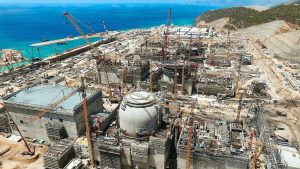
Illustrative image. Photo: Nuclear Regulatory Commission, Public domain, via Wikimedia Commons — source