


South Korea Pledges $120 Billion for Eight US Nuclear Reactors

South Korea has committed $120 billion to help build eight large nuclear reactors in the United States, the single biggest piece of a $350 billion Korean investment package tied to its trade deal with Washington. The plan, unveiled October 1 after months of closed-door talks, pairs six Westinghouse AP1000 units with two Korean-designed APR1400s and marks the first time Seoul’s nuclear industry has been asked to help build reactors on American soil rather than compete with Westinghouse for contracts abroad.
Six AP1000s, two APR1400s, no sites yet
The reactors fall under what the two governments are calling Project Power, one of three energy-focused investment tracks in the broader package alongside a gas-fired plant in Encinal, Texas (Project Star, $22.3 billion) and the Alaska LNG project (Project North, $50 billion). The AP1000 units — 1,110 MWe pressurized water reactors already running at Georgia’s Vogtle plant and at four sites in China — would be built as twin pairs on three federal sites. The two APR1400s, 1,400 MWe units that Korea Hydro & Nuclear Power (KHNP) has exported to the UAE’s Barakah plant and, more recently, to the Czech Republic’s Dukovany site, would go on federal land as well, though neither government has named the locations. U.S. Commerce Secretary Howard Lutnick pointed to Ohio, Tennessee, South Carolina and Kentucky as candidate states without confirming any of them.
Of the $120 billion, $100 billion is earmarked for construction and $20 billion held as contingency; South Korea has agreed to advance $10 billion by the end of the year to cover long-lead items such as reactor-grade forgings and turbine components, which typically have multi-year order backlogs. No construction start date or commissioning target has been set, and officials from both sides describe the figures as a framework rather than a signed construction contract — each reactor will still need site-specific licensing, engineering and procurement agreements.
Why Seoul wants a piece of Westinghouse
The deal’s more contentious thread is ownership. KEPCO and KHNP are in talks to take a minority stake in Westinghouse Electric, currently split 51% to Canada’s Cameco and 49% to Brookfield Asset Management, with one option being a “cornerstone” position of 5-10%; Westinghouse has also filed confidentially for an IPO. The logic is straightforward: Westinghouse and KHNP spent years in litigation over how much of the APR1400’s design derives from Westinghouse’s own System 80 technology, a dispute that was only settled in January 2024 and that Seoul blames for complicating its reactor-export bids elsewhere. A seat at Westinghouse’s table, Korean officials argue, would remove that friction for future sales.
Academics quoted in Korean media are less convinced. Dankook University’s Moon Joo-hyun called a stake “necessary to remove obstacles to exports,” but Kyung Hee University’s Chung Bum-jin countered that equity “does not guarantee” the intellectual-property dispute stays resolved, and pointed to Toshiba’s $5.4 billion purchase of Westinghouse in 2006 — a deal that preceded Westinghouse’s 2017 bankruptcy — as a cautionary precedent. Terms of any Korean stake remain under negotiation.
Korea’s export machine turns toward its biggest customer
For KHNP, building reactors on U.S. soil would be a role reversal. The company’s commercial pitch has long rested on speed and cost discipline relative to Western utilities — the four APR1400 units at Barakah were completed in roughly a decade, far faster than comparable Western projects, and Dukovany’s roughly $17 billion contract assigns 60% of construction work to Czech firms. Vogtle 3 and 4, the only AP1000s built in the U.S. so far, came in more than $17 billion over budget and seven years late, a record the industry has cited as reason enough to bring in outside construction expertise.
South Korea’s Ministry of Trade, Industry and Energy convened the first meeting of a new Nuclear Export Strategy Committee on October 1, bringing together government officials, state nuclear utilities, financiers and industry representatives to map out, in the ministry’s words, “step-by-step and sector-specific implementation plans” for licensing, engineering and construction contracts. The ministry is also setting up a “Team Korea” structure centered on KEPCO and KHNP, and will use the Nuclear Export & Safety conference in Gyeongju, scheduled for October 27-29, to court U.S. industry buyers directly.
Part of a larger, still-disputed package
The nuclear pledge arrives alongside — and is more settled than — the Alaska LNG piece of the same $350 billion package, where Seoul has publicly disputed the $50 billion figure President Trump cited, calling any investment decision premature pending commercial viability reviews. By contrast, Korean officials have moved immediately to stand up implementation structures for Project Power, suggesting Seoul sees more upside in nuclear construction work, where its state firms are contractor rather than financier, than in LNG infrastructure where it would mainly be putting up capital. Still, as officials on both sides acknowledge, Project Power remains a framework: site selection, licensing timelines, the Westinghouse ownership question and the remaining engineering contracts all have yet to be worked out.
The announcement lands in the middle of a broader run of U.S. nuclear activity: Holtec submitted a safety report for twin SMR-300 units at its Palisades site to the NRC just a day earlier, and Amazon signed a 20-year nuclear supply deal with Constellation to expand Calvert Cliffs the same week — evidence that both new construction and new demand are moving at the same time, even as Project Power’s own construction contracts remain unsigned.
Sources
- ANS Nuclear Newswire, “South Korea to invest in U.S. nuclear projects, including 8 large reactors,” October 2, 2026 — investment breakdown, reactor counts and siting details.
- NucNet, “South Korea Announces $120 Billion Plan For Eight Large-Scale Nuclear Power Plants In US,” October 1, 2026 — reactor mix and package structure.
- SBS News (Korea), “South Korea Begins Push for U.S. Nuclear Market Entry,” October 1, 2026 — Nuclear Export Strategy Committee, Team Korea, NES 2026 conference.
- Korea JoongAng Daily, “Westinghouse stake emerges as new but potentially risky option in Korea-U.S. nuclear cooperation talks,” September 10, 2026 — Westinghouse ownership structure, academic commentary, IP dispute history.
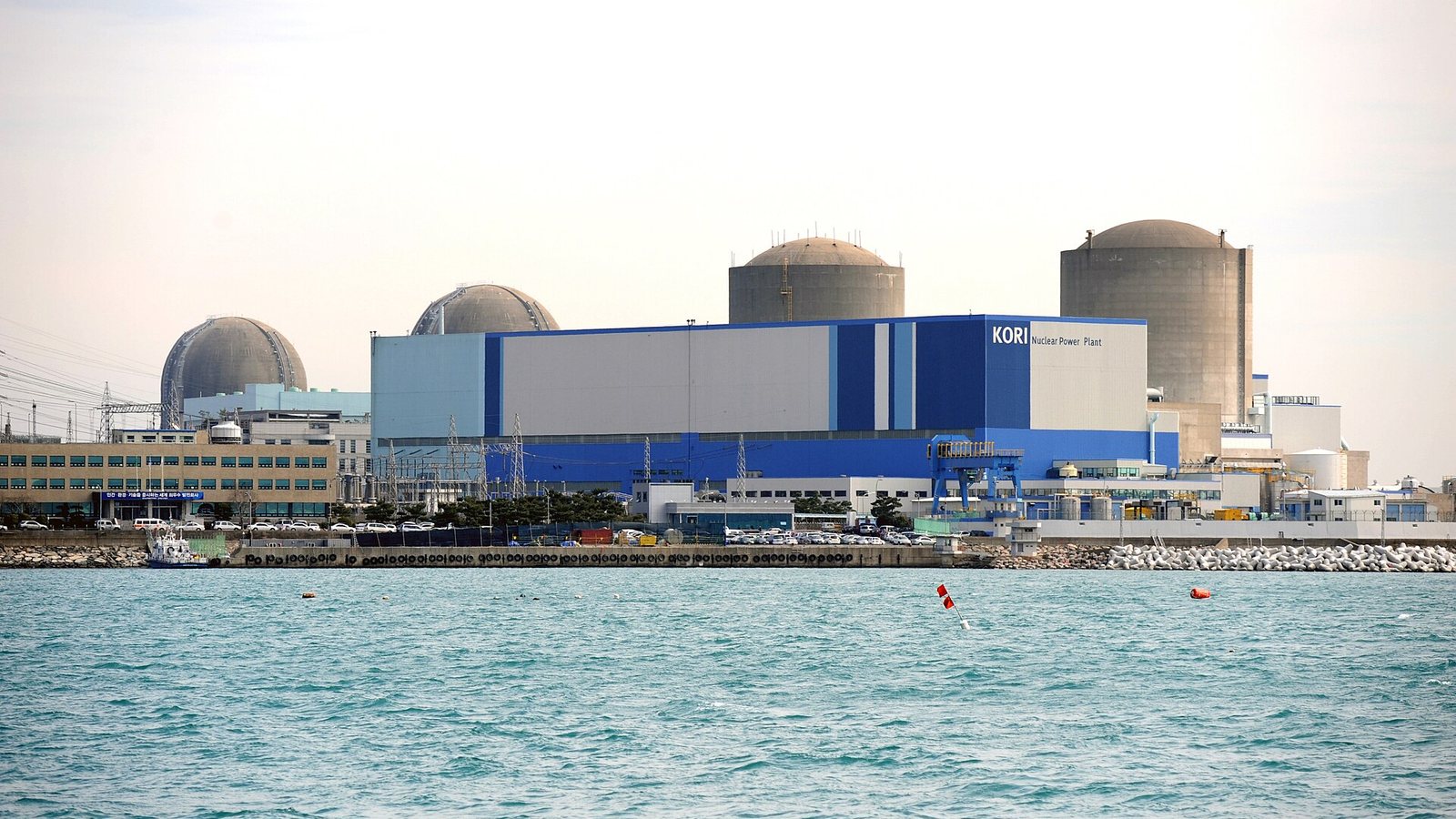
Illustrative image. Photo: IAEA Imagebank, Public domain, via Wikimedia Commons — source


.jpg)