UAE Energy Mix: Gas, Nuclear and Solar Explained

The UAE energy mix is built on natural gas for most electricity, a fast-growing contribution from solar power and, since the Barakah plant came online, a large block of nuclear generation. The country is also one of the world’s major oil exporters, so its domestic energy choices are closely tied to its export strategy. This guide explains how electricity is produced, which projects matter, where imports and exports fit in and what risks the system faces.
UAE Energy Mix: Overview and Key Figures
The United Arab Emirates is a federation of seven emirates, and Abu Dhabi holds the great majority of the country’s oil and gas resources. Oil and gas dominate primary energy supply and export earnings, while electricity generation has diversified more quickly than many observers expected.
Key points to remember:
- Natural gas is still the largest source of electricity generation.
- Nuclear power, from the four-unit Barakah plant, supplies roughly a quarter of the country’s electricity according to the operator ENEC.
- Solar capacity, both large photovoltaic plants and concentrated solar power, has expanded rapidly and is the main renewable source.
- Electricity demand is shaped by air conditioning and desalination, which peak in summer.
For up-to-date capacity and generation statistics, consult the UAE Ministry of Energy and Infrastructure, the International Energy Agency (IEA) country profile and the Energy Institute Statistical Review.
Energy Mix and Resources
Oil and gas
The UAE holds one of the largest proven oil reserve bases in the world, at roughly 113 billion barrels according to the Energy Institute, with the bulk in Abu Dhabi. The state company ADNOC manages most production and has set a goal of reaching 5 million barrels per day of production capacity. Gas is produced both as associated gas from oil fields and from dedicated fields, but demand for power, industry and water has been high enough that the country also imports gas.
Nuclear
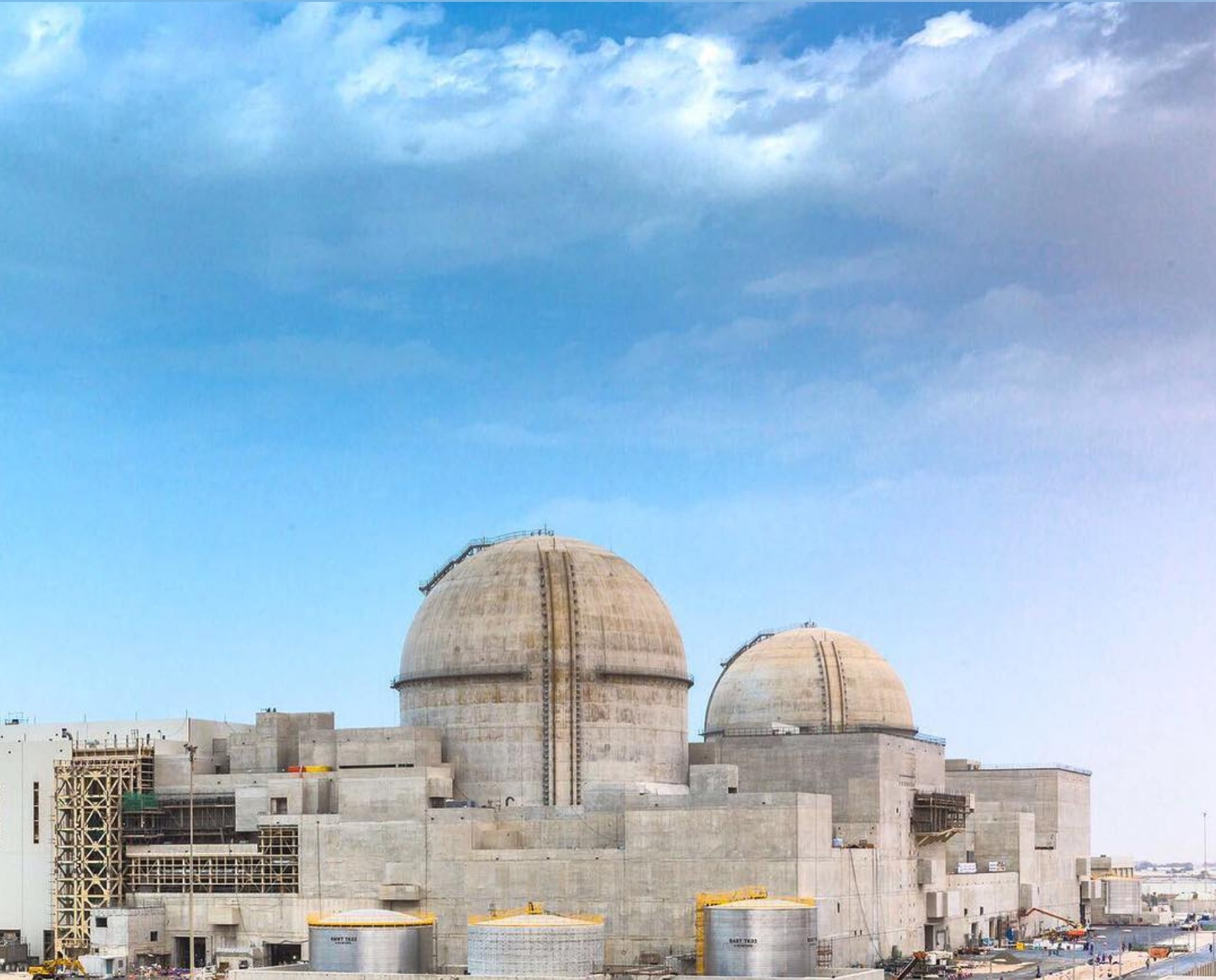
The Barakah plant in Abu Dhabi’s Al Dhafra region has four APR-1400 reactors with a combined capacity of about 5.6 gigawatts. The first unit began commercial operation in 2021 and the fourth followed in 2024. Barakah was the first commercial nuclear power plant in the Arab world, and it was built with South Korean partners under the Emirates Nuclear Energy Corporation (ENEC).
Solar
Large solar plants have been built in Abu Dhabi and Dubai. The Noor Abu Dhabi plant at Sweihan has a capacity of about 1.2 gigawatts, and the Al Dhafra solar plant, developed by Masdar and partners, added roughly 2 gigawatts. In Dubai, the Mohammed bin Rashid Al Maktoum Solar Park is being developed in phases and combines photovoltaic and concentrated solar power with storage.
UAE Electricity: How the Mix Is Structured
| Source | Role in the system | Key assets |
|---|---|---|
| Natural gas | Backbone of power and desalination, flexible capacity | Combined-cycle plants in Abu Dhabi, Dubai, Sharjah |
| Nuclear | Large, steady low-carbon baseload | Barakah (four units) |
| Solar | Daytime generation, fastest-growing renewable | Noor Abu Dhabi, Al Dhafra, Mohammed bin Rashid Al Maktoum Solar Park |
| Other | Small contributions and backup | Waste-to-energy and oil-fired units |
Power and water companies are organised mainly by emirate, with Abu Dhabi, Dubai (DEWA), Sharjah (SEWA) and the Federal Electricity and Water Authority serving different areas. Interconnection between the emirates helps balance supply.
Major Companies and Projects
- ADNOC: oil and gas producer, expanding gas production and LNG ambitions, including the Ruwais LNG project under development.
- Masdar: the clean energy company, active in the UAE and abroad in solar, wind and storage.
- ENEC and Nawah: owner and operator of Barakah.
- TAQA and EWEC: Abu Dhabi power producers and procurement entity for new capacity and water.
- DEWA: Dubai’s utility, central to the solar park and demand management.
Imports, Exports and Infrastructure
The UAE exports crude oil, mostly from terminals at Fujairah on the Gulf of Oman side and Jebel Dhanna on the Gulf. The Habshan-Fujairah pipeline carries Abu Dhabi crude to Fujairah, which allows exports to bypass the Strait of Hormuz.
On gas, the Dolphin pipeline brings Qatari gas to the UAE and Oman, and LNG import terminals, such as the one at Jebel Ali in Dubai, add flexibility during peak demand. This is why the country can be both a major hydrocarbon exporter and a gas importer. Domestic gas supply growth, including sour gas development, aims to reduce that reliance.
UAE Energy Strategy: Policy and Investment Outlook
The UAE energy strategy was set out in a long-term plan with the goal of raising the share of clean energy in the power mix to around half by mid-century, and the country later announced a net-zero emissions target for the same period. It was the first country in the Middle East and North Africa to make such a commitment.
Policy tools include competitive tenders for solar, long-term power purchase agreements with state utilities, nuclear investment and energy efficiency standards. The state also invests heavily in technology such as carbon capture, hydrogen and battery storage. Investors and analysts watch whether announced targets are matched by firm project approvals and grid upgrades.
Why storage and flexibility matter
Solar and nuclear plants both supply large volumes of low-carbon power, but neither follows demand on its own. Solar output peaks at midday, while air-conditioning load stays high into the evening. Nuclear units run steadily and are not designed to ramp up and down every day. Gas-fired plants and, increasingly, battery storage and thermal storage at concentrated solar plants fill that gap. This is why the UAE continues to build both new clean generation and flexible capacity at the same time.
Risks and Challenges
- Peak demand: summer cooling and water desalination raise load sharply, and solar output does not align fully with evening peaks without storage.
- Gas supply: reliance on imports and associated-gas output exposes the system to price and supply swings.
- Regional security: energy infrastructure sits in a sensitive region, which raises insurance and protection costs.
- Policy credibility: hosting global climate talks and expanding oil production at the same time draws scrutiny.
- Grid integration: adding large solar and nuclear blocks requires flexible capacity, storage and strong transmission.
What the UAE Energy Mix Means for Global Energy Markets
As an oil exporter, the UAE benefits when more domestic electricity comes from nuclear and solar, because every barrel of oil or cubic metre of gas not burned at home is available for sale. The country is also a buyer and developer of renewable projects in other markets through Masdar, and its sovereign investors help to finance energy projects abroad. Its spare production capacity, a global LNG ambition and its role as a trading hub make the UAE a significant influence on energy flows between Asia, Europe and Africa.
Frequently Asked Questions About the UAE Energy Mix
What is the main source of electricity in the UAE?
Natural gas is the largest source, with nuclear power next and solar growing quickly.
How much of the UAE’s electricity comes from nuclear?
ENEC states that Barakah provides roughly a quarter of the country’s electricity.
Does the UAE import energy?
Yes, it imports natural gas through the Dolphin pipeline and LNG terminals, even though it exports large volumes of oil.
Where is the UAE’s largest solar plant?
Large plants operate at Sweihan (Noor Abu Dhabi), Al Dhafra in Abu Dhabi and at the Mohammed bin Rashid Al Maktoum Solar Park in Dubai.
What is the UAE’s clean energy target?
The national energy strategy aims for about half of the power mix to come from clean sources by mid-century, alongside a net-zero emissions goal.
Conclusion
The UAE energy mix shows how an oil and gas exporter can use gas, nuclear and solar together to meet rising demand while preserving hydrocarbons for sale. Gas remains central, Barakah supplies a large, steady share and solar continues to grow. Its success will depend on storage, grid upgrades, secure gas supply and continued investment, and readers should check official statistics for the latest capacity and generation figures.
Sources and further reading
- UAE Ministry of Energy and Infrastructure (moei.gov.ae)
- International Energy Agency, United Arab Emirates country profile (iea.org)
- Energy Institute, Statistical Review of World Energy (energyinst.org)
- Emirates Nuclear Energy Corporation (enec.gov.ae)
- Masdar (masdar.ae) and ADNOC (adnoc.ae)