Saudi Arabia Intercepts More Houthi Missiles as Riyadh Reels From Deadliest Attack in Over a Decade


Saudi Arabian air defenses intercepted two ballistic missiles fired toward the capital on Tuesday, the kingdom said, a day after a separate Houthi strike on Riyadh’s King Khalid International Airport killed at least 12 people and wounded more than 300 — an attack several regional outlets described as the deadliest on Saudi soil in more than a decade.
A Third Day of Strikes on the Capital
The missiles intercepted on Tuesday caused no reported casualties, Saudi authorities said, in contrast to the strike two days earlier that hit the domestic terminals of King Khalid International Airport. That attack killed four Saudi nationals along with citizens of Bangladesh, Palestine, the United States, Egypt, Jordan and Sudan, according to Saudi officials, and left more than 300 people wounded. It came just days after an earlier Houthi strike on the same airport killed three people, including an airline pilot.
The Saudi-led coalition has blamed the Iran-aligned Houthi movement, which controls much of northern Yemen, for the attacks. A Houthi military spokesperson claimed an earlier ballistic-missile strike on the airport but had not commented, as of Tuesday, on the mounting civilian toll.
Oil Markets Swing, Then Steady
Crude prices jumped roughly 2% to two-week highs after the deadly strike, with traders citing fears that the attacks could widen into broader disruption of Gulf energy infrastructure, even as OPEC officials pointed to resilient oil demand, according to market coverage from OilPrice.com. Benchmark prices eased back from above $106 a barrel on Tuesday after Saudi Arabia’s energy minister, Prince Abdulaziz bin Salman, said the kingdom’s energy supply system remained resilient and that crude exports would continue without interruption.
The pattern echoes late September, when Brent crude jumped more than 4% to above $107 a barrel following an earlier round of Houthi missile and drone fire aimed at Saudi Arabia — a reminder that, so far, Riyadh has kept oil flowing even as attacks on its own territory have intensified.
Travel Warnings Pile Up
Riyadh’s airport suspended operations to assess damage after the weekend strike. In its aftermath, the United States, Australia, Canada, Japan, South Korea and New Zealand all urged their citizens to avoid travel to Saudi Arabia, an unusually broad set of advisories against a country that is both a major global oil exporter and a regional aviation hub.
Markets Weigh a Widening Regional War
The Riyadh strikes compound a broader conflict that has already drawn in tanker traffic through the Strait of Hormuz and unsettled global energy markets for weeks. The International Monetary Fund has flagged the Middle East energy crisis as the top risk to global economic growth this year, even as it points to AI-related investment spending as a partial offset, according to OilPrice.com’s market coverage. OPEC officials, meanwhile, have pointed to resilient oil demand as a reason prices retreated almost as quickly as they rose this week.
Saudi Arabia remains the world’s largest oil exporter and the de facto leader of OPEC+, meaning any sustained disruption to its production or export infrastructure would ripple well beyond the kingdom’s borders. The kingdom has for years operated an East-West pipeline, commonly known as Petroline, that can move an estimated 7 million barrels per day of crude overland to the Red Sea port of Yanbu specifically to reduce its exposure to Hormuz; officials have in recent months held preliminary talks about expanding that capacity further, though no final investment decision has been announced. The insistence that supply remains secure also follows a warning last month from Saudi Aramco’s own chief executive, who said global oil inventories were “scarily thin,” leaving markets with less of a buffer to absorb a sustained disruption than in past Gulf crises.
Houthis Threaten a ‘Harsh Response’
Hours after Tuesday’s interceptions, the Houthi movement said it would respond “harshly” to Saudi Arabia, and explosions were reported in the Yemeni capital, Sanaa, raising the prospect of further exchanges in the coming days. Riyadh has not announced any retaliatory strikes inside Yemen in response to the airport attacks, instead emphasizing that its energy exports and domestic flight operations have continued.
Sources
- Al Jazeera, “Attack on Riyadh airport kills 12, injures over 300, Saudi Arabia says,” Oct. 10, 2026 — casualty figures and nationalities.
- Al Jazeera, “Houthi attack on Riyadh airport killed three Saudi nationals,” Oct. 9, 2026 — earlier strike toll.
- OilPrice.com, Latest Energy News (World News), Oct. 12–13, 2026 — oil price moves and Saudi interception/export statements.
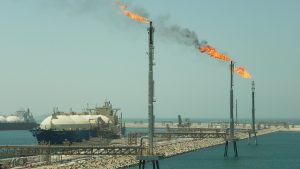
Illustrative image. Photo: B.alotaby, CC BY-SA 4.0, via Wikimedia Commons — source