Mozambique Approves ExxonMobil’s Redesigned Rovuma LNG Plan, Clears Path to Year-End FID

Mozambique’s Council of Ministers has approved a redesigned development plan for ExxonMobil’s Rovuma LNG project, clearing a key regulatory hurdle for a nearly $30 billion liquefied natural gas scheme in the country’s northern Cabo Delgado province. The decision, confirmed this week after ExxonMobil upstream president Dan Ammann met Mozambican President Daniel Chapo in Maputo, raises the planned onshore plant’s capacity to 18.6 million tonnes per annum (mtpa) of LNG, up from the 15.2 mtpa approved in 2019, and sets the stage for a final investment decision ExxonMobil expects before the end of 2026.
A redesigned plan clears Maputo’s Council of Ministers
The approval, reported by the Mozambican outlet O Económico, updates the development plan Mozambique first signed off on in 2019, before a Cabo Delgado insurgency forced ExxonMobil, TotalEnergies and other operators to evacuate staff and suspend work for years. The government says the revised design cuts costs by using electric, rather than gas-fired, processing modules at the onshore liquefaction plant, a shift that also lowers the project’s carbon footprint. Mozambique’s National Petroleum Institute (INP) expects the new design to cut emissions by around 40% compared with the original plan.
Rovuma LNG draws gas from Area 4 of the offshore Rovuma Basin, the same acreage that feeds Eni’s floating Coral Sul and Coral Norte LNG vessels. The onshore plant itself sits in Cabo Delgado, where attacks by an Islamic State-linked insurgency displaced hundreds of thousands of people and forced a multi-year pause on the adjacent, TotalEnergies-led Mozambique LNG project, which formally resumed construction earlier this year.
More capacity, and a bigger slice for the domestic market
Beyond the capacity increase to 18.6 mtpa, the approved plan reserves 25% of produced gas for Mozambique’s domestic market, a provision aimed at addressing long-standing criticism that the country’s gas wealth has mostly been exported while electrification at home lags. INP estimates the project could generate roughly $121 billion in state revenue over its projected 25-year production life, according to figures reported by The Energy Year, though such long-horizon forecasts carry significant uncertainty tied to future gas prices and output rates.
The Eni asset swap behind Exxon’s bigger stake
The approval follows an asset swap agreed in October under which ExxonMobil raised its Rovuma LNG stake to 50%, exchanging interests with partner Eni, which operates the Coral Sul and Coral Norte floating LNG units in the same basin. The restructuring is designed to let each company concentrate operational responsibility where it has the deeper expertise, with ExxonMobil taking the lead on the larger onshore scheme. Eni and ExxonMobil have not detailed the full financial terms of the swap.
Financing a $30 billion project in a still-recovering province
Standard Bank estimates the redesigned Rovuma LNG project will cost close to $30 billion, which would make it Mozambique’s largest onshore industrial development. That price tag sits alongside the $20 billion, 13.1 mtpa TotalEnergies-led Mozambique LNG project next door, meaning the two schemes together represent roughly $50 billion of liquefaction capacity concentrated in a province still working through the aftermath of insurgent violence. Security remains a live consideration for lenders and insurers weighing the project, even as construction activity has resumed.
ExxonMobil has not yet taken a formal final investment decision on Rovuma LNG. Company guidance points to an FID before the end of 2026, with Bloomberg reporting, via EnergyConnects, that first LNG output would not arrive until the early 2030s given the scale of construction still required.
What it means for global LNG supply
Taken together, Mozambique’s approved and under-construction LNG projects would lift the country’s total nameplate capacity to nearly 45 mtpa, according to BloombergNEF estimates — equivalent to roughly 10% of global LNG supply as of last year, among the world’s largest LNG exporting countries. BNEF projects global LNG demand will grow by around 40% through 2035, a trajectory that has pulled renewed buyer and investor interest toward East African supply following disruptions tied to the wars in Ukraine and, more recently, Iran. Fitch Ratings separately forecasts that sub-Saharan Africa’s LNG exports could rise nearly 175%, from 35.7 billion cubic metres in 2024 to 98 bcm by 2034, with Mozambique as the region’s single largest contributor to that growth.
For now, the approval is a planning and permitting milestone rather than a construction green light. The next marker to watch is whether ExxonMobil and its partners — including Eni and a consortium that has also included China National Petroleum Corporation, Mitsui, Galp, KOGAS and Mozambique’s state-owned ENH — can lock in financing and offtake agreements in time for the targeted year-end FID.
Sources
O Económico, “Mozambique government approves ExxonMobil’s amended Rovuma LNG plan,” November 2026.
EnergyConnects (via Bloomberg), reporting on Rovuma LNG capacity and timeline, November 2026.
The Energy Year, Mozambique National Petroleum Institute (INP) revenue and emissions estimates, 2026.
The Rio Times, reporting on the Ammann–Chapo meeting in Maputo, November 2026.
BloombergNEF, Mozambique LNG capacity and global LNG demand forecasts, 2026.
Fitch Ratings, sub-Saharan Africa LNG export forecast, 2026.
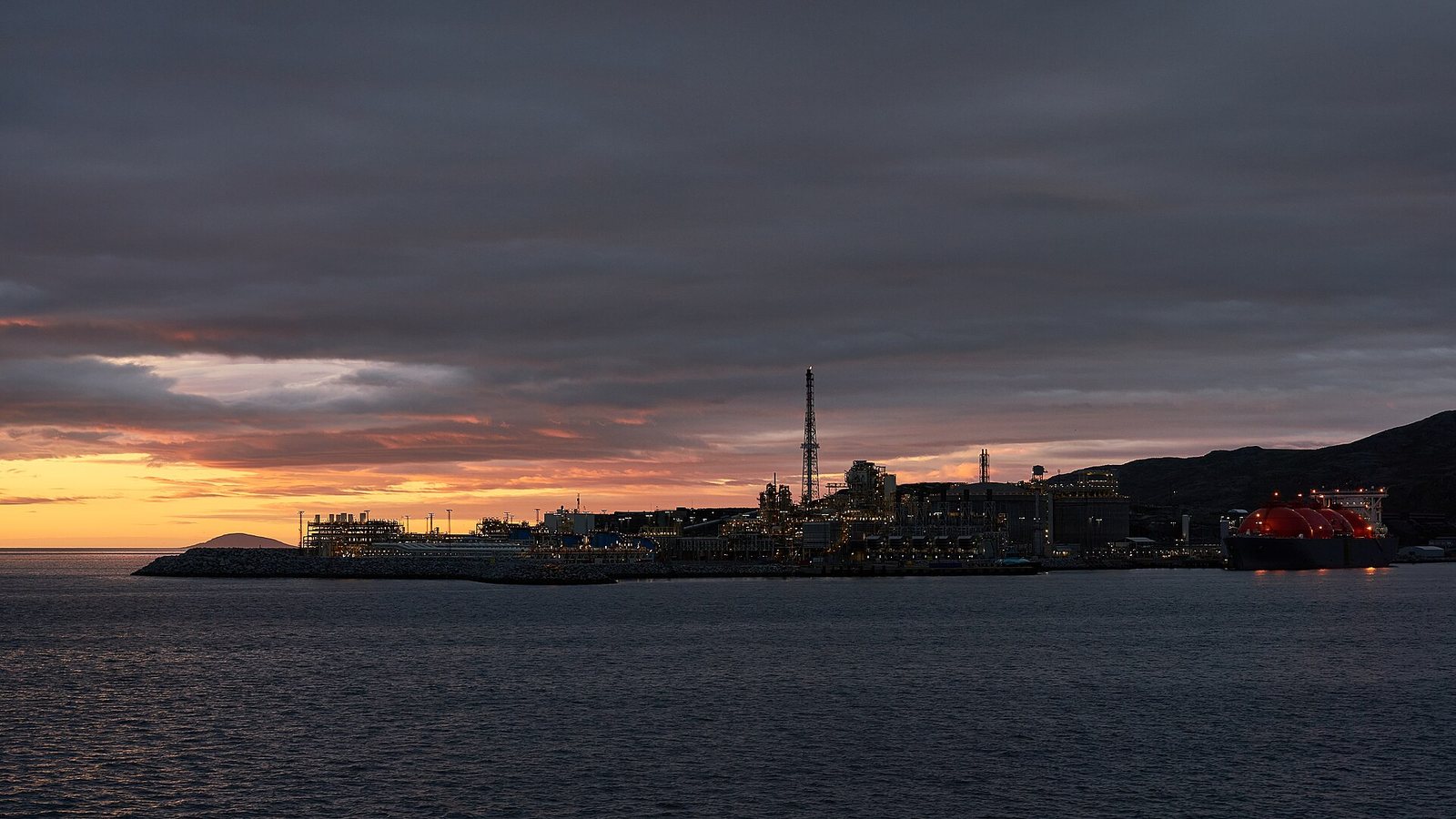
Illustrative image. Photo: Virtual-Pano, CC BY-SA 4.0, via Wikimedia Commons — source