Lithium Supply Chains: Defence Meets Battery Demand

Last updated: November 29, 2026
Lithium sits in an unusual position among critical minerals: it is produced in only a handful of countries, refined almost entirely in one, and increasingly treated by defence planners as a material too strategic to leave to the open market. In July 2026, the US Defense Logistics Agency (DLA) issued its first-ever solicitation to add lithium carbonate to the National Defense Stockpile — up to 16,167 metric tons, with a ceiling value of $300 million. Five weeks later, on August 3, 2026, DLA cancelled the tender outright. That reversal, more than any single battery contract, shows how unsettled the defence side of the lithium market still is, even as civilian demand for lithium-ion batteries keeps climbing. This page looks at where lithium actually comes from, why militaries have started buying it directly, where lithium batteries show up in defence hardware, and why the defence sector remains a minor, price-taking participant in a market that civilian battery demand built. It sits alongside our existing coverage of critical minerals for energy and defence, including rare earths and copper.
How concentrated is the global lithium supply chain?
Mined lithium is less concentrated than many other critical minerals, but refined lithium is not. According to US Geological Survey data compiled by the OECD and Our World in Data, Australia accounted for roughly 36.7% of global mined lithium output in 2024, Chile about 20.4%, and China about 17.1% — together close to three-quarters of world supply, with Zimbabwe, Argentina and Brazil making up most of the rest. Chile’s state minerals agency Cochilco forecasts a shifting mix for 2026, with Australia’s share falling to around 28%, Argentina and Chile together contributing about 26%, and China’s own mined output rising to roughly 23% as new domestic projects ramp up.
The bottleneck is further downstream. Industry estimates consistently put China’s share of global lithium processing — converting spodumene concentrate or brine into battery-grade lithium carbonate and lithium hydroxide — at around 65%. Most Australian concentrate is exported to China for conversion rather than refined domestically, and Chilean and Argentine brine operations, while refining more of their own output in-country, still compete for capacity against a Chinese processing base built over two decades of EV-driven investment — a concentration pattern we’ve also tracked on the mining side in Critical Metals’ 2026 takeover of the European Lithium project in Austria, one of the relatively few Western-controlled lithium assets outside the big three producing countries.
| Country | Share of mined lithium, 2024 (actual) | Share of mined lithium, 2026 (Cochilco forecast) | Source |
|---|---|---|---|
| Australia | 36.7% | ~28% | USGS/OECD (2024); Cochilco (2026 forecast) |
| Chile | 20.4% | ~13–15% (part of combined Argentina+Chile ~26%) | USGS/OECD; Cochilco |
| China | 17.1% | ~23% | USGS/OECD; Cochilco |
| Argentina | 7.5% | part of combined ~26% with Chile | USGS/OECD; Cochilco |
| Zimbabwe | 9.2% | ~8% | USGS/OECD; Cochilco |
| China (processing/refining, all years) | ~65% of global capacity | Industry estimates cited by multiple trade press | |
Why militaries are now buying lithium directly
Until recently, defence involvement in lithium was indirect: militaries bought finished batteries, not the raw mineral behind them. That started to change under the US Defense Production Act (DPA). In 2023, the Department of Defense awarded Albemarle $90 million under DPA Title III authority, funded through Inflation Reduction Act appropriations, to support reopening its Kings Mountain, North Carolina lithium mine — explicitly framed as reducing US dependence on imported lithium for both civilian and defence battery supply chains. As of 2026 reporting, Kings Mountain’s restart timeline has slipped; DoD’s original release pointed to operations between 2025 and 2030, while trade press in 2026 described the project as delayed pending permitting, with no fixed restart date confirmed.
The more direct move came through the National Defense Stockpile itself. DLA’s March 2026 sources-sought notice (around 550 metric tons) was followed by a formal July 2, 2026 solicitation for up to 16,167 metric tons of 99.5%-purity battery-grade lithium carbonate, with deliveries proposed to DLA depots in New York, Nevada, Indiana and Ohio, under a five-year, $300 million-ceiling structure. It was reported as the first time lithium had been formally proposed for inclusion in the stockpile. DLA cancelled the solicitation in its entirety effective August 3, 2026; trade press cited market volatility and pricing uncertainty as likely factors, though DLA did not give a public reason in the reporting reviewed for this page. No replacement solicitation had been reported as of this update.
| Milestone | Date | Scale | Status | Source |
|---|---|---|---|---|
| DoD – Albemarle, Kings Mountain mine (DPA Title III) | 2023 award | $90 million | Delayed restart (per 2026 reporting) | DoD release; Engineering & Mining Journal |
| DLA sources-sought notice, lithium carbonate | March 2026 | ~550 metric tons | Market-research notice, non-binding | SAM.gov notice via contracting trade press |
| DLA National Defense Stockpile solicitation, lithium carbonate | Issued July 2, 2026 | Up to 16,167 t; $300 million ceiling | Cancelled effective August 3, 2026 | Engineering News; Mining Weekly; SMM |
Where lithium batteries do the fighting
Away from mineral policy, lithium-ion batteries have already displaced older chemistries in several defence applications. The US Navy’s Orca extra-large unmanned underwater vehicle, with a stated range approaching 10,000 km, relies on lithium-ion cells rather than the lead-acid batteries used in older uncrewed systems. South Korea’s Jang Bogo-III Batch-II submarine is described by Korean defence industry sources as the country’s first domestically built submarine equipped with lithium-ion batteries, chosen over lead-acid for longer cell life and improved underwater endurance. Soldier-worn electronics — night-vision, radios, body-armour-integrated power packs — are a separate, smaller but fast-growing draw on lithium-ion supply as dismounted troops carry more networked equipment. Unmanned aerial, ground and underwater systems add a further layer of demand: lithium-polymer cells power the large majority of small first-person-view drones in both military and commercial use, a segment where UK defence-research institute RUSI has flagged China’s dominance of cell manufacturing as a specific supply-chain concern for Western militaries. Lithium-ion is also the chemistry behind the man-portable and vehicle batteries produced by defence-linked manufacturers profiled in our roundup of defence companies investing in energy technologies, including Turkish battery maker ASPİLSAN Enerji.
The scale comparison matters here. A RAND Corporation assessment of military battery supply chains found that civilian demand, not defence demand, is what drives battery development and manufacturing investment — consumer and EV volumes dwarf military orders by orders of magnitude, so a US-based battery manufacturer serving defence needs cannot rely on military contracts alone to justify new capacity. That is the core of the energy-defence relationship for lithium: militaries consume a small, specialised slice of a market whose scale, cost curve and manufacturing base were built almost entirely by civilian electric-vehicle and grid-storage demand. Defence planners are, in effect, trying to secure guaranteed access to — and in the stockpile case, a price floor within — an industrial base they do not control and did not build.
China’s export controls add a second layer of risk
Mineral supply is only part of the exposure. Starting in July 2025, China’s Ministry of Commerce added lithium-ion battery and lithium-processing technologies to its export control list, requiring a government-issued licence to transfer overseas processes covering LFP and LMFP cathode preparation, lithium carbonate and hydroxide production, metallic lithium preparation and brine-based lithium extraction. In October 2025, Beijing expanded the controls to cover high-performance lithium-ion cells and packs with energy density of 300 Wh/kg or above, along with specialised production equipment such as continuous graphitization and liquid-phase coating lines. The stated intent, per Chinese trade-policy statements reported by multiple outlets, is to protect China’s technological lead in battery manufacturing rather than to block mineral exports outright; even so, the measures mean that countries trying to build independent lithium-processing or advanced-cell capacity — a stated US and European goal, defence-linked or not — now need Chinese government sign-off to licence some of the underlying process technology, even where they are not short of the raw mineral itself. The policy also follows a broader pattern we cover in China’s grip on critical minerals for energy and defence.
Where the technology is used in civilian energy
Everything described above exists because of civilian demand, not the other way around. Lithium-ion chemistry is the default choice for electric-vehicle traction batteries worldwide and for the fastest-growing category of grid-scale storage — utility and residential battery energy storage systems (BESS) that firm up solar and wind output and provide grid services. Cochilco’s 2026 demand outlook, cited in multiple lithium-market analyses this year, puts global lithium demand at roughly 2.08 million tonnes of lithium-carbonate equivalent in 2026, rising toward 2.25 million tonnes in 2027, overwhelmingly on the back of EV and storage battery production rather than defence or any other industrial use. Defence stockpiling and DPA-funded mine restarts are best read as a strategic hedge riding on top of that civilian-built market — an attempt to secure a reliable, domestically available slice of a supply chain whose size, pricing and technology roadmap are set by electric cars and grid batteries.
Frequently asked questions
Why is lithium considered a critical mineral for defence?
Lithium is the basis for the lithium-ion batteries used in soldier power systems, unmanned underwater and aerial vehicles, and newer submarine designs, and supply is concentrated in a small number of mining countries and even more concentrated in Chinese processing capacity — which is why the Pentagon has tried, so far without full success, to add it to the National Defense Stockpile and to fund a domestic mine restart under the Defense Production Act.
Does the military use a large share of global lithium?
No. A RAND Corporation study found that civilian demand, overwhelmingly electric vehicles and grid storage, dwarfs military lithium-battery demand and is what drives manufacturing investment; defence programmes are a small, specialised buyer riding on a civilian-scale industrial base.
Which countries produce the most lithium?
Australia, Chile and China were the top three mined-lithium producers in 2024 (USGS/OECD data), together supplying close to three-quarters of global output; Cochilco’s 2026 forecast shows China’s mined share rising while Australia’s falls, with Argentina and Chile’s combined output also significant.
Why does China dominate lithium processing even though it isn’t the top miner?
Two decades of EV-driven investment built Chinese capacity to convert raw spodumene and brine into battery-grade lithium carbonate and hydroxide, giving China an estimated 65% share of global processing capacity even though its mined-lithium share is smaller than Australia’s.
Is the United States building a national lithium stockpile?
It tried to. DLA issued a $300 million-ceiling solicitation for battery-grade lithium carbonate in July 2026, the first attempt to formally add lithium to the National Defense Stockpile, but cancelled it in full effective August 3, 2026; no replacement solicitation has been reported since.
What happens if lithium battery technology exports from China are restricted?
China’s 2025 export controls require a government licence to transfer certain lithium-processing and high-energy-density battery technologies abroad; this does not block raw lithium exports but slows other countries’ ability to license Chinese process technology while they build independent processing or advanced-cell manufacturing capacity, defence-linked programmes included.
Sources
- USGS / OECD, “Enhancing Resilience Through Traceability – Lithium,” 2024 mined-production shares
- Our World in Data, lithium production by country, 2024
- Cochilco (Chilean Copper Commission), 2026 global lithium demand and production forecasts
- US Department of Defense, Albemarle Title III award announcement, 2023; Engineering & Mining Journal follow-up reporting, 2026
- Engineering News / Mining Weekly, “US defence agency seeks to buy up to $300m of lithium,” July 8, 2026
- ChemAnalyst / Oilprice.com, DLA lithium stockpile tender cancellation, August 2026
- RAND Corporation, military battery supply chain research report
- RUSI, “Wanted: More Batteries for Defence” commentary
- Thomson Reuters / Caixin Global, China lithium battery and processing technology export controls, July and October 2025
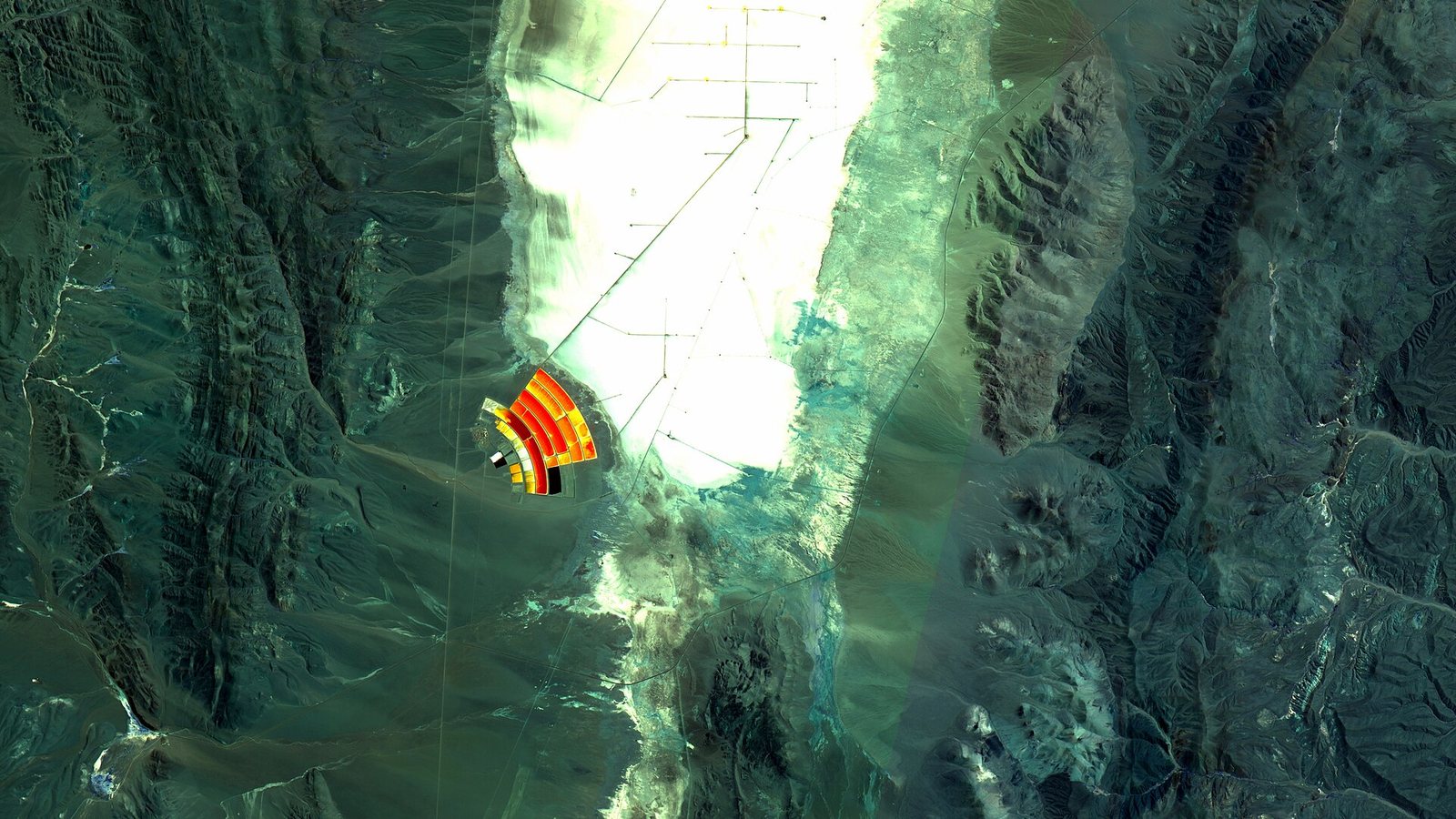
Illustrative image. Photo: Coordenação-Geral de Observação da Terra/INPE, CC BY-SA 2.0, via Wikimedia Commons — source