DOE Clears Accelerated Final Stage for World’s First Fast-Spectrum Molten Chloride Reactor


The US Department of Energy has approved cost-shared funding to accelerate the final stage of the Molten Chloride Reactor Experiment (MCRE), a project led by Southern Company in partnership with Idaho National Laboratory (INL) and maritime nuclear specialist Core Power, according to World Nuclear News. The project targets first criticality in 2027 for what its backers describe as the world’s first fast-spectrum molten chloride reactor, a zero-power research unit built to generate data for future commercial designs rather than to produce electricity itself.
MCRE sits under the DOE’s Advanced Reactor Demonstration Program and traces back to a November 2021 cooperative agreement between Southern Company and the DOE, which also involved TerraPower, EPRI, Orano Federal Services and 3M alongside INL and Core Power. The experiment is designed as a less-than-1-megawatt fast-spectrum reactor that uses liquid uranium chloride salt as both fuel and coolant, intended to validate safety and performance data ahead of a future TerraPower molten chloride fast reactor demonstration.
The Fuel-Salt Bottleneck
Reaching criticality requires INL to produce between 72 and 75 batches of fuel salt, a target the DOE’s Office of Nuclear Energy calls the laboratory’s largest fuel production challenge in three decades. Work on the salt began in 2020, and early batches fell short of both the 90% uranium-to-uranium-chloride conversion target and the 18-kilogram-per-batch goal. A process change in 2024 lifted conversion efficiency to 95% and enabled full-sized batches; INL says it can now produce a complete batch in as little as one day, a pace that underpins the newly accelerated timeline.
Jess Gehin, INL’s associate laboratory director for nuclear science and technology, said the experiment “will be the world’s first fast-spectrum molten chloride reactor to achieve criticality.” Mark Berry of Southern Company framed the funding as an example of public-private cost-sharing moving a technology from concept toward demonstration, while Core Power’s Mikal Bøe has tied the broader molten chloride platform to a separate commercial goal: adapting the technology for maritime nuclear propulsion on large commercial ships, a market distinct from Southern’s land-based utility interest but reliant on much of the same core fuel-salt chemistry.
Why Chloride, Not Fluoride
Most of the molten-salt reactor concepts that have attracted public attention in the past decade, including designs from Kairos Power and TerraPower’s own Natrium sodium-cooled line, use different salt chemistries or coolants. Chloride-salt fast reactors are a narrower niche: the fast neutron spectrum allows the reactor to use fuel more efficiently and, in principle, to consume certain long-lived actinides, but chloride salts are more corrosive and less thoroughly characterized in reactor environments than the fluoride salts used in 1960s-era molten-salt reactor experiments at Oak Ridge National Laboratory. The fuel-production difficulty behind MCRE’s multi-year delay is itself evidence of how much chemistry and manufacturing work a chloride-fuelled design demands before it can run, even at sub-megawatt scale.
Part of a Broader US Advanced Reactor Push
MCRE is one of several DOE-backed efforts to get non-light-water reactor concepts into physical operation this decade. The Nuclear Regulatory Commission has already issued a construction permit for a BWRX-300 small modular reactor at the Tennessee Valley Authority’s Clinch River site, the DOE has offered Vistra a $4.2 billion loan to uprate existing large reactors in Ohio and Pennsylvania, and BWXT’s BANR microreactor was recently selected for an Indigenous-led transportable nuclear project in Canada. Each targets a different niche, light-water SMRs for grid-scale baseload, uprates for near-term capacity, and microreactors for remote or defence applications, while MCRE is aimed further out, at validating a reactor class that no one has yet operated anywhere.
The DOE’s environmental review process for MCRE, completed in 2023, authorized a limited run of roughly six months at INL before the test reactor is decommissioned; the unit is not intended to operate commercially or indefinitely. Southern Company has described the original five-year, cost-shared agreement as valued at roughly $170 million, with DOE funding about 80% and the industry partners covering the remainder, though neither the companies nor WNN’s report on this week’s acceleration decision disclosed a revised budget figure for the accelerated final stage.
What Happens After Criticality
Reaching criticality would not make MCRE a power-producing reactor; its purpose is purely experimental, generating operational and safety data that TerraPower and other molten-chloride developers would use to support licensing and design work for a future, larger demonstration unit. For Southern Company, which already operates the conventional Vogtle AP1000 units in Georgia alongside its advanced-reactor research role, MCRE adds a third nuclear technology track to a company that has positioned itself as a repeat demonstrator of first-of-kind US reactor designs. Whether the accelerated schedule holds will depend on INL sustaining its faster fuel-salt production rate across the remaining batches needed before the reactor can go critical.
Sources: World Nuclear News, “US DOE funding to accelerate molten chloride reactor development,” October 15, 2026 (funding decision, fuel-salt production data, quotes); Idaho National Laboratory and Southern Company joint announcement, November 2021 (original cooperative agreement, partners, program structure); US Department of Energy, final environmental assessment for the Molten Chloride Reactor Experiment, August 2023 (operating duration, decommissioning plan).
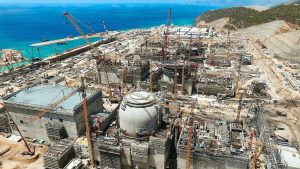
Illustrative image. Photo: Fischer.H, CC BY-SA 4.0, via Wikimedia Commons — source