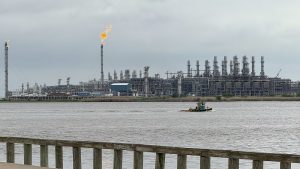
Overview
Technology: combined cycle; fuel: natural gas.
Ownership: Entergy Louisiana LLC.
Why it matters
- At a typical capacity factor of 40% for this technology, it would generate roughly 3.5 TWh of electricity a year (indicative estimate).
Gas-fired plants — especially combined-cycle units — provide flexible output that can ramp quickly to balance demand and variable renewables, so their availability is closely tied to gas supply and prices.
Oil & gas power in United States
United States has 590.9 GW of operating oil & gas capacity across 1,106 plants in the Global Energy Monitor dataset — 46% of the country's total operating power capacity of 1,280.9 GW.
The oil & gas pipeline in United States includes 29.4 GW under construction and 257.6 GW at earlier planning stages.
Other major oil & gas plants in United States include West County energy center (4.26 GW), Bruce Mansfield power station (3.64 GW) and Crystal River Energy Complex (3.45 GW).
See the full list: Gas & oil power plants in United States →
Units and phases
| Unit / phase | Capacity | Status | Technology | Start | Retired |
|---|---|---|---|---|---|
| PB01 | 1.00 GW | combined cycle | 2020 |
How gas & oil power plants work
Gas- and oil-fired power plants burn fuel either in a gas turbine, a steam boiler or a reciprocating engine. In a combined-cycle plant the hot exhaust of the gas turbine is used to raise steam for a second, steam-driven turbine, lifting overall efficiency to 55–62%.
Because gas units can start quickly and change output within minutes, they play a central role in balancing electricity systems with growing shares of wind and solar. Their operating costs track fuel prices closely, so gas supply security — via pipelines or LNG — directly affects how often they run. A modern combined-cycle plant emits roughly 0.35–0.4 tonnes of CO₂ per megawatt-hour.
Technology at Lake Charles power station
Combined-cycle units pair gas turbines with a heat-recovery steam generator and steam turbine, reaching efficiencies of 55–62% — the highest of any thermal power plant.
Location
Lake Charles power station is located in Louisiana, United States, at approximately 30.2726, -93.2991. Open the interactive map to explore nearby power plants, high-voltage lines and substations.
Ownership
Lake Charles power station is owned by Entergy Louisiana LLC. Across the dataset, Entergy Louisiana LLC is linked to 17 power plants with 11.8 GW of operating capacity.
Frequently asked questions
What is the capacity of Lake Charles power station?
Lake Charles power station has a capacity of 1.00 GW according to the latest Global Energy Monitor data.
What type of facility is Lake Charles power station?
Lake Charles power station is a oil- and gas-fired power station. Combined-cycle units pair gas turbines with a heat-recovery steam generator and steam turbine, reaching efficiencies of 55–62% — the highest of any thermal power plant.
Who owns Lake Charles power station?
Lake Charles power station is owned by Entergy Louisiana LLC.
Where is Lake Charles power station located?
It is located in Louisiana, United States. Approximate coordinates: 30.2726, -93.2991.
Is Lake Charles power station operational?
According to the latest data, Lake Charles power station is in operation. Operating means the facility is built and in commercial service.
When did Lake Charles power station start operating?
Start year: 2020. Current status: Operating.
How much electricity does Lake Charles power station generate?
Actual output data are not published for every plant. As an indicative estimate, Lake Charles power station would produce about 3.5 TWh a year, assuming a capacity factor of 40%, which is typical for this technology.
How big is Lake Charles power station compared with other facilities in United States?
Lake Charles power station ranks #165 by capacity among 1106 comparable oil & gas facilities tracked in United States.