China Begins Construction of World’s First Commercial HTGR Unit at Xuwei


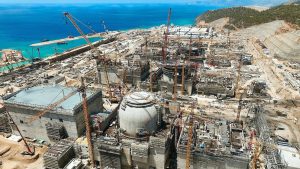
China’s state-owned China National Nuclear Corporation (CNNC) poured first concrete for the nuclear island of Unit 3 at the Xuwei Nuclear Heating and Power Plant in Lianyungang, Jiangsu province, marking the formal start of construction on what the company calls the world’s first commercial high-temperature gas-cooled reactor (HTGR) project, World Nuclear News reported on November 6.
A Reactor Built to Supply Industrial Steam
Unit 3 is a 660-megawatt-electric Chilong One reactor, designed for a 60-year operating life, and sits alongside two 1,208 MWe (net) Hualong One pressurized-water units already under construction at the same site, close to CNNC’s existing Tianwan nuclear plant. Unit 1, a Hualong One, had its own first-concrete milestone earlier in the year.
The project is owned and operated by CNNC Suneng Nuclear Power Company, with CNNC Energy Technology Company, in which CNNC holds a 46% stake, responsible for the HTGR’s design, equipment and material procurement, certification, construction support and project management. The reactor was jointly developed by CNNC and Tsinghua University, building on China’s earlier Shidaowan HTGR demonstration project in Shandong, for which CNNC served as the EPC contractor and which entered commercial operation after completing 168 hours of continuous running.
What sets Xuwei’s HTGR apart is its role in the plant’s steam system: its primary steam reheats saturated steam already produced by the site’s two Hualong One units, yielding three separate grades of industrial steam at different pressures and temperatures for use by nearby energy-intensive industry. CNNC says the plant’s steam heat-exchange station will use a heat-to-electricity conversion mode for the first time.
Large Industrial and Climate Claims
Once the Xuwei Phase I units are fully operating, CNNC projects the complex will supply about 32.5 million tonnes of industrial steam and more than 11.5 billion kilowatt-hours of electricity annually, figures the company says would cut standard coal consumption by 7.26 million tonnes a year and avoid 19.6 million tonnes of carbon dioxide emissions annually. In September 2025, a construction consortium was awarded a 4.2 billion yuan (roughly $590 million) contract covering the conventional islands of all three Xuwei units.
Part of China’s Wider HTGR and Nuclear Heat Push
Xuwei Phase I was among 11 reactors approved by China’s State Council in August 2024, part of a broader expansion of nuclear capacity that has also included new pressurized-water units. CNNC frames HTGR technology as a route to decarbonizing heat for heavy industry, including petrochemicals, rather than purely a power-generation technology, distinguishing it from the small modular reactor designs being pursued elsewhere mainly for electricity and data-center supply.
The milestone follows other recent progress across China’s nuclear construction program, including first concrete poured for Unit 5 at China’s Haiyang nuclear plant, underscoring the pace at which Chinese state nuclear developers are advancing both conventional and advanced reactor designs simultaneously.
Sources
- World Nuclear News, “Construction of Chinese HTGR begins,” published November 6, 2026 — project ownership, technical specifications, construction timeline and CNNC statements.
- China National Nuclear Corporation (CNNC), public project statements as reported by World Nuclear News and Energy Intelligence — output, emissions and contract-value figures.
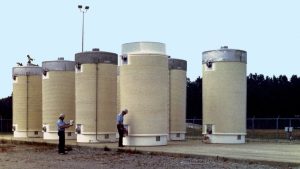
Illustrative image. Photo: Nuclear Regulatory Commission, Public domain, via Wikimedia Commons — source