Bangladesh Connects First Nuclear Power to National Grid at Rooppur


Bangladesh fed nuclear-generated electricity into its national grid for the first time on Tuesday, when Unit 1 of the Rosatom-built Rooppur Nuclear Power Plant supplied roughly 350 MW on a trial basis starting around 3pm local time, according to Bangladeshi outlets including The Business Standard, The Daily Star and Prothom Alo. The connection makes Bangladesh the 33rd country in the world to generate electricity from nuclear fission, though the plant is still months away from commercial operation.
A trial feed, not yet commercial power
Tuesday’s supply was explicitly a test, not the start of commercial generation. Bangladeshi officials said the plan was to keep Unit 1 synchronised with the grid for roughly 8 to 10 hours before disconnecting it again for further technical checks. Reconnection depends on approval from the Bangladesh Atomic Energy Regulatory Authority (BAERA), which must sign off on each successive phase of trial operation before the reactor can resume feeding power to consumers.
Under Bangladesh’s contract with Rosatom, the Russian state nuclear corporation building the plant, Unit 1 must complete a trial operation period of around 10 months — running the reactor intermittently while regulators and plant operators verify its systems under real grid conditions — before it is handed over for full commercial electricity supply. That puts a realistic start date for steady, revenue-generating output for Rooppur Unit 1 closer to the second half of 2027, even though Tuesday’s feed is the first time the reactor’s output has reached ordinary consumers.
Seven years after fuel loading, criticality in October
Rooppur Unit 1’s path to this point has run through the standard sequence of reactor start-up milestones. The unit reached first criticality — the point at which its fission chain reaction becomes self-sustaining at low power — in October 2026, World Nuclear News has reported, a step that typically precedes grid synchronisation by only a few weeks as operators progressively raise reactor power and run through commissioning tests. Construction of the two-unit plant began in 2017 under a 2011 intergovernmental agreement between Dhaka and Moscow, with Russia financing the bulk of the roughly $12.65 billion project through a state loan and Rosatom’s engineering arm acting as general contractor.
Each of Rooppur’s two reactors is a Russian-designed VVER-1200 pressurised water reactor rated at 1,200 MWe, for a combined capacity of 2,400 MWe once both units are in commercial service. Rosatom delivered the first nuclear fuel assemblies for Unit 2 in late October, putting the second reactor roughly a year to 18 months behind Unit 1 on the same start-up sequence.
What the plant means for Bangladesh’s grid
Bangladesh currently draws the large majority of its roughly 25–26 GW of installed generation capacity from domestic and imported natural gas and furnace oil, with the country increasingly reliant on costly LNG and oil imports to cover a widening gap between gas production and demand. A single Rooppur unit at 1,200 MW would represent one of the largest individual blocks of generation capacity on the national grid, and the government has pitched the plant as a way to diversify away from fossil-fuel imports and reduce exposure to volatile fuel prices. Once both units are fully commercial, Rooppur is expected to cover a meaningful share of national electricity demand, though Bangladesh’s Power Development Board has not published an updated percentage figure tied to current demand forecasts.
The project has also left Bangladesh carrying substantial sovereign debt to Russia, and Dhaka’s ability to service that loan — originally denominated largely in dollars — has drawn scrutiny from local economists as the taka has weakened in recent years. Tuesday’s grid connection, however limited, gives the government a concrete milestone to point to after a construction and licensing process that has run years behind the original schedule set when work began in 2017.
A slow build-up to full power
The trial period ahead will see Rooppur Unit 1 alternately connected to and disconnected from the grid as operators and BAERA step through progressively longer and higher-power test runs, a process similar to the hot-functional and power-ascension tests other new reactors — including Turkey’s Akkuyu plant, also built by Rosatom — have had to clear before entering service. Rosatom, Russia’s state nuclear conglomerate, is simultaneously building or has recently started reactors in Turkey, Egypt, India and China, making Bangladesh one of several export markets where the company’s standard VVER-1200 design is now reaching the final stages of commissioning around the same time.
For now, Bangladesh’s nuclear programme remains a one-plant, two-unit effort, with no additional sites publicly announced. The next milestones to watch are BAERA’s approval of subsequent trial-operation phases for Unit 1, and progress on fuel loading and first criticality at Unit 2, which would move Bangladesh closer to a fully operational, 2,400 MW nuclear plant.
Sources
- World Nuclear News, “Bangladesh’s Rooppur 1 supplies country’s first nuclear energy”, 17 November 2026 — criticality timeline and plant background. world-nuclear-news.org
- The Business Standard, “Rooppur power plant’s first unit begins 350MW trial supply to nat’l grid”, 17 November 2026 — trial output figure and timing. tbsnews.net
- The Daily Star, “Rooppur Nuclear Power Plant Connected to National Grid”, 17 November 2026 — independent confirmation of grid connection and trial-period details. thedailystar.net
- Prothom Alo, “Nuclear power connected to national grid for the first time”, 17 November 2026 — BAERA approval process for trial operation. en.prothomalo.com
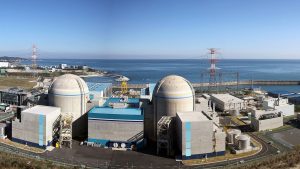
Illustrative image. Photo: Fischer.H, CC BY-SA 4.0, via Wikimedia Commons — source