


NRC Approves Construction of Dow’s Four-Unit Xe-100 Reactor Plant in Texas


The US Nuclear Regulatory Commission has approved construction of a four-unit small modular reactor plant at Dow’s Seadrift, Texas, chemical complex, clearing the first American permit for a high-temperature gas-cooled reactor in nearly 60 years. The NRC said on November 9 that the permit for the Long Mott Generating Station went to Long Mott Energy, a Dow subsidiary, for four Xe-100 reactors designed by X-energy, and that the agency met its self-imposed 18-month review schedule for the application.
A Reactor Type the NRC Hasn’t Licensed Since the 1960s
According to the NRC’s November 9 release, the Long Mott permit is the agency’s first-ever approval for a high-temperature gas-cooled reactor (HTGR) design, a category the US last licensed for construction nearly six decades ago. The regulator also listed three other firsts tied to the application: its first approval of a multi-module advanced reactor facility, its first approval of a pebble-bed reactor core, and its first approval of a design built around continuous, online refueling rather than periodic shutdowns.
The NRC said it finished the project’s safety evaluation report in October, a month ahead of its own schedule, after issuing an environmental assessment and finding of no significant impact in May. The application itself was filed by Long Mott Energy in March 2025 and docketed for review two months later. NRC Chairman Ho K. Nieh said in the agency’s statement that the review “delivered on the 18-month schedule, proving we can do rigorous safety reviews on predictable timelines,” and the regulator noted this is the third advanced-reactor construction permit it has issued this year.
Four Pebble-Bed Units Built for Industrial Steam, Not Just Power
The Xe-100 is X-energy’s pebble-bed HTGR design, which uses TRISO-coated fuel particles embedded in billiard-ball-sized graphite pebbles rather than conventional fuel rods, and is cooled by helium gas instead of water. Industry trade outlet World Nuclear News, citing project documentation, put each of the four Long Mott units at roughly 80 MWe of electrical output and 200 MWt of thermal output, for a combined capacity on the order of 320 MWe. The same reporting said the plant is designed primarily to supply high-temperature steam and process heat to Dow’s adjacent Seadrift petrochemical operations, with any surplus electricity exported to the grid, and that regulators expect the plant’s emergency planning zone to extend only about 400 meters from the site — a small fraction of the roughly 16-kilometer zones typically set around conventional light-water reactors.
Dow has framed the project as a way to replace aging on-site generation and process-heat assets with a lower-emissions source over a design life the company has said could reach 60 years. X-energy chief executive Clay Sell said the permit was “further validation of the Xe regulatory approach,” according to World Nuclear News, and credited the NRC’s licensing reforms for allowing the review to finish ahead of schedule.
Construction Permit, Not an Operating License
The NRC was explicit that Tuesday’s approval authorizes construction only. Long Mott Energy must still file and win a separate operating license before any of the four reactors can load fuel or begin running, a process that typically takes years and will require its own safety and environmental review. Dow has also not made a final decision to build the plant. According to World Nuclear News, Dow business vice president for energy and climate Edward Stones called the permit “a testament to the thoughtful, thorough and efficient review conducted by the NRC,” but said the company will still weigh the project’s competitiveness, execution readiness and capital cost before proceeding, with a preliminary investment decision expected to be considered in 2027. If Dow moves forward, construction could begin later this decade, with startup targeted for the early 2030s, the outlet reported.
One of Several US Bets on Advanced Reactors
Long Mott is part of a wider US push to commercialize small modular and advanced reactors for industries and data centers that need firm, low-carbon power or heat, an effort that has drawn federal backing through the Department of Energy’s Advanced Reactor Demonstration Program, which has supported X-energy’s Xe-100 development. X-energy is pursuing similar projects elsewhere: the company is working with Amazon and American Electric Power on a proposed 960 MW Xe-100 fleet at a retired coal plant site in Indiana, as TheDailyEnergy previously reported. The Seadrift project itself had already cleared a separate NRC milestone, the completion of its final safety evaluation report, which TheDailyEnergy covered on November 8.
The construction permit also lands alongside continued federal support for the broader US nuclear fuel supply chain; Westinghouse separately said last month it would invest $1 billion in a new US nuclear fuel plant, as TheDailyEnergy reported in October. For Dow, the Long Mott project would be the chemical giant’s first nuclear generating asset and one of the first industrial-site HTGR plants anywhere, testing whether pebble-bed reactors can compete on cost against gas-fired boilers for the steam-intensive chemicals sector.
Sources
- US Nuclear Regulatory Commission, press release 26-083, “NRC Issues First High-Temperature Gas-Cooled Reactor Construction Permit in Nearly 60 Years,” November 9, 2026 — primary source for the permit decision, review timeline, and NRC Chairman quote. nrc.gov
- World Nuclear News, “US issues landmark construction permit for Texas SMR plant,” November 10, 2026 — independent trade-press source for reactor capacity figures, emergency planning zone comparison, company quotes and investment-decision timeline. world-nuclear-news.org
- TheDailyEnergy.com, “NRC Completes Final Safety Review of Dow’s Texas SMR Project,” November 8, 2026 — for background on the preceding regulatory milestone.
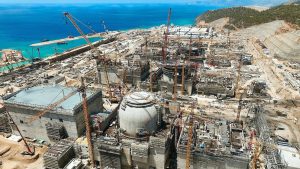
Illustrative image. Photo: Nuclear Regulatory Commission, Public domain, via Wikimedia Commons — source




[…] reactor programs such as the Xe-100 project the US approved for construction on November 9, as TheDailyEnergy reported this week, and by continuing enrichment capacity additions such as Urenco USA’s first commercial LEU+ […]