ConocoPhillips Company Profile and Operations

ConocoPhillips is a Houston-based oil and gas producer that describes itself as the world’s largest independent exploration and production company. Unlike integrated majors such as Shell or ExxonMobil, it does not run refineries or a retail fuel network. It finds, develops and sells crude oil, natural gas, natural gas liquids and liquefied natural gas (LNG). This profile covers its history, how it makes money, where it operates and how it is positioned for a lower-carbon energy system.
ConocoPhillips at a Glance
- Headquarters: Houston, Texas, United States.
- Listing: New York Stock Exchange, ticker COP, and a member of the S&P 500 index.
- Business model: upstream only, meaning exploration, development and production, plus LNG and gas marketing.
- Main regions: the Lower 48 US states, Alaska, Canada, Norway, Qatar, Australia and a few other countries.
- Scale: production in the range of two million barrels of oil equivalent per day or more after recent acquisitions (approximate; the latest annual report gives exact figures).
The company is best known to the public through its Alaska heritage and its shale position in the Permian Basin. To investors it is known for a disciplined, low-cost-of-supply approach and for returning cash to shareholders through dividends and buybacks.
ConocoPhillips History and Ownership
The company’s roots go back to two older firms. Continental Oil and Transportation Company, which became Conoco, was founded in Ogden, Utah, in the 1870s. Phillips Petroleum Company was founded in 1917 in Bartlesville, Oklahoma, by brothers Frank and L.E. Phillips. The two merged in 2002 to create ConocoPhillips.
The corporate timeline since then shows a steady shift from a broad integrated model to a focused producer:
| Milestone | What happened |
|---|---|
| 2002 | Conoco Inc. and Phillips Petroleum Company merge to form ConocoPhillips |
| 2006 | Acquisition of Burlington Resources, adding large North American gas and unconventional positions |
| 2012 | Refining, marketing and midstream businesses spun off as Phillips 66, making ConocoPhillips a pure upstream company |
| 2021 | Acquisition of Concho Resources, followed by the purchase of Shell’s Permian Basin assets |
| 2024 | Acquisition of Marathon Oil completed in an all-stock transaction valued at roughly $22.5 billion including debt (company announcement) |
Ownership is public. There is no controlling shareholder; large asset managers and index funds hold much of the stock, as is typical for US-listed energy companies.
Core Business and Revenue Drivers
ConocoPhillips earns most of its revenue by selling crude oil, bitumen, natural gas and natural gas liquids. Its income therefore rises and falls with benchmark prices such as WTI and Brent, Henry Hub gas and international LNG prices. The company has said it aims to keep projects competitive at the lower end of the cost curve so that they stay profitable even when prices weaken. In practice that means it ranks investments by cost of supply, the oil price at which a project earns a set return, and funds the cheapest barrels first.
Its portfolio mixes three kinds of production:
- Short-cycle shale and tight oil: wells that can be drilled and brought online quickly, and scaled up or down with prices.
- Long-life conventional assets: fields such as those in Alaska and Norway that produce steadily for decades.
- LNG and international gas: stakes in LNG projects that sell gas under long contracts and on spot markets.
Key Assets, Projects and Markets
Lower 48
The Lower 48 is the largest production base. It includes the Delaware and Midland sub-basins of the Permian in Texas and New Mexico, the Eagle Ford in South Texas and the Bakken in North Dakota. The Marathon Oil deal strengthened its Eagle Ford and Bakken acreage and added more drilling inventory.
Alaska
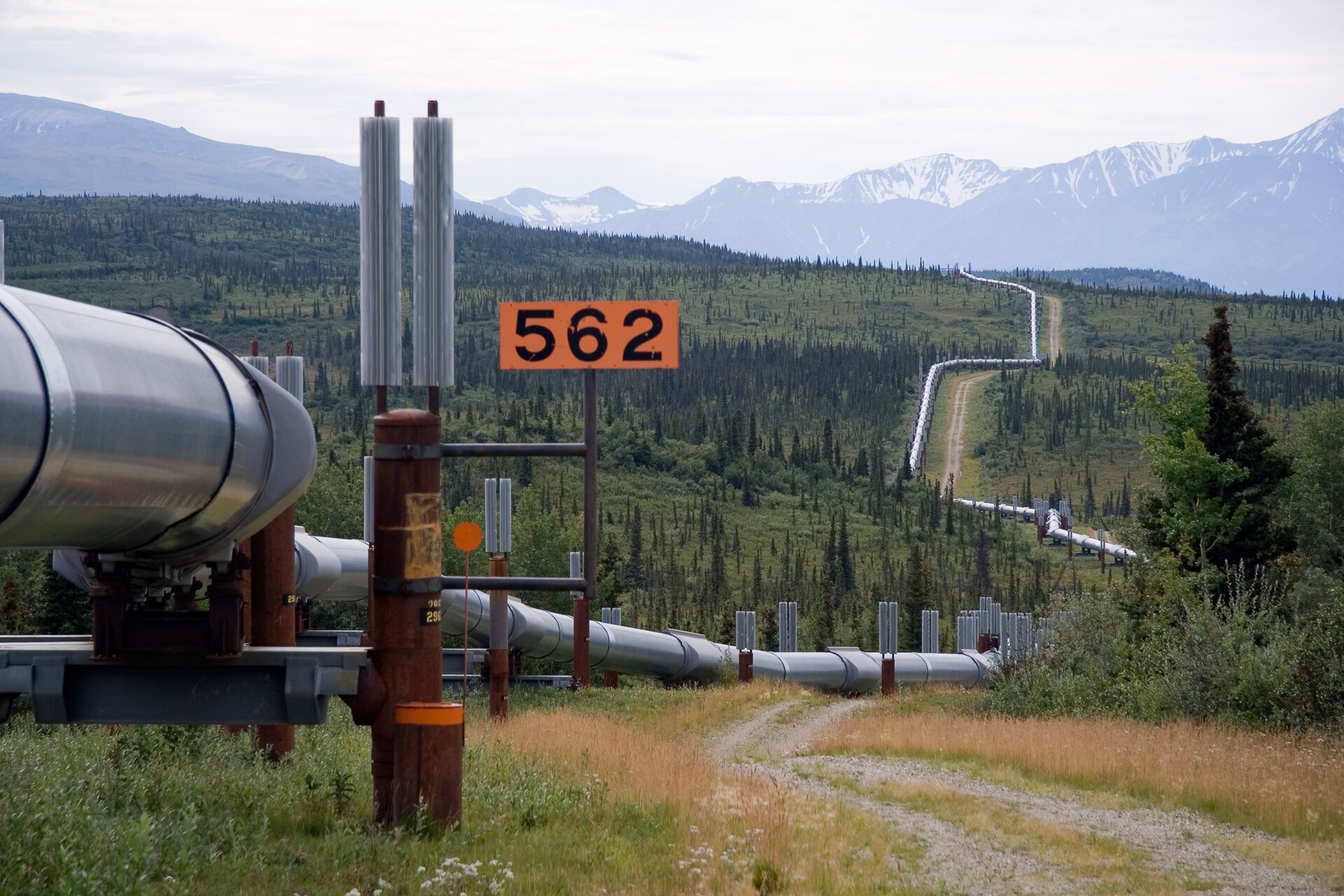
Alaska is the company’s historic stronghold. It operates fields on the North Slope, including Kuparuk and Alpine, and holds an interest in the giant Prudhoe Bay field. Oil from the North Slope reaches market through the Trans-Alaska Pipeline System. The Willow project on the National Petroleum Reserve-Alaska received US federal approval in 2023, and the company has said first oil is planned for later this decade.
Canada and Norway
In Canada, ConocoPhillips has interests in the Surmont oil sands project, developed with a partner, and in unconventional gas plays. In Norway it has long been a key partner in the Ekofisk area of the North Sea, one of the continental shelf’s oldest and most important production centres.
LNG
The company holds a major stake in Australia Pacific LNG in Queensland, which supplies Asian buyers. It also participates in Qatar’s expanding LNG capacity and has signed offtake and terminal agreements aimed at building a more global gas portfolio. LNG gives the company exposure to growing gas demand in Asia and Europe.
Financial Performance and Scale
ConocoPhillips reports results quarterly and files annual reports with the US Securities and Exchange Commission. The company usually states its capital allocation priorities in a fixed order: sustaining production and a strong balance sheet first, then a growing ordinary dividend, then variable returns such as buybacks, and finally disciplined growth projects.
For investors, the main indicators to watch are production volumes, realised prices, free cash flow after capital spending, net debt and shareholder distributions. We have deliberately left out specific revenue and profit figures here because they change every quarter; the investor relations pages on conocophillips.com and the company’s annual report are the right place for the latest numbers.
ConocoPhillips Strategy and the Energy Transition
ConocoPhillips argues that oil and gas will remain part of the energy mix for decades, so its strategy is to supply them at lower cost and with lower emissions per barrel. The company has set an ambition of net-zero operational emissions (scope 1 and 2) by mid-century, along with interim targets for emissions intensity and a commitment to end routine flaring. Methane monitoring and leak detection feature prominently in its disclosures.
Critics point out that these targets cover operations rather than the emissions from burning the products it sells, which is true of most oil and gas producers. Supporters note that cutting methane and flaring is among the fastest ways to reduce the industry’s climate impact. Either way, reading the company’s sustainability report alongside its financial filings gives the most complete picture.
Jobs and Careers at ConocoPhillips
The company employs geoscientists, petroleum, reservoir, drilling and facilities engineers, data scientists, finance and commercial specialists and field operators. Major offices are in Houston, Anchorage, Calgary and Stavanger, plus field locations across the Permian, Eagle Ford and Bakken. Entry routes include university recruiting, internships and experienced hires. Pay is usually competitive within the upstream sector but depends heavily on role and location, so check current postings on the careers pages of conocophillips.com.
Frequently Asked Questions About ConocoPhillips
Is ConocoPhillips an oil major?
It is among the largest oil and gas companies by market value and production, but it is classed as an independent because it has no refining or retail business.
What happened to its refining business?
It was separated in 2012 as Phillips 66, which now operates independently.
Where does ConocoPhillips produce most of its oil and gas?
The Lower 48 United States, especially the Permian Basin, is the largest source, followed by Alaska, Canada, Norway and its LNG interests.
Who owns ConocoPhillips?
It is publicly listed, so ownership is spread among institutional and retail investors.
Does ConocoPhillips invest in renewables?
Its capital is overwhelmingly directed at oil and gas, with emphasis on lowering operating emissions. Readers should consult its latest sustainability report for any lower-carbon investments.
Conclusion
ConocoPhillips is a pure upstream producer built through a series of large mergers, from the original Conoco and Phillips combination to the Marathon Oil acquisition. Its strengths are scale in US shale, a long-life Alaska base, a global LNG position and a cost-focused investment model. Its main risks are exposure to commodity prices and pressure over climate policy. Anyone following ConocoPhillips should rely on its annual report, quarterly filings and sustainability disclosures for current figures.
Sources and further reading
- ConocoPhillips annual reports, news releases and sustainability reports (conocophillips.com)
- U.S. Securities and Exchange Commission, company filings (sec.gov)
- U.S. Energy Information Administration, production and basin data (eia.gov)
- International Energy Agency, oil and gas market analysis (iea.org)
- Phillips 66, company history (phillips66.com)