


CenterPoint Energy Raises 10-Year Capital Plan by $4 Billion to $70.7 Billion


CenterPoint Energy raised its 10-year capital spending plan by $4 billion to $70.7 billion through 2035, the Houston-based utility said on its third-quarter earnings call on October 27, 2026, as it races to connect industrial and data-center customers it says could add 14 gigawatts (GW) of new electricity demand by 2030.
Spending pulled forward, not just added
The new total is up from the $66.7 billion plan CenterPoint announced in July. About $1.5 billion of the increase was pulled forward into the 2026-2030 window rather than added at the back end, lifting near-term planned spending to $38.7 billion from $34.2 billion. Of the full 10-year plan, $51.5 billion is allocated to the electric business and $19 billion to natural gas operations, with the remainder at the corporate level. CenterPoint says it has already identified at least $10 billion of further investment opportunities through 2035, tied to Houston-area transmission, resiliency work and large-load projects in Indiana — spending not yet included in the $70.7 billion figure.
Houston’s load-growth math
CEO Jason Wells told investors that industrial and commercial leasing activity in the Houston area is up more than 30% from a year earlier, which he called a “powerful multiplier effect” on electricity demand. CenterPoint has received nearly 1 GW of distribution-level load requests over the past year and has submitted 17 GW of prospective projects into ERCOT’s new large-load interconnection process, of which it expects about 12 GW to ultimately qualify as base load or studied load. “Batch Zero,” the first tranche of projects to move through that process, is already under way; a second batch opens for applications in summer 2027. The company says the resulting 14 GW of demand growth should generate roughly $5 billion in customer savings across Texas over the next decade, as fixed grid costs are spread across a larger base of electricity sales.
Funding the build-out
CenterPoint plans to fund about 40% of the $4 billion increase with new equity. The company raised its 2026 non-GAAP earnings guidance to $1.90-$1.92 per share and introduced 2027 guidance of $2.07-$2.09, implying roughly 9% growth at the midpoint, and it reiterated an expected 7%-9% annual earnings growth range through 2030, trending toward the higher end. Third-quarter net income came in at $331 million, or 50 cents per diluted share, versus 45 cents a year earlier. Wells said the company began an internal transmission study earlier in 2026 to add import capacity, improve system stability and expand intra-regional transmission — work he described as the next phase of the build-out, with a further System Resiliency Plan due to be filed by the end of 2027.
One utility among many chasing the same customers
CenterPoint’s expanded plan lands in the middle of a broader scramble among U.S. utilities to finance new generation and grid capacity for data centers and large industrial loads. AEP has separately signed for up to 1.6 GW of Mainspring generators worth as much as $4 billion to serve similar demand elsewhere in its territory, while smaller utilities such as Black Hills Corporation are building dedicated gas plants and microgrids for individual data-center customers, including a $1.8 billion project for a Google facility in Wyoming. CenterPoint’s bet is that Houston’s industrial base, rather than a single hyperscale customer, will be broad enough to justify spreading the cost of a $70.7 billion grid across its entire regulated rate base.
A reliability story alongside the growth story
CenterPoint has tied the capital increase to a reliability narrative as much as a growth one, saying system reliability has improved 40% since 2024 — a figure the company has repeatedly cited since Hurricane Beryl exposed weaknesses in its Houston-area distribution network in 2024. The next System Resiliency Plan, due by the end of 2027, is expected to lay out a further multi-year hardening program on top of the load-growth spending detailed this week. For regulators and customers, that combination — faster load growth paying down fixed costs, set against a utility still rebuilding its reliability record — will likely frame how Texas regulators treat CenterPoint’s rate requests as the $70.7 billion plan moves from PowerPoint slide to actual steel in the ground.
Sources
- Utility Dive, “CenterPoint expands 10-year capital plan by $4B to handle load growth,” October 27, 2026 — capital plan figures, load-growth data, executive quotes.
- CenterPoint Energy, Form 8-K third-quarter 2026 earnings release, filed with the U.S. Securities and Exchange Commission, October 27, 2026 — financial results and guidance.
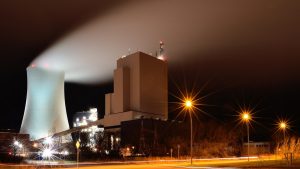
Illustrative image. Photo: David Daniel Turner, CC BY 4.0, via Wikimedia Commons — source




[…] a similar pattern at other U.S. utilities grappling with data-center-driven load growth, including CenterPoint Energy’s recent increase of its own 10-year capital plan to $70.7 billion and the federal government’s own response, such as the Department of Energy’s $10.1 […]