Mitsubishi Heavy Industries Delivers Three Replacement Steam Generators to EDF’s Cruas Plant


Mitsubishi Heavy Industries (MHI) said on October 15 that it has completed delivery of three replacement steam generators to Électricité de France (EDF) for Unit 2 of the Cruas Nuclear Power Plant in the Ardèche department of southeastern France. The 900 MWe pressurised water reactor (PWR) is one of four units at the riverside site, which EDF brought into commercial operation in the mid-1980s.
The three generators were manufactured at MHI’s Kobe facility, with production completed in January 2024. They then went through a lengthy certification process before clearing a compliance certificate from France’s nuclear safety regulator at the end of February 2026, after which they were shipped to France. MHI said each steam generator stands about 21 metres tall, weighs roughly 330 tonnes, and contains around 4,500 heat-transfer tubes made from TT690 alloy.
Part of a nine-unit order placed in 2019
EDF ordered nine replacement steam generators from MHI in 2019, working alongside Marseille-based maintenance contractor Onet Technologies, which has partnered with MHI on French reactor work since 2002. The three units delivered to Cruas are the first tranche of that order; the remaining six are still being manufactured at MHI’s Kobe facilities, with delivery scheduled from 2028 onward.
MHI has now delivered more than 30 replacement steam generators for reactors outside Japan, across France, Belgium and the United States, and puts its combined order book for steam generators in Japan and abroad at more than 130 units. Including the batch delivered to Cruas, the company has supplied 18 replacement steam generators to EDF since 2005.
Why EDF is replacing decades-old components
Steam generators transfer heat from the primary coolant loop that passes through the reactor core to the secondary loop that drives the turbine; in a PWR, they rank among the largest and most heavily stressed components in the plant. The original units installed across EDF’s fleet in the 1980s have been progressively swapped out as EDF works to extend reactor lifespans well beyond their original 40-year design basis — a strategy, often referred to inside the company as the Grand Carénage programme, that is central to keeping the bulk of France’s roughly 57-reactor fleet in service into the 2040s and beyond rather than replacing it with new build on a similar timetable.
That extension strategy has carried extra weight this year. France logged a record of roughly 800 hours of negative wholesale power prices in 2026, as a drought curbed hydropower output and left the grid more dependent on nuclear generation to balance supply — a reminder of how central the ageing PWR fleet remains to French electricity even as the government pursues new reactor construction over the coming decades.
A busier year for reactor equipment and new build alike
MHI’s Cruas delivery lands in a year when nuclear activity has picked up well beyond France. Days earlier, Slovakia connected its newly built Mochovce 4 reactor to the national grid, and in Canada, Bruce Power reported finishing calandria tube installation on its Unit 4 refurbishment ahead of schedule. Equipment suppliers such as MHI sit at the intersection of both trends: the same manufacturing capacity used to build components for new reactors is also being leaned on to keep existing fleets like EDF’s running for decades longer than originally planned.
EDF did not comment publicly on the delivery beyond MHI’s release, and MHI’s statement did not name the French regulator or individual officials involved in certifying the components.
Sources
- Mitsubishi Heavy Industries, press release, October 15, 2026 — delivery details, manufacturing and certification dates, order figures, component specifications.
- World Nuclear News, “MHI delivers replacement steam generators for French reactor,” October 15, 2026 — independent confirmation and additional context on EDF’s replacement programme.
- The Daily Energy, “France’s Negative Power Price Hours Hit a Record 800 in 2026 as Drought Squeezes Nuclear and Hydro” — French nuclear fleet context.
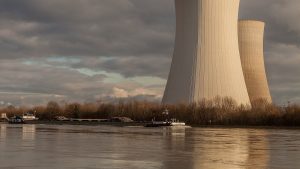
Illustrative image. Photo: Fischer.H, CC BY-SA 4.0, via Wikimedia Commons — source