US Treasury Secretary Bessent Urges World Bank to Drop Its Ban on Financing Upstream Oil and Gas


US Treasury Secretary Scott Bessent has called on the World Bank Group to “formally retire its prohibition on financing upstream gas and oil,” in a written statement issued for the World Bank’s Development Committee and the IMF’s International Monetary and Financial Committee ahead of this month’s annual meetings in Bangkok, according to Reuters. Bessent did not attend the Bangkok meetings in person; the Treasury Department said his deputy represented the US instead.
The World Bank Group pledged in 2017 to stop financing upstream oil and gas projects after 2019, while carving out an exception for “exceptional circumstances” that allows the Bank to consider upstream gas financing in the poorest countries when it clearly improves energy access and remains consistent with a country’s Paris Agreement commitments. Bessent’s statement argues that exception has proven too narrow, and that the Bank should instead adopt a fully technology-neutral approach to energy financing, removing constraints specifically on natural gas and responding positively when borrowing countries request gas projects.
Framed Around Africa, Aimed at a Broader Reversal
Bessent tied the request to the World Bank’s and African Development Bank’s existing joint goal of extending electricity access to 300 million more people in Africa, arguing the upstream financing ban works against that target and that the Bank “cannot credibly claim respect for country ownership while excluding upstream projects before assessing their merits.” He said the Bank has taken some steps back toward its core mission of reducing poverty and raising growth, but that “significantly more is needed,” according to the text of the statement reported by Reuters and carried in full by einpresswire and newsroomamerica.com. Separately, Reuters reported his statement also called for World Bank support for deep-sea critical minerals mining and faster graduation of wealthier borrowing countries, including China and Poland, out of the Bank’s lending programs.
The request fits a pattern the Trump administration has pursued since returning to office in January 2025: Energy Secretary Chris Wright said in September 2026 that the US would either reform the International Energy Agency or leave it, telling reporters “my strong preference is that we reform it,” in a dispute centered on the IEA’s advocacy for reduced oil and gas investment. The IEA, created after the 1970s Arab oil embargo to coordinate energy security among importing nations, has increasingly focused its forecasting on the energy transition, a shift the administration has criticized as moving beyond the agency’s original security mandate.
Where the Pressure on Fossil Finance Is Already Shifting
Even without a formal policy change at the World Bank, financing for oil and gas infrastructure in the countries the ban was meant to affect has continued to find other routes. Nigeria’s Dangote Refinery, Africa’s largest, closed a $1.6 billion IPO this month, one of the continent’s largest share sales, financed through private capital markets rather than multilateral development lending. Japan has separately urged other Asian governments to build larger strategic oil reserves as Middle East supply risks mount, a security-driven push that sits outside the World Bank’s upstream financing debate but reflects the same broader tension between energy security arguments and climate-finance restrictions.
The contrast with renewables-focused development finance is also stark: South Korea’s $747 billion K-GX plan to triple renewable capacity by 2030 illustrates the scale of state-backed capital still flowing toward the energy transition even as the US pushes multilateral lenders to loosen fossil-fuel restrictions. Whether the World Bank’s shareholders, who must approve any change to the 2017 policy, will act on Bessent’s request remains unclear; the Bank’s board has not indicated a timeline for revisiting the upstream financing exclusion, and other major shareholders, including European governments, have historically supported keeping it in place.
Sources: Reuters, “Bessent calls for World Bank reforms, including upstream oil and gas financing,” October 15, 2026 (statement contents, context, attendance); full text of Bessent’s statement to the World Bank Development Committee and IMF International Monetary and Financial Committee, published via einpresswire.com and newsroomamerica.com, October 14-15, 2026; World Bank Group, 2017 announcement on ending upstream oil and gas financing after 2019 (policy background).
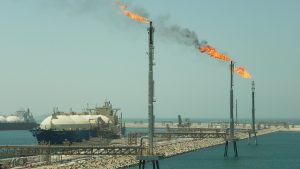
Illustrative image. Photo: David Daniel Turner, CC BY 4.0, via Wikimedia Commons — source