Black Hills to Invest $1.8 Billion in New Gas Plant and Microgrid for Google’s Wyoming Data Center


Black Hills Corporation said on October 6 that it has signed definitive agreements to supply a planned Google data center in Cheyenne, Wyoming, with up to 590 MW of grid-connected power and to manage a further 2.1 GW of third-party generation through a privately run microgrid — a combined resource package of about 2.7 GW that ranks among the largest utility-to-hyperscaler power deals disclosed so far in 2026. The Rapid City, South Dakota-based utility holding company plans to spend roughly $1.8 billion between 2027 and 2029 building new, company-owned natural gas generation at its existing Cheyenne Prairie Generating Station to cover its share of the load.
What Black Hills Is Actually Building
The $1.8 billion in capital spending buys 564 MW of nameplate natural gas generation, constructed and owned through a non-regulated Black Hills affiliate at the company’s existing Cheyenne Prairie site. Combined with roughly 26 MW sourced from market energy purchases and retail utility service under an industrial tariff, that generation delivers the full 590 MW of grid-connected service Google’s data center will draw directly from Black Hills. Because the new gas plant sits with a non-regulated affiliate rather than Black Hills’ regulated Wyoming utility, the capital cost and any associated risk are intended to stay off the rate base that ordinary Wyoming electricity customers pay into — a structure utilities have increasingly used as data center deals have drawn political scrutiny over cost-shifting to residential ratepayers.
A Microgrid Black Hills Doesn’t Own
The larger number in the deal — 2.1 GW — does not belong to Black Hills at all. That capacity comes from third-party resources, reportedly a mix of turbines and fuel cells, that Black Hills will coordinate rather than build. Under Wyoming’s Large Power Contract Service tariff, the company will run a privately managed microgrid linking those resources to the data center, earning a management fee for grid operations, reliability services and dispatch instead of a return on capital. That keeps Black Hills’ balance-sheet exposure limited to its own 564 MW of new gas capacity while still letting it capture revenue from the much larger resource pool Google’s project requires — a model other utilities facing hyperscaler demand are likely to study closely.
Long Contract, Slow Ramp
The agreements took effect on September 30, 2026, and run through 2048 — a 22-year horizon unusual even by the standards of long-term utility power contracts, reflecting how far in advance data center developers are now trying to lock in electricity supply. Energy service is expected to begin in late 2027, with the load ramping up to its full peak only by 2030. Black Hills estimates the arrangement will add about $150 million to its net income around 2030, with generation returns and microgrid management fees starting to contribute to earnings as early as 2027. The company separately projects roughly $2.4 billion of unlevered free cash flow from the project through 2048, net of its $1.8 billion in upfront capital spending — a payback profile that depends on the data center load materializing roughly as planned over the next decade.
Part of a Bigger Pattern
The Cheyenne deal lands in the same month as two other major reactor and power deals tied to data center demand: Google and Constellation Energy’s $4.3 billion, 890 MW nuclear uprate agreement covering reactors in the PJM grid, and the US Department of Energy’s conditional $4.2 billion loan offer to Vistra for uprates at its Pennsylvania and Ohio nuclear plants. Amazon, too, has been buying into existing nuclear capacity through its own 20-year deal with Constellation at Calvert Cliffs. What distinguishes the Black Hills arrangement is its reliance on new gas-fired generation plus a third-party microgrid rather than nuclear uprates — a reminder that, outside the PJM nuclear fleet, gas turbines remain the fastest way for a regional utility to add firm capacity on the multi-year timelines hyperscalers are now demanding.
The Open Questions
Black Hills’ release does not identify the specific turbine and fuel cell suppliers behind the 2.1 GW microgrid, nor does it disclose the data center’s planned compute capacity or whether this is Google’s only Wyoming site. The company has also not said how much new transmission investment, if any, will be needed to move power within the Cheyenne area beyond what the release describes — the 2.7 GW total explicitly excludes transmission expansion costs. One financial outlet’s claim that Alphabet will directly finance the $1.8 billion buildout could not be confirmed against Black Hills’ own disclosures and should be treated cautiously until the company’s next quarterly filing clarifies the financing structure.
Sources
- Black Hills Corporation, press release / Form 8-K Exhibit 99.1, October 6, 2026. SEC EDGAR filing
- Power Engineering, “Black Hills to build 564 MW of new gas, manage 2.1 GW microgrid for Google data center in Wyoming,” October 2026. power-eng.com
- Enerdata, “Black Hills signs deal with Google to supply 2.7 GW power capacity in the US,” October 2026. enerdata.net
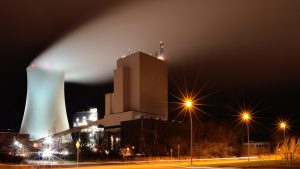
Illustrative image. Photo: Christian A. Schröder (ChristianSchd), CC BY-SA 4.0, via Wikimedia Commons — source