Saudi Aramco Explained: History, Business and Reserves

Saudi Aramco is the Saudi Arabian national oil company, and in 2025 it produced an average of 12.9 million barrels of oil equivalent per day while paying out $85.5 billion to shareholders. It traces its origins to 1933, is headquartered in Dhahran and runs the largest oil and gas operations in the world. This profile explains its history, ownership, business model, key assets and role in the energy transition.
Saudi Aramco at a Glance
Saudi Aramco, formally the Saudi Arabian Oil Company, explores, produces, refines and sells oil, gas and petrochemicals. The company reports 76,664 employees at the end of 2025 and operations in more than 50 countries. Its average hydrocarbon production in 2025 was 12.9 million barrels of oil equivalent per day (mmboed), including 11.4 billion standard cubic feet per day of gas.
For 2025 Aramco reported adjusted net income of $104.7 billion, capital investment of $52.2 billion and free cash flow of $85.4 billion. Its gearing ratio, a measure of debt against equity, stood at 3.8% at the end of the year. For 2026 the company guides capital investment of $50 billion to $55 billion and announced a share buyback of up to $3 billion over 18 months.
History: From a 1933 Concession to a Global Energy Company
The story begins in 1933, when Saudi Arabia granted an oil concession to Standard Oil of California, which assigned it to a subsidiary. The first commercial discovery came in 1938 at the Dammam No. 7 well near Dhahran. In 1944 the company was renamed the Arabian American Oil Company, or Aramco.
Ownership then moved gradually to the state. In 1950 a 50/50 profit-sharing agreement was reached. In 1973 the Saudi government took a 25% stake, and in 1974 it raised that stake to 60%. A royal decree in 1988 created the Saudi Arabian Oil Company, known as Saudi Aramco, to take over the former Aramco assets. In December 2019 the company listed on the Saudi stock exchange, Tadawul. Its shares were priced at 32 riyals and the offering raised $25.6 billion, then the largest IPO on record.
Who Owns Saudi Aramco?
The Saudi state remains the controlling owner. According to the company's public listing, the government of Saudi Arabia holds about 82%, the Public Investment Fund about 12% and Sanabil about 4%, with the remainder traded on Tadawul. Amin H. Nasser serves as chief executive and Yasir Al-Rumayyan as chairman. Because the state owns most of the shares, Aramco acts both as a commercial company and as a pillar of national economic policy.
Core Business and Revenue Drivers
Aramco's business has three main parts.
- Upstream. Exploration and production of crude oil, condensate and natural gas. This is where most profit is made.
- Downstream. Refining, chemicals and fuel marketing, in Saudi Arabia and abroad. Aramco owns a 70% stake in the chemicals group SABIC, acquired in 2020, and is a partner in the Motiva refinery at Port Arthur in the United States.
- Gas and power. The Master Gas System collects and distributes gas across the kingdom, and new fields such as Jafurah are expanding gas supply for power, industry and future exports.
Revenue depends mostly on crude oil prices and volumes. In 2025 profit fell compared with 2024 because lower crude and product prices outweighed higher sales volumes.
Key Assets and Reserves
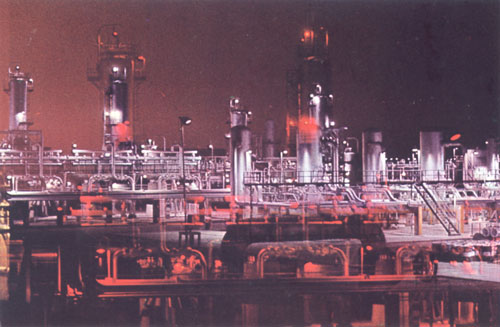
Aramco operates some of the world's most important oil assets. Ghawar is the largest onshore oil field in the world, and Safaniya, discovered in 1951, is the largest offshore field. Abqaiq is a major oil processing centre, and Ras Tanura hosts a large refinery and export terminal. The East-West pipeline carries crude to the Red Sea coast so that exports can reach markets without passing the Strait of Hormuz.
On reserves, the US Energy Information Administration states that Saudi Arabia holds about 17% of the world's proved oil reserves. EIA also reports that Aramco's maximum sustainable production capacity is 12 million barrels per day of crude, after the company dropped an earlier plan to reach 13 million barrels per day. Saudi crude oil production was about 9.6 million barrels per day in 2025, up from 9.2 million in 2024, which shows how output is set by OPEC+ policy rather than by capacity.
Gas Growth and the Jafurah Project
Gas is Aramco's main growth area. Jafurah is the kingdom's largest unconventional gas field, and Aramco says production has started. In August 2025 the company sold a 49% stake in the related processing infrastructure to a consortium led by BlackRock for $11 billion, a way to bring in private capital while keeping operational control. Aramco also says gas projects will lift sales gas capacity by about 80% by 2030 compared with 2021, and it is investing in liquefied natural gas.
Strategy and the Energy Transition
Aramco argues that oil and gas demand will remain strong for decades, so it invests in lower-cost, lower-carbon production while building new businesses. It also runs a corporate venture arm, Aramco Ventures. Critics point out that its core business still produces large emissions, and the company's capital plans stay focused on oil and gas. For readers following the sector, the balance between upstream spending and new energy investment is one of the key stories to watch.
Jobs and Careers at Saudi Aramco
Aramco is one of the largest employers of petroleum engineers, geoscientists and technicians in the Middle East. It runs graduate and scholarship programmes, and roles range from drilling and reservoir engineering to digital and data jobs. Competition is strong, so strong grades in engineering or geoscience, English skills and relevant internships help. Check the official Aramco careers pages for current openings and requirements.
Frequently Asked Questions About Saudi Aramco
When was Saudi Aramco founded? The company traces its origins to 1933 and took its current form as the Saudi Arabian Oil Company in 1988.
Who owns Saudi Aramco? The Saudi government is the main owner, with the Public Investment Fund, Sanabil and public shareholders holding the rest.
How much does Saudi Aramco produce? Average hydrocarbon production was 12.9 million barrels of oil equivalent per day in 2025.
Where is Saudi Aramco headquartered? In Dhahran, in Saudi Arabia's Eastern Province.
Is Saudi Aramco the largest oil company? By production and reserves it is among the largest, and it is regularly at the top of global oil and gas company rankings by profit.
Conclusion
Saudi Aramco combines a 1930s concession history, state ownership and a listed-company structure, and it remains the central player in global oil supply with 12.9 million barrels of oil equivalent per day. Its next chapter depends on gas growth, downstream integration and how fast it expands lower-carbon businesses. Follow The Daily Energy for company news as results and projects are announced.
Sources: Aramco, Fourth quarter and full year results; Aramco, At a glance; Wikipedia, Saudi Aramco (history, ownership, assets); US EIA, Saudi Arabia Country Analysis Brief (reserve share, capacity); US EIA, Today in Energy (2025 crude production).