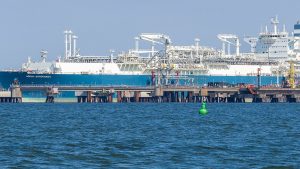
Overview
The tracker lists 3 trains, units or expansion phases at the terminal.
Capacity is expressed in million tonnes per annum (mtpa) of LNG that can be received and regasified.
One mtpa of LNG corresponds to roughly 1.36 billion cubic metres of natural gas per year, so this capacity equals about 13.0 bcm/y of gas.
Ownership: Dunkerque LNG (parent company: AXA SA; Credit Agricole Group; Energy Infrastructure Partners AG; Hanwha Investment and Securities; IBK Securities; Publigaz SA; Samsung; small shareholder(s)).
Its 2 operating units were commissioned between 2017 and 2023.
Why it matters
- The 3rd-largest LNG import (regasification) terminal in France by capacity (of 5 operating lng import terminal facilities tracked).
- Ranks #46 worldwide among lng import terminal facilities of the same status group by capacity.
Import terminals regasify liquefied natural gas delivered by tanker and inject it into the grid, giving countries access to seaborne gas supply from many exporters.
LNG terminals in France
The dataset tracks 5 lng terminals in France, including operating, planned and shelved projects.
France has 34.5 mtpa of operating LNG import capacity across 5 terminals.
Trains and phases
| Unit / phase | Capacity | Status | Technology | Start | Retired |
|---|---|---|---|---|---|
| — | 9.55 mtpa | 2017 | |||
| Ammonia Import Terminal | Proposed | ||||
| Debottlenecking | 2023 |
How lng terminals work
An LNG import terminal receives liquefied natural gas from tankers, stores it at around −162 °C in insulated tanks and warms it back into gas (regasification) before sending it into the pipeline grid. Many newer terminals are floating storage and regasification units (FSRUs), which can be installed much faster than onshore plants.
Import terminals give countries access to gas from many exporters worldwide, improving supply security and price competition — a role that became especially visible in Europe after 2022.
Location
Dunkirk LNG Terminal is located in Hauts-de-France, France, at approximately 51.0336, 2.1965. Open the interactive map to explore nearby power plants, high-voltage lines and substations.
Ownership
Dunkirk LNG Terminal is owned by Dunkerque LNG. The ultimate parent company is AXA SA; Credit Agricole Group; Energy Infrastructure Partners AG; Hanwha Investment and Securities; IBK Securities; Publigaz SA; Samsung; small shareholder(s).
Frequently asked questions
What is the capacity of Dunkirk LNG Terminal?
Dunkirk LNG Terminal has a capacity of 9.55 mtpa according to the latest Global Energy Monitor data. This figure covers the 3 units or phases listed for the site.
What type of facility is Dunkirk LNG Terminal?
Dunkirk LNG Terminal is a LNG import (regasification) terminal.
Who owns Dunkirk LNG Terminal?
Dunkirk LNG Terminal is owned by Dunkerque LNG. The ultimate parent company is AXA SA; Credit Agricole Group; Energy Infrastructure Partners AG; Hanwha Investment and Securities; IBK Securities; Publigaz SA; Samsung; small shareholder(s).
Where is Dunkirk LNG Terminal located?
It is located in Hauts-de-France, France. Approximate coordinates: 51.0336, 2.1965.
Is Dunkirk LNG Terminal operational?
According to the latest data, Dunkirk LNG Terminal is in operation. Operating means the facility is built and in commercial service.
When did Dunkirk LNG Terminal start operating?
Start year: 2017. Current status: Operating. Its 2 operating units were commissioned between 2017 and 2023.
How big is Dunkirk LNG Terminal compared with other facilities in France?
Dunkirk LNG Terminal ranks #3 by capacity among 5 comparable lng import terminal facilities tracked in France.